

Most MLM company owners obsess over recruitment bonuses, and that makes sense. Recruitment helps expand the network faster and drives early growth.
But recruitment alone doesn’t build a stable network. What will keep your MLM business healthy in the long term is leaders who stay invested in their teams. They train, support, and develop the people below them. An MLM matching bonus is designed exactly for this.
If you have included a matching bonus in your compensation plan, or are planning to include it, this guide is for you. Read on to understand everything about this element of the compensation plan- how it works, how it’s calculated, and how to build it most efficiently to keep leaders engaged, active, and invested in every level of your network.
Key takeaways
01
Matching bonuses reward distributors for supporting team performance, creating long-term residual income opportunities beyond individual product sales and direct commissions.
02
Effective matching bonus structures balance motivation and profitability through qualification rules, payout caps, rank requirements, and automated commission tracking systems.
03
Binary, Unilevel, Matrix, and Generation-based compensation plans apply matching bonuses differently, influencing leadership development, team depth, and distributor engagement.
04
Sustainable matching bonus programs prioritize retail sales activity, helping companies reduce compliance risks and avoid recruitment-focused compensation model concerns.
05
Most companies use declining matching percentages across levels, commonly around 20%, 10%, and 5%, to maintain scalable payout structures.
📖 Topics Covered in this Article
01
What is a Matching Bonus in MLM?
02
How Does a Matching Bonus Work in MLM? Step-by-Step Process
03
How Matching Bonus Works Across Different MLM Compensation Plans?
04
How the Matching Bonus Differs from the Breakaway Bonus?
05
Common Network Marketing Matching Bonus Configuration Mistakes
06
Common Misconceptions About MLM Matching Bonus
07
Real-World Examples: How Herbalife and Nu Skin Structure Their Matching Bonuses
08
How to Build An Effective MLM Matching Bonus Plan?
09
FAQs
What is a Matching Bonus in MLM?
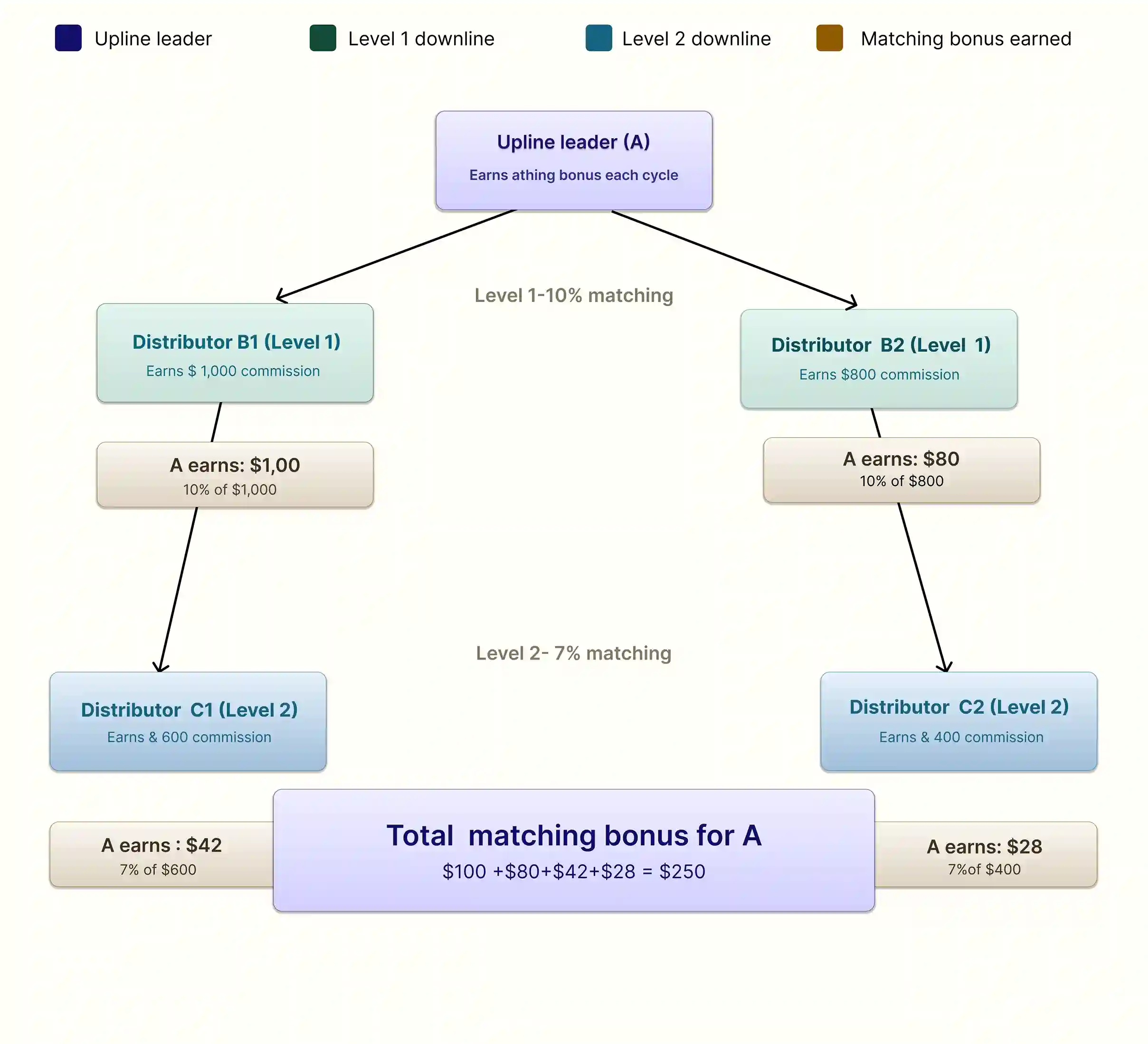
A matching bonus is an additional payout that upline distributors earn as a percentage of their downline's commissions, on top of their own earnings.
The matching bonus is paid on commissions earned from retail sales to end customers, not on internal purchases or recruitment activity, based on the FTC requirement.
Include a matching bonus in your compensation plan if your goal is:
Long-term leadership development over rapid recruitment
Retaining top performers beyond their first year
Creating a financial incentive for mentorship at every level
Building a network where upline leaders stay invested in downline success
Why the matching bonus matters:
It aligns upline and downline interests
It rewards mentorship, not just personal sales volume
It creates a self-sustaining leadership culture without additional incentive programs
It reduces leader drop-off after the initial recruitment phase
How Does a Matching Bonus Work in MLM? Step-by-Step Process
A matching bonus works by paying an upline distributor a percentage of the commissions earned by their downline. The process happens across 5 steps.
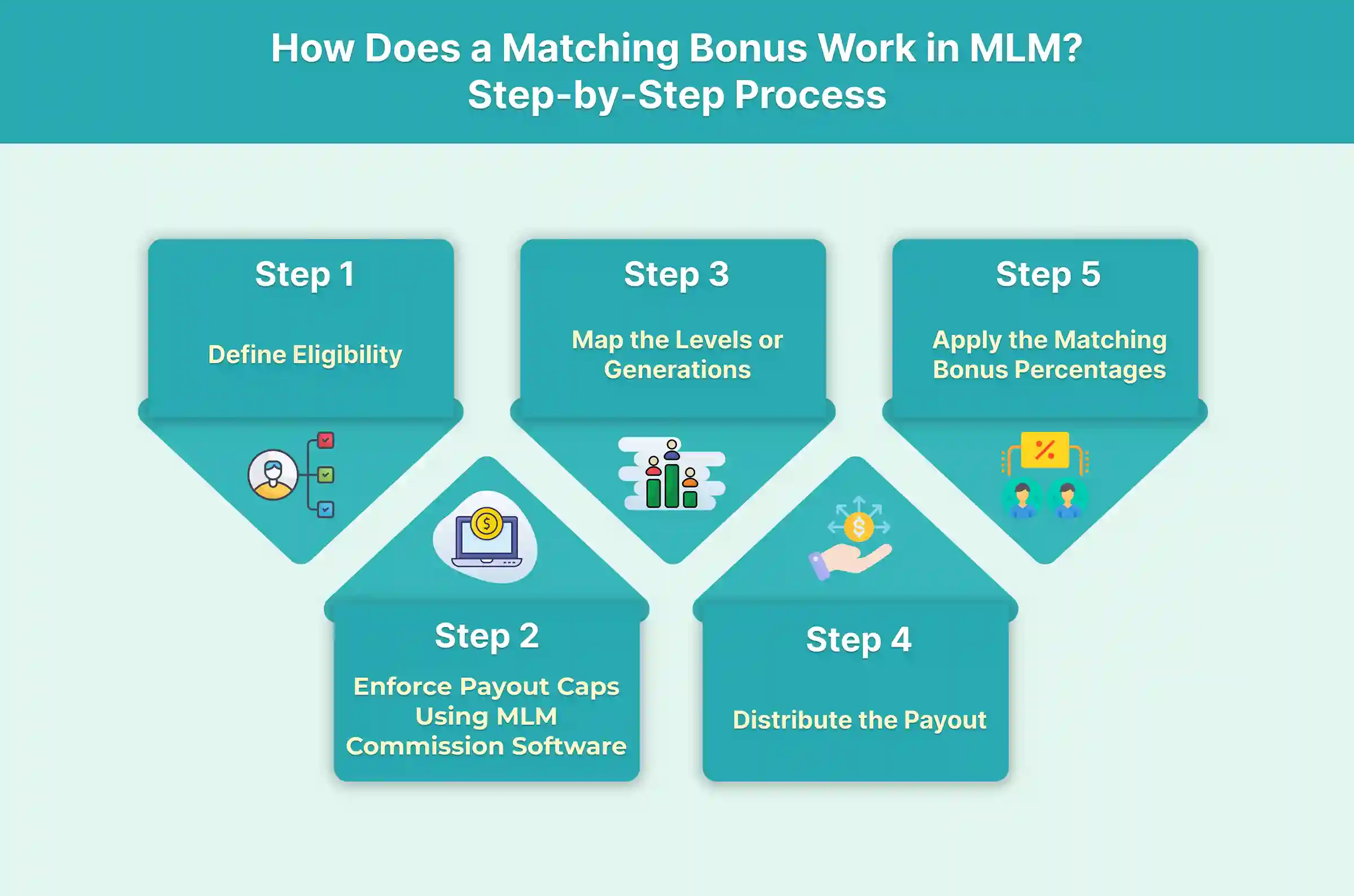
Step 1: Define Eligibility
Before any matching bonus is paid, a distributor must qualify for it. Eligibility is typically measured by three criteria:
Personal Volume (PV): It is the core qualification metric to calculate matching bonus eligibility. The distributor must meet a minimum PV threshold to qualify for that cycle.
Business Volume (BV): It is the group-level sales volume generated across a distributor's entire downline organization. BV is one of the core group-level qualifiers that triggers generation-based matching. The higher the BV, the deeper the matching bonus can flow through the network.
Active Status: The distributor must be classified as active under your plan's rules
Retail Customer Requirement: The distributor should have a minimum number of verified retail customers to ensure commissions originate from genuine sales activity
Distributors who do not meet the required qualifications in a given cycle do not receive matching bonus payouts for that cycle, regardless of what their downline earns.
Step 2: Map the Levels or Generations
Next, your plan must define how deep the matching bonus is paid in your genealogy tree, the structural map of your distributor network. It can follow the level-based model or a generation-based model:
| Level-Based | Generation-Based |
|---|---|
| Pays down a fixed number of structural levels in the genealogy tree | Pays across groups of distributors separated by a qualified leader, regardless of structural depth |
| Depth is predictable and stops at a defined level count | Depth is dynamic — follows qualified leaders however deep they sit in the tree |
| Simpler to configure and communicate to distributors | Better suited for deep networks with strong leadership development |
| When an unqualified distributor occupies a level in the downline, the upline loses the matching bonus for that leg entirely in that cycle | When an unqualified distributor occupies a level in the downline, dynamic compression skips them and routes the matching bonus to the next qualified distributor below — so the payout is never lost, just redirected |
Step 3: Apply the Matching Bonus Percentages
Once the eligibility and levels are locked in, you must fix the actual percentage of the matching bonus. The following formula will be applied to calculate it:
Matching Bonus = Downline Member's Commission × Matching Bonus Percentage
The MLM matching bonus percentages are typically tiered. They are lower as depth increases and higher as the upline’s rank advances. Once these values are fixed, your MLM commissions software will automatically apply them across every active leg in the genealogy tree, at every cycle.
Here is a typical structure for how you can plan your matching bonus across each level and each rank of your MLM network.
| Levels | Silver Rank Distributors | Gold Rank Distributors |
|---|---|---|
| Level 1 | 10% | 12% |
| Level 2 | 8% | 10% |
| Level 3 | 6% | 8% |
| Level 4 | 5% | 7% |
| Level 5 | 3% | 5% |
Example:
If a level 1 downline member earns $500:
A Silver Rank upline earns: $500 X 10%= $50
A Gold Rank upline earns: 500 X 12%= $60
Step 4: Enforce Payout Caps Using MLM Commission Software
Enforce caps across all levels of the downline network to protect your payout budget. Once set, your MLM commission software stops any matching bonus that exceeds the defined limit automatically without manual intervention. This prevents unexpected payout spikes as your network scales.
Step 5: Distribute the Payout
Once the matching bonus is implemented into your compensation plan, the bonus will be added to the distributor’s final payout and sent to e-wallets or bank accounts, with a full breakdown visible on each distributor’s dashboard.
How Matching Bonus Works Across Different MLM Compensation Plans?
The matching bonus works differently across binary, unilevel, and matrix compensation plans. The structure of each plan directly determines how the bonus is triggered, how many levels it pays, and how it is calculated. Let’s look at each one:
01
Matching Bonus in Binary MLM
In a binary MLM plan, each distributor has two legs: a left and a right. The matching bonus in a binary plan is often called a “Check Match.” It pays a percentage of the binary earnings of downline leaders in both legs, and not sales volume directly.
Example: If a downline leader earns $500 in binary commissions that cycle, and your plan offers a 10% matching bonus, their upline earns $50 as a matching bonus.
A binary MLM software tracks earnings across both legs in real time, ensuring matching bonus calculations are accurate and paid out correctly every cycle.
02
Matching Bonus in Unilevel MLM
In a unilevel plan, each distributor can sponsor an unlimited number of frontline members. The matching bonus pays a percentage of whatever a downline member earns, across levels and ranks as defined in your compensation plan.
Example: if a Level 2 downline member earns $600 and your plan offers 8% at that level, their upline earns $48 that cycle.
Unilevel mlm software tracks commission flow across all legs and applies the correct percentage at each level automatically.
03
Matching Bonus in Matrix MLM Plan
In a matrix plan, the downline is fixed in both width and depth. A 3×5 forced matrix, for example, allows three frontline members and five levels deep. The matching bonus here is tied to milestones like level completion or full matrix completion. When a downline member hits one of these milestones, the upline receives a matching percentage of that.
Example: If a downline member completes Level 3 of the matrix and earns $400 in commissions, and your plan offers a 7% matching bonus at that milestone, their upline earns $28.
The entire system is tracked by the Matrix MLM software. It enforces completion triggers automatically, so matching bonuses are released only when the criteria are met.
How the Matching Bonus Differs from the Breakaway Bonus?
A breakaway plan is a structure where distributors break away from their uplines when they reach certain qualifications set by the company. When this happens, the upline earns a reduced override on that group's volume and loses the full depth of commissions from that leg.
Choose the matching bonus to build a culture of long-term, invested leadership.
Choose the breakaway structure if you want emerging leaders to operate independently as they advance.
Common Network Marketing Matching Bonus Configuration Mistakes
A well-designed matching bonus can be one of the most effective retention tools in your MLM compensation plan. A poorly configured one can drain your payout budget, expose you to compliance risk, and erode distributor trust. To find the right MLM plan, it's important to understand the common mistakes that surface most often:
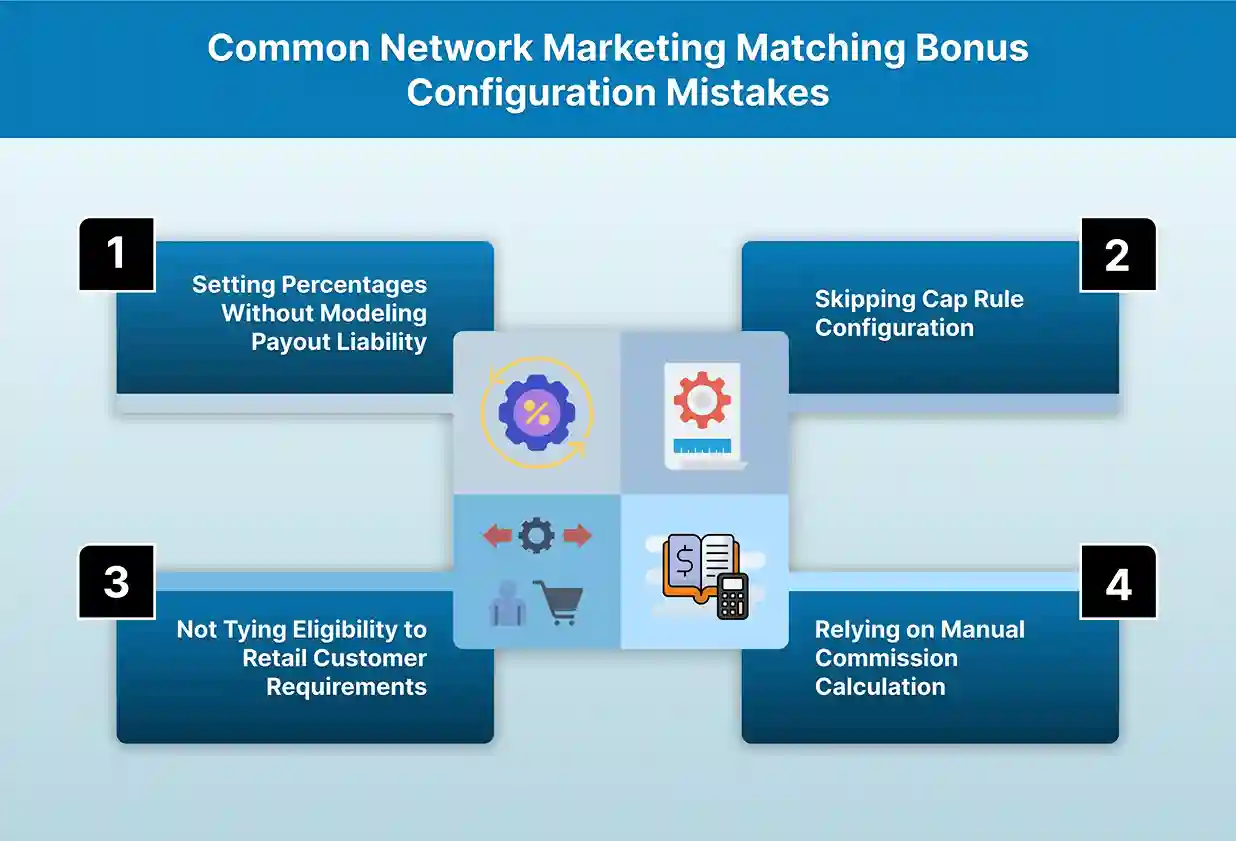
1) Setting Percentages Without Modeling Payout Liability
Most owners fix matching bonus percentages based on what looks competitive — without modeling what those percentages cost at scale. As your network grows, matching bonuses compound across multiple levels. A 1-2% miscalculation can create significant payout liability. Always run a compensation plan simulation against realistic growth scenarios before your plan goes live.
Even a 1-2% miscalculation can create significant payout liability. Therefore, always model your percentages against realistic network growth scenarios before your plan goes live.
2) Skipping Cap Rule Configuration
A matching bonus without a cycle-based payout cap is a financial risk. When you don't set caps, a single high-performing leg can generate matching bonus payouts that can exceed your entire budget for that cycle. Make sure your MLM software is configured with capping rules across all levels to ensure fair and sustainable payouts.
3) Not Tying Eligibility to Retail Customer Requirements
Many MLM company owners set PV thresholds for matching bonus eligibility but overlook retail customer requirements entirely. This can be a huge compliance red flag. Under FTC guidelines, commissions must be tied to genuine retail sales, and not distributor consumption. Failing to build retail customer requirements into your eligibility can attract legal action.
4) Relying on Manual Commission Calculation
Matching bonus calculations involve multiple levels, tiered percentages, rank-based changes, and cap enforcements, running simultaneously every cycle. If you rely on manual processes like spreadsheets, there is a risk of commission errors and inconsistencies. This is one of the fastest ways to erode distributor trust. Use advanced systems like MLM commissions software to automate the process and significantly reduce calculation errors.
Common Misconceptions About MLM Matching Bonus
A matching bonus is one of the most misunderstood elements of an MLM compensation plan. There are many misconceptions floating around it, which may affect your distributors' understanding of the plan, and in some cases, attract regulatory scrutiny. Here are some misconceptions, debunked:
- 01
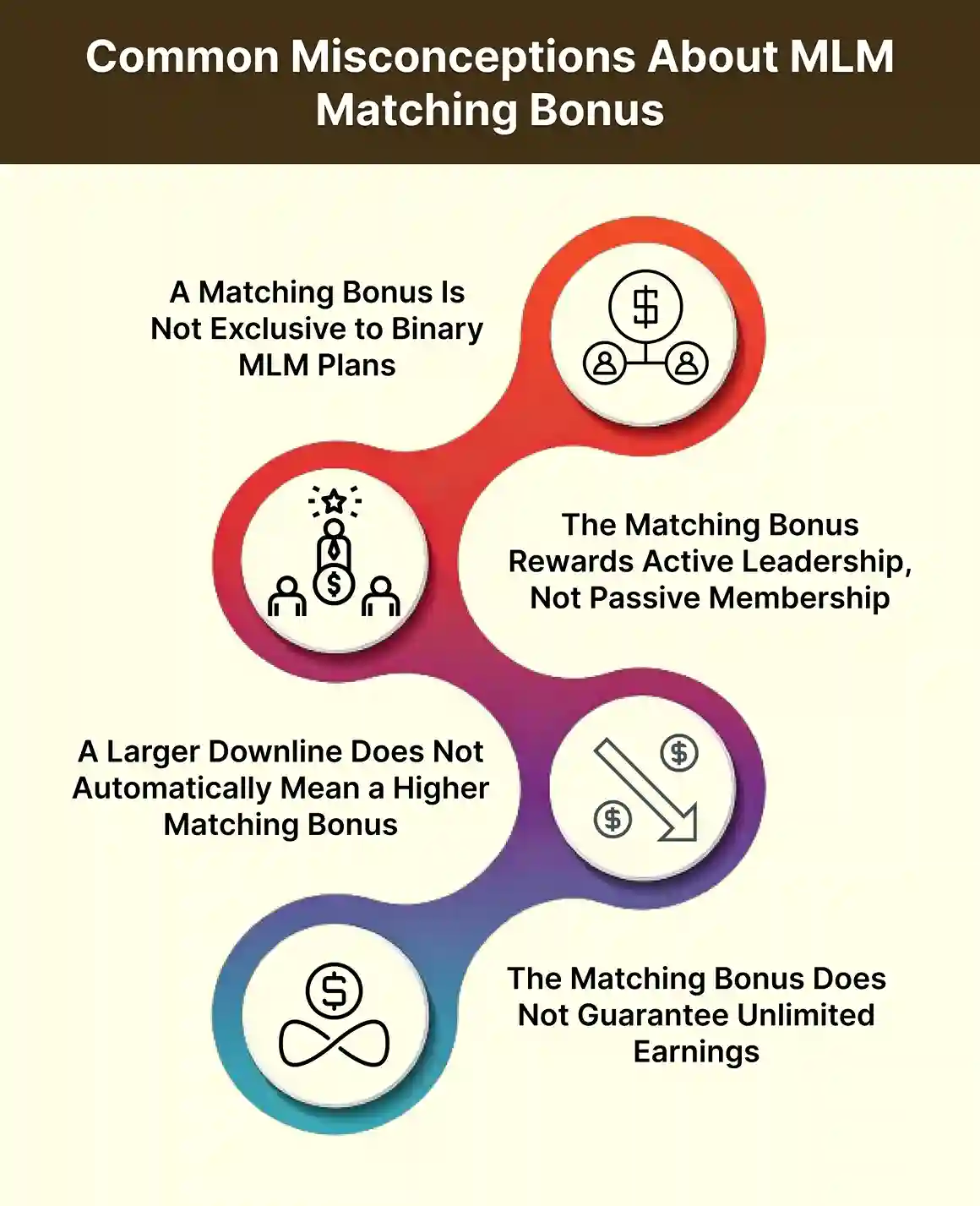
A Matching Bonus Is Not Exclusive to Binary MLM Plans
The matching bonus works across binary, unilevel, and matrix compensation plans — not just binary. The mechanics differ by structure, but the core principle remains the same: upline distributors earn a percentage of their downline's commissions across all three.
- 02
The Matching Bonus Rewards Active Leadership, Not Passive Membership
The matching bonus is tied directly to downline performance. If a leader stops mentoring and supporting their team, downline earnings decline, and so does their matching bonus. It rewards active leadership, not passive membership.
- 03
A Larger Downline Does Not Automatically Mean a Higher Matching Bonus
Network size alone does not determine matching bonus earnings; active retail selling does. Distributors who do not meet their PV threshold or retail customer requirements in a given cycle are disqualified, regardless of downline size.
- 04
The Matching Bonus Does Not Guarantee Unlimited Earnings
Payout caps, rank-based limits, and qualification criteria all define how much a distributor can earn from the matching bonus in a given cycle. A distributor who does not meet eligibility requirements for that cycle earns nothing, regardless of downline performance.
Real-World Examples: How Herbalife and Nu Skin Structure Their Matching Bonuses
Two of the world’s largest MLM companies handle matching bonuses differently. Yet, both offer useful design lessons for MLM entrepreneurs looking to include this bonus in their compensation plans:
1) Herbalife Offers Royalty Overrides as the Matching Mechanism:
According to Herbalife’s official compensation plan document, the company does not use the term “Matching bonus” explicitly, but its royalty overrides work the same way.
Supervisors can earn up to 5% on sales generated by their three active levels of downline supervisors.
An additional production bonus of 2% to 7% is applied at the TAB team level.
Both these bonuses are rank-gated. This means that the bonuses only activate when downline members have also reached the Supervisor rank.
2) Nu Skin Offers Matching Bonuses Across Multiple Generations:
Nu Skin’s official compensation plan document explicitly names that matching bonus in its compensation plan. It pays a percentage match of bonuses across six generations. It is earned by personally enrolled “Brand Representatives” who have reached leadership ranks. Some other features of the plan include:
A Gold Partner earns on one generation, while a Presidential Director earns on six generations.
The percentage of the matching bonuses also varies by activity. When first-generation leaders complete six or more building blocks in a month, they receive 10%. Deeper generation leaders receive 5% up to six generations deep.
One more thing to note here is that qualifications are strictly tied to retail selling. Being eligible for these bonuses requires a minimum of five retail sales per month.
How to Build An Effective MLM Matching Bonus Plan?
When built correctly, a matching bonus is one of the most effective tools in an MLM compensation plan. It pays for leadership development and strengthens long-term retention within your company.
As you finalize your plan, remember to include all the key principles mentioned in this article.
It's important to get details like commission eligibility, payout caps, etc, configured correctly from the start.
If you are looking for expert advice, Global MLM Solution has helped 400+ direct selling companies configure their compensation plan and automate commission calculation at scale. Our client success stories offer a closer look at our experience and expertise. You can also opt for our MLM consulting services, where our expert team will help you build a compensation plan perfect for your business goals and needs.

Shabana is a dynamic writer and strategist with profound expertise in network marketing. Her sharp analysis of industry trends and exceptional ability to distill complex concepts into clear, actionable insights make her content invaluable for professionals at every level. Through her writing, she empowers readers to navigate the evolving landscape of relationship-driven sales with confidence and integrity. Blending data-driven strategies with human-centric principles, Shabana provides a unique perspective that helps businesses thrive while maintaining authentic connections.
FAQs
1. What is a matching bonus percentage in MLM?
The matching bonus percentage is the rate applied to your downline member's commission to calculate your payout.
2. What is the difference between a matching bonus and an override commission?
A matching bonus is a type of override commission. But not all override commissions are matching bonuses. An override commission is any earnings an upline receives from downline activity. But a matching bonus is specifically calculated as a percentage match of the downline member’s earnings.
3. How does MLM compression affect the matching bonus?
MLM compression skips inactive distributors and passes the matching bonus to the next qualified distributor in the genealogy tree.
4. Can MLM software automate matching bonus calculations?
Yes. MLM commission software automatically applies matching bonus percentages across all levels, enforces payout caps, and distributes payouts every cycle without manual intervention.
5. What is the Future of MLM Matching Bonus?
Matching bonuses are evolving. Modern MLM companies are moving away from recruitment-heavy reward structures and toward compensating leaders who actually develop their teams. Modern systems will involve more automation, tighter compliance, and performance-driven payouts that reward genuine leadership over network size.