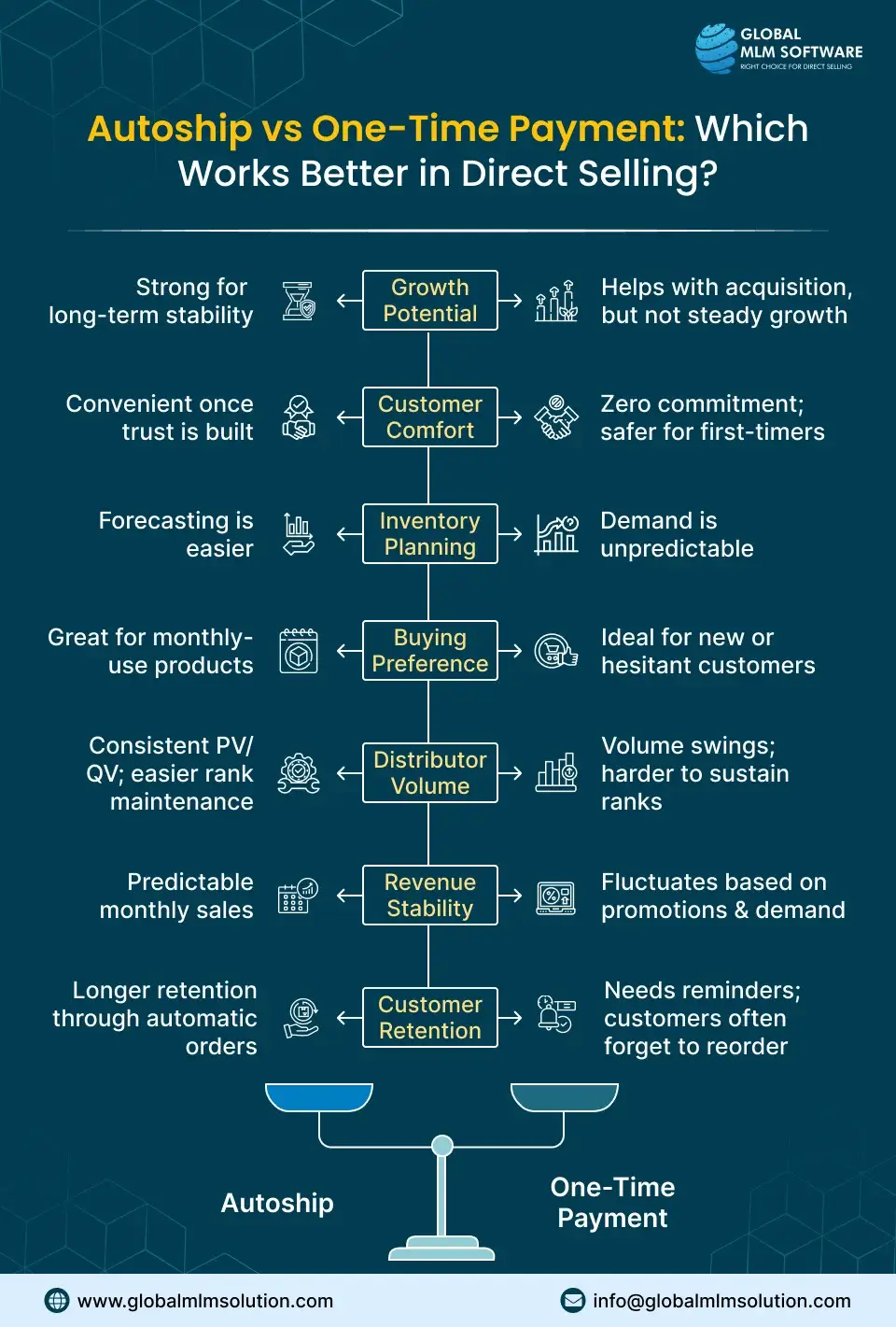
If you’ve spent any time in direct selling, you already know that the way customers buy your products can completely change how your business behaves. Some companies lean heavily on direct selling autoship because it keeps orders rolling in without much effort. Others prefer sticking to one-time purchases, especially when they’re trying to win over new buyers who aren’t ready to commit.
There’s no universal “best” model. But the differences between the two show up quickly once you look at how they affect your revenue, your distributors, and the kind of relationship you build with customers.
Revenue Predictability
Autoship:
With recurring orders through direct selling autoship, you rarely get surprised by your numbers. The revenue patterns start looking steady, and that makes it easier to plan your next few months: stock levels, payouts, promotions, everything.
One-Time Payment:
Here, your revenue feels more like a fluctuation. Great if you run a successful campaign, not so great the month after. It works, but it never feels “stable.”
Customer Retention
Autoship:
People stay longer because their orders are already scheduled. Most of the time, unless they cancel, they simply keep receiving what they need.
One-Time Payment:
You have to nudge people to come back. Some will, but many get busy and forget, even if they liked the product.
Distributor Volume & Rank Consistency
Autoship:
This is where direct selling autoship really shines. PV/QV doesn’t swing wildly, and distributors aren’t stressed about meeting rank requirements at the last minute.
One-Time Payment:
One quiet week can hurt a distributor’s monthly volume. Good months feel amazing, but the dips can be demotivating.
How Customers Prefer to Buy
Autoship:
Perfect for items people use regularly. If a product genuinely becomes part of their routine, autoship feels like a convenience rather than a commitment.
One-Time Payment:
Some customers simply prefer buying when they feel like it, especially early on. If someone’s trying a product for the first time, they’re usually happier starting here.
Inventory & Planning
Autoship:
Your warehouse doesn’t have to guess. You know roughly how many orders are coming next month, so you plan inventory accordingly.
One-Time Payment:
Since demand goes up and down, you might end up storing more products than you need or scrambling when there’s a sudden rush.
Customer Mindset
Autoship:
Once a customer trusts the brand, autoship feels like a useful subscription. Until then, it can seem like a big step.
One-Time Payment:
Zero pressure, no long-term strings attached—this alone makes new customers more comfortable.
Long-Term Growth
Autoship:
If you're trying to build a steady, predictable business that doesn’t constantly swing from high to low, autoship makes life much easier.
One-Time Payment:
It helps you build a customer base and get products into more hands, but relying only on one-time buyers makes long-term stability harder.
Conclusion
Autoship is great for stability because it promotes steady sales, better retention, consistent PV/QV, and smoother planning. One-time purchases, on the other hand, are unbeatable when you’re bringing in new customers or selling products people don’t buy often.
Most successful companies don’t pick one side. They blend both: start customers with a simple one-time purchase, and once they trust the product, offer autoship with perks that make the transition feel natural.