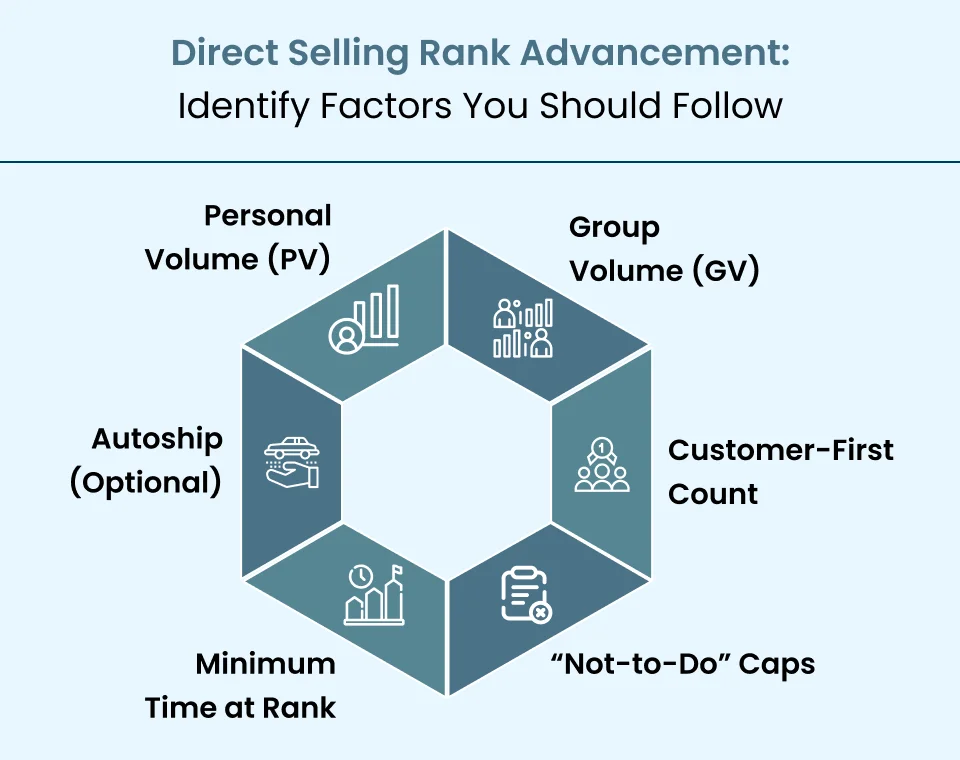
When you look at how most direct selling companies structure their rank advancement systems, a few metrics show up almost everywhere. They’re used because they reflect genuine effort, real customer activity, and healthy team growth.
One of the foundations is Personal Volume (PV), which is basically the sales a distributor personally generates within a month or cycle. PV is important because it proves the distributor is actually working the business, not just leaning on their downline. Most companies set a monthly PV requirement that gradually increases by rank.
Another pillar is Group Volume (GV), which tracks the total qualified sales from a distributor’s team. This is the metric that rewards leadership and duplication. As a distributor climbs the ladder, their GV targets usually rise, and companies align those targets with their compensation budget.
To keep things customer-first, many compensation plans now incorporate a Customer-First Count, which is the number of unique retail customers and retail orders a distributor brings in. This is a practical way to discourage inventory loading and make sure the business revolves around real buyers. Some companies also monitor what portion of PV comes from retail customers to keep compliance solid.
At the same time, good direct selling rank advancement criteria don’t just look at what distributors should do. They also monitor the things they shouldn’t. That’s where “Not-to-Do” Caps come in. These measure chargebacks, returns, and support complaints. The goal is to spot unhealthy selling practices early. The key is to keep these rules clear and give distributors a fair review or appeal path.
Many plans also require some Minimum Time at a Rank before a distributor can move up. This helps maintain cost control and signals that the business isn’t a “jump ranks overnight” model. The typical requirement is staying at a rank for two or three consecutive months. It also sends the right message to regulators by emphasizing stability and consistency.
Some organizations use MLM Autoship as an optional supporting metric, not a hard requirement. It tracks recurring retail subscriptions, which help stabilize monthly volume.
Bottom Line: Rank advancement works best when the criteria reflect real sales, real customers, and real leadership, not shortcuts. A balanced set of KPIs keeps the plan fair, predictable, and aligned with long-term growth.