Global MLM Software has configured direct selling platforms for founders across the USA and seven other markets. The pattern we see consistently across growing operators confirms what Direct Selling News published in July 2026: Companies that intentionally build community as core business infrastructure—not merely as a byproduct of growth—retain distributors. and customers at dramatically higher rates than companies that treat community as a reward for hitting recruitment targets.
This article draws exclusively on verified USA industry sources published in 2026. Every claim traces to a named, real organisation or publication. We will cover what the community-led model is, what the data shows about its performance, what went wrong with the alternative, what it looks like in practice, and specifically what software a community-led direct selling company needs.
The community-led direct selling model prioritizes belonging, mentorship, and shared purpose before recruitment incentives— instead of assuming community happens automatically as a byproduct of growth. In 2026, every USA direct selling brand with 20%+ year-over-year growth used this approach, and the clearest new launch (Atmosphera) hit 68%+ customer retention using it.
Key Takeaways :
People stay for community, not just commissions — A strong sense of belonging, shared purpose, mentorship, and product advocacy can create deeper distributor relationships than compensation alone.
Customer relationships are becoming more important than recruitment volume — Community-led models place greater emphasis on creating genuine product users and loyal customers rather than measuring success primarily through network expansion.
Purpose can become a competitive advantage — A clearly defined mission gives distributors something meaningful to represent and can make the company more attractive to today's socially connected sellers.
Social platforms make community-driven growth scalable — Distributors can build personal brands, share experiences, educate customers, and create conversations without depending entirely on traditional prospecting methods.
Technology should enable relationships, not replace them — The right direct selling platform should support communication, engagement, customer retention, mentorship, and recognition alongside conventional MLM functions such as genealogy and commissions.
What is the community-led direct selling model?
The community-led direct selling model is a business architecture where distributor retention, product adoption, and recruitment are driven by intentional community design — shared purpose, belonging, and mentorship — rather than commission structure alone.
In July 2026, Direct Selling News published "Community with the aid of Design" in its quarterly magazine. Author Jenn Ashby wrote: "One of the largest misconceptions in direct promoting is that community happens mechanically. We expect that because human beings accumulate around a product, a challenge or an possibility, culture will obviously form on its own. We assume momentum creates connection. We suppose increase creates loyalty. We think a shared repayment plan is sufficient to maintain human beings aligned. But after nearly decades in this industry, I even have found out that strong groups hardly ever show up by way of twist of fate. They are deliberately designed, bolstered and guarded through the years. And when they're no longer, agencies sooner or later feel the effects anywhere — thru retention challenges, inconsistent duplication, leadership breakdowns and stalled momentum".
That diagnosis names the failure mode of the conventional model precisely. For years, the direct promoting channel centered on systems, tools, and strategies designed to accelerate increase — large uplines, deeper commission systems, quicker recruitment incentives. The network-led model does now not reject commissions or recruitment. It insists that neither is sufficient as the number one infrastructure for a sustainable direct selling commercial enterprise.
The difference between the community-led model and traditional MLM is not the MLM Compensation Plan. It is the intentionality with which the human infrastructure is built around the product and the mission. Community-led companies design for belonging before they design for recruitment. They build mentorship systems before they build rank advancement tables. They define their purpose before they define their compensation plan.
The DSN definition in practice: A community-led direct selling company is one where a distributor who has not recruited a single person in six months still feels connected to the brand, still trusts the company, and still purchases the product — because the community infrastructure makes them want to stay, independent of their commission earnings.
Why is it outperforming traditional MLM in 2026?
Three verified USA market signals confirm the community-led model is outperforming traditional recruitment-focused MLM in 2026. They are not opinions or predictions — they are documented outcomes from named companies and named publications.
68%+ customer retention from a community-first hybrid model
Former Beautycounter managing directors launched Atmosphera in the USA with a hybrid model combining a flat affiliate tier and a multi-level community tier. The model was explicitly described as a "rehabilitation of the direct-sales model." Customer retention rate from the first months of US operation: 68%+. (measured as repeat-purchase rate among enrolled customers, as per PR Newswire release, April 30, 2026). The company charges affiliates a $50 annual fee — a low-barrier entry designed to attract product advocates who may eventually build community organisations. Source: Direct Selling News, Beauty Independent, PR Newswire.
11 brands with 20%+ year-over-year growth — all community-first
Direct Selling News named 11 brands with at least 20% year-over-year revenue growth in its April 2026 Momentum Index: Bravenly Global, EllieMD, MAKE Wellness, Neora, NewULife, The Super Patch Company, Velovita, Vital Health, Zinzino, PM-International, and Immunotec. The common characteristic across all of them is not their compensation plan structure. It is their community architecture: strong distributor identity, purpose-driven mission, mentorship culture, and social-first recruitment. Source: Direct Selling News, April 2026.
The industry's flagship publication names community as the defining competitive advantage
Direct Selling News devoted its July/August/September 2026 cover to "Building Better" — featuring Amway, SeneGence, and USANA. The editorial theme: "Today's consumers want authenticity. Employees want purpose. Distributors want connection and mentorship. Communities want companies willing to invest beyond the bottom line." The DSN podcast, across 138 expert interviews over five years, named community and customer acquisition as the two defining themes of successful direct selling leadership. Source: Direct Selling News, July 2026; DSN Direct Approach Podcast, June 2026.
The pattern: Every growing USA direct selling brand in 2026 is building community intentionally. Every declining brand in 2026 is either abandoning the community for transactional affiliate economics or failing to build it in the first place. This is not coincidence — it is a structural shift in what distributors and customers demand from a direct selling company.
Why Did the Traditional Recruitment-First Model Struggle?
The traditional recruitment-focused MLM model — where growth depends primarily on recruiting new distributors who then recruit more distributors — has shown a specific structural fragility when market conditions change or when the compensation economics shift.
In 2026, several established direct selling brands announced their departure from the network marketing model, moving to flat affiliate-only structures. Direct Selling News reported in April 2026 that this trend was generating "significant and widespread backlash from distributors in the field who feel left behind by a culture and business they helped build."
The backlash was not primarily about commission rates. Distributors who had invested years in building teams and communities within these companies felt that when the compensation model changed, no community infrastructure remained to anchor their identity to the brand. The community had been a byproduct of the compensation plan — not an independently designed system. When the plan changed, the community dissolved.
The structural failure mode: A direct selling company built primarily on recruitment commission incentives, without independent community infrastructure, has only one retention mechanism — the commission. When the commission changes, there is nothing else holding the distributor network together. Community-led companies have a second retention mechanism that exists independently of the compensation plan: belonging.
Direct Selling News covered multiple leaders publicly reaffirming their commitment to the MLM model in 2026 — Neora, PM-International, Mannatech, and others. Their public statements were not just business decisions. They were community signals — telling their field organisations that the belonging and identity they had built within these companies was not going away.
The contrast is clear. Companies that built community as infrastructure retained their distributor networks through model changes and market pressure. Companies that had not done this work found that when the compensation changed, the community — whatever community existed — dissolved rapidly.
What does the community-led model look like in practice?
Atmosphera's USA launch is the most instructive current example because it was designed from scratch with the community-led model as the primary architecture — not bolted on after years of a different approach.
The model works in two tiers. The affiliate tier charges a $50 annual fee, provides a 20% personal purchase discount, and allows affiliates to earn commissions by sharing products they love. This tier is designed for people who are not interested in building a business — just in sharing something they believe in. The community tier allows affiliates who want to build organisations to recruit, lead, and earn multi-level commissions from their downline's activity.
Both tiers operate inside the same community. Both have access to the same recognition systems, the same mission storytelling, the same purpose around climate-adaptive skincare. The result: 68%+ customer retention from the first months of US operation — because the community is the constant, not the commission tier.
Among the DSN Momentum Index brands growing at 20%+ year-over-year, the common operational characteristics are:
Bravenly Global
EllieMD
MAKE Wellness
Neora
NewULife
The Super Patch Co.
Velovita
Vital Health
Zinzino
PM-International
Immunotec
Strong community identity that distributors feel proud to represent beyond the commission opportunity
Mentorship infrastructure — formal or informal systems for new distributors to learn from experienced leaders
Purpose and mission storytelling built into distributor-facing tools — not just the company website
Social-first distributor recruitment — new distributors discovered the brand through personal recommendation and authentic content, not cold outreach or advertising
Product that generates genuine repeat purchase — community is reinforced by customers who actually use and love what they sell
See the Community Features in a Live 30-Minute Demo
Hybrid commission engine, social selling integration, distributor community dashboard — configured to your specific model. Written quote within 24 hours.
Book Your Free DemoWhat are the tradeoffs of the community-led model?
Community infrastructure takes longer to build than a commission plan — most founders should budget 6-12 months before mentorship and recognition systems produce measurable retention effects. The model also depends more heavily on founder/leadership charisma and is harder to systematize at scale than a pure comp-plan-driven model.
Companies should weigh this build time against the retention upside before committing.
The 7 software features a community-led direct selling company needs
The community-led model is not just a strategy—it comes with specific operational requirements that software must support. Traditional MLM software was built for recruitment-first models, and many platforms still treat the capabilities below as secondary. For a community-led company, however, these capabilities are essential.
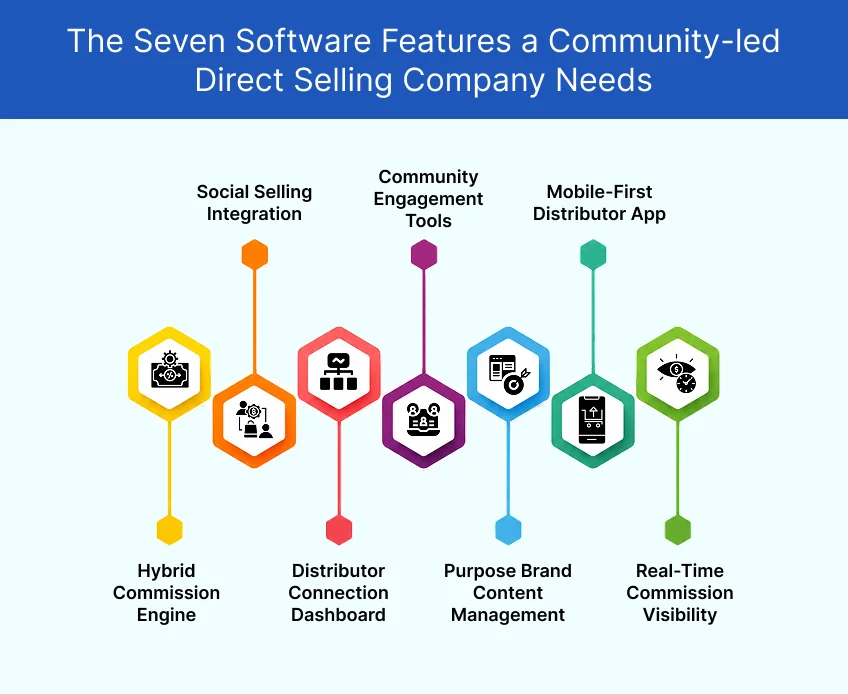
A community-led company needs software that can manage two commission structures simultaneously, provide distributors with a personal storefront, display real-time team activity, and deliver a fully mobile experience. These are the seven essential capabilities:
| Feature | What It Does | Why Community-Led Model Needs It | Priority |
|---|---|---|---|
| Hybrid Commission Engine | Runs flat affiliate commissions and multi-level organisational commissions simultaneously on the same transaction | The Atmosphera model requires two parallel commission structures. Without a dual engine, you cannot run both tiers on the same platform — forcing two separate systems or choosing one model | Critical |
| Social Selling Integration | Shareable personal enrollment links, replicated distributor storefronts, social content libraries for approved sharing | Community-led recruitment happens through authentic personal recommendation on social media — not through cold outreach. Every distributor needs a personal digital storefront from day one | Critical |
| Distributor Connection Dashboard | Real-time team visibility, mentor-mentee tracking, rank advancement notifications, downline activity feed | Community-led companies need leaders to see their team's real-time activity — not yesterday's batch report. Mentorship requires visibility. Community requires connection tools, not just genealogy trees | Critical |
| Community Engagement Tools | Recognition systems, milestone celebrations, leaderboards, distributor achievement badges, team challenge mechanics | Community is maintained between purchase cycles by recognition and celebration — not by commission reminders. Distributors who are celebrated publicly stay longer than those who receive only financial rewards | High |
| Purpose Brand Content Management | Mission storytelling tools, approved brand content libraries, impact reporting for distributors to share | Community-led brands have a purpose beyond the product — climate impact, wellness mission, community investment. Distributors who can tell the mission story authentically recruit better and retain longer | High |
| Mobile-First Distributor App | Full back-office access, commission visibility, team management, content sharing — on iOS and Android | Community lives on phones. DSN Social Media Day attracted 5,500+ distributors. The community-led distributor recruits, shares, and manages their business from their phone — the software must match that reality | High |
| Real-Time Commission Visibility | Commissions calculated and displayed immediately on every qualifying transaction — not in nightly batch runs | Community trust requires commission transparency. Distributors who cannot see their earnings in real time lose confidence in the company — one of the most consistent patterns in distributor churn data | High |
| All USA configurations on Global MLM Software include FTC compliance tools as standard — IDS generation, retail-to-recruit monitoring, and a 3-year audit trail — regardless of model type. | |||
The platform verification question: Before assuming your existing MLM software can support a community-led model, Ask your software vendor the following questions: does this platform run affiliate and multi-level commissions simultaneously on the same transaction? Does it provide real-time rank advancement notifications? Does it have social selling enrollment links built in? If any answer is no — the platform may need to be upgraded or replaced before you launch.
Choose community-led if your product has a lifestyle/mission angle and you want social-first recruitment.
Choose traditional MLM if the income opportunity itself is the primary draw.
Most 2026 founders are doing both.
How do you choose between a community-led model and a traditional MLM model?
The community-led model is not right for every direct selling business. The choice depends on three founder decisions — your product, your audience, and your recruitment philosophy.
Community-led works best for: Products with a lifestyle, mission, or identity component — wellness, beauty, personal care, fitness, sustainability. Products that generate genuine repeat purchase and customer advocacy.
Traditional MLM may fit better for: Products that are primarily an income opportunity vehicle, where the product is secondary to the business system.
Community-led works best for: Growth through authentic personal recommendation. Distributors who find the brand through content they believe in and join because they love the product.
Traditional MLM may fit better for: Business-opportunity-first recruitment where the income model is the primary attraction and the product is secondary.
Community-led needs: Hybrid commission engine, social selling tools, community dashboards, purpose brand content management, mobile-first distributor app.
Traditional MLM needs: Deep commission plan flexibility, strong genealogy management, rank advancement calculation accuracy at scale.
Global MLM Software supports both and all hybrid combinations.
Most founders building a new direct selling business in 2026 benefit from a hybrid approach: a community-led culture and architecture, with a well-designed traditional MLM compensation plan underneath it. The Atmosphera model is the clearest example — hybrid affiliate+MLM commission structure, community-led culture. These are not opposites. The best direct selling companies in 2026 are doing both.
| Dimension | Community-Led Model | Traditional Recruitment-First |
|---|---|---|
| Primary retention mechanism | Belonging + commission | Commission only |
| Customer retention (2026 data) | 68%+ (Atmosphera, May 2026) | Industry norm: 20–35% |
| Distributor recruitment method | Social-first, personal recommendation | Opportunity-led, prospecting |
| Resilience to comp plan changes | High — community independent of plan | Low — retention tied to plan |
| FTC alignment | Strong — product-first by design | Requires careful compliance management |
| Software requirement complexity | Higher — needs community features | Lower — standard MLM platform |
| 2026 growth performance | 11 of 11 Momentum Index brands | Declining or flat for most operators |
Shabana is a dynamic writer and strategist with profound expertise in network marketing. Her sharp analysis of industry trends and exceptional ability to distill complex concepts into clear, actionable insights make her content invaluable for professionals at every level. Through her writing, she empowers readers to navigate the evolving landscape of relationship-driven sales with confidence and integrity. Blending data-driven strategies with human-centric principles, Shabana provides a unique perspective that helps businesses thrive while maintaining authentic connections.
FAQ: Community-Led Direct Selling Model and Software 2026
1. What is the community-led direct selling model and why is it different from traditional MLM?
The community-led direct selling model is a business architecture where distributor retention, product adoption, and recruitment are driven by intentional community design — shared purpose, belonging, and mentorship — rather than commission structure alone. Direct Selling News published "Community by Design" in July 2026, stating that strong communities rarely happen by accident. The difference from traditional MLM is not the compensation plan — it is the intentionality with which the human infrastructure is built around the product and the mission.
2. Why is the community-led model outperforming traditional MLM in 2026?
Three verified signals confirm the community-led model is outperforming. First, Atmosphera launched in the USA in May 2026 with a hybrid community model and achieved 68%+ customer retention. Second, the DSN Momentum Index (April 2026) found all 11 brands with 20%+ year-over-year growth share community-first characteristics. Third, DSN's July 2026 cover "Building Better" identified authenticity, purpose, and distributor connection as the defining competitive advantages for growing direct selling brands.
3. What went wrong with the traditional MLM recruitment model?
The traditional recruitment-focused model has shown structural fragility when market conditions change. In 2026, several established brands moved to flat affiliate-only structures. Direct Selling News reported widespread backlash from distributors who felt left behind by a culture and business they had helped build. When the compensation plan was the only community infrastructure, changing the plan dissolved the community. Companies with independently designed community infrastructure retained their field organisations through the same changes.
4. What does the community-led model look like in practice?
Atmosphera's USA launch (April 30, 2026) is the clearest current example. A hybrid model with a $50 affiliate tier for product sharers and a multi-level tier for community builders. Both tiers share the same community culture and mission. Result: 68%+ customer retention. Among the DSN Momentum Index brands growing at 20%+ year-over-year, common characteristics include strong community identity, mentorship structures, purpose storytelling in distributor tools, and social-first recruitment.
5. What software features does a community-led direct selling company need?
A community-led direct selling platform should provide these seven capabilities:
Hybrid commission engine — flat affiliate and multi-level commissions simultaneously.
Social selling integration — shareable enrollment links and replicated storefronts.
Distributor connection dashboard — real-time team visibility and mentor-mentee tracking.
Community engagement tools — recognition and milestone systems.
Purpose brand content management.
Mobile-first distributor app.
Real-time commission visibility. All USA configurations should include FTC compliance tools as standard.
6. How do you choose between a community-led model and a traditional MLM model?
The choice depends on your product, your audience, and your recruitment philosophy. Community-led works best for lifestyle, mission, or identity products — wellness, beauty, personal care, fitness — where authentic personal recommendation drives recruitment. Traditional MLM fits better for business-opportunity-first models where the income system is the primary attraction. Most new founders in 2026 benefit from a hybrid approach: community-led culture with a well-designed MLM compensation plan underneath. Global MLM Software supports all architectures and hybrid combinations.
7. Is the community-led direct selling model FTC compliant?
Yes — community-led models are inherently more FTC-aligned because they prioritise product adoption and customer retention over recruitment fees. Atmosphera's 68%+ customer retention is evidence of genuine retail demand — the FTC's preferred signal. Community-led software should still include FTC compliance tools — IDS generation, retail-to-recruit monitoring, and audit trails — as these are requirements regardless of business model.
8. Can existing MLM software handle the community-led model?
Many traditional platforms treat community features as secondary. Before assuming your platform can support a community-led model, verify: does it run affiliate and multi-level commissions simultaneously on the same transaction? Does it provide real-time rank advancement notifications? Does it integrate with social selling platforms? If any answer is no, the platform may need upgrading before launch.
9. What is the difference between a hybrid affiliate plus MLM model and traditional MLM?
A traditional MLM model has one commission structure. A hybrid model has two parallel structures: a flat affiliate tier and a multi-level organisational tier. Atmosphera operates this way — $50 affiliate fee for product sharers, multi-level tier for community builders. The software requirement is a dual commission engine running both calculation systems simultaneously on every qualifying transaction.
10. How does community-led direct selling affect distributor retention?
Community-led direct selling consistently produces higher distributor retention because distributors stay when they feel connected and part of something meaningful — independent of commission earnings. DSN's "Community by Design" (July 2026) identifies the symptoms of neglected community infrastructure: retention challenges, inconsistent duplication, leadership breakdowns, and stalled momentum. Atmosphera's 68%+ retention is the most current proof case for what intentional community design produces from day one.
11. Which USA direct selling brands are growing fastest with a community-led model in 2026?
The DSN Momentum Index (April 2026) identified 11 brands with 20%+ year-over-year growth: Bravenly Global, EllieMD, MAKE Wellness, Neora, NewULife, The Super Patch Company, Velovita, Vital Health, Zinzino, PM-International, and Immunotec. Common characteristics: strong community identity, purpose-driven mission, social-first recruitment, and a product that generates genuine repeat purchase.
12. What does Global MLM Software offer for community-led direct selling companies?
Global MLM Software supports all direct selling models — traditional MLM, flat affiliate, hybrid affiliate plus MLM, and custom architectures. Specific capabilities for community-led companies include a hybrid commission engine, social selling integration, real-time distributor rank advancement notifications, community engagement and recognition tools, purpose brand content management, AI-powered churn prediction, and mobile-first distributor app. All USA configurations include FTC compliance tools as standard. Book your free 30-minute demo at globalmlmsolution.com/demo — written quote within 24 hours.
Build Your Community-Led Direct Selling Business on Global MLM Software
Hybrid commissions, social selling tools, distributor community features, and FTC compliance — all in one platform. Configured to your specific model.
Book a Free Demo Get In Touch