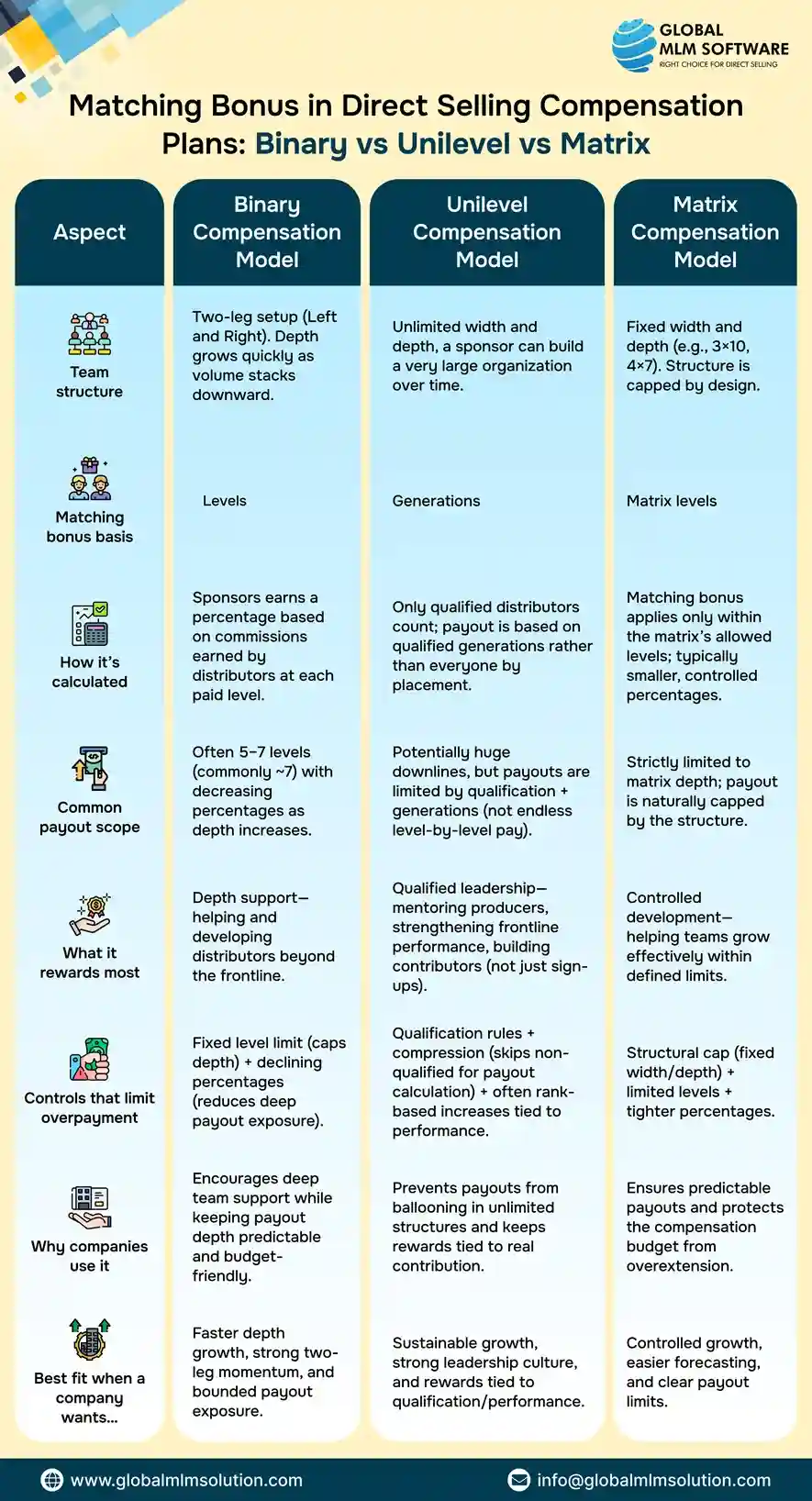
Matching bonus works differently in different MLM plans. While the overall goal stays the same: To motivate distributors, strengthen retention, and encourage support for the team, each compensation model uses matching bonuses to promote different behaviors.
Because matching bonuses are a core part of compensation design, understanding how they function by model helps you decide:
Rank advancement rules
Qualification requirements
Payout caps
Team and leg structures
Binary Compensation Model
The binary MLM plan is created to build depth, where each distributor builds two legs, left and right. So, team sales volume increases as new members keep joining under existing legs.
MLM binary structure naturally creates deep organizations. Therefore, the matching bonus is used to reward sponsors who stay involved beyond their direct recruits.
In many binary plans, the matching bonus pays through a set number of levels. The percentage declines as the levels go deeper.
This approach strikes a practical balance:
Distributors stay engaged, since earnings aren’t limited to direct recruits only.
The company controls exposure, because the payout depth is clearly defined.
It also makes it easier to set clear rules by answering these:
How far down the organization do matching bonuses apply?
How much support is rewarded at each level?
How to keep the plan attractive without pushing payouts beyond budget?
Unilevel Compensation Model
Unilevel MLM plan provides unlimited width or depth. Therefore, it can become expensive for the organization if a single sponsor builds a large team and the matching bonus is paid for the deepest level.
That’s why unilevel matching bonuses are usually calculated by generations rather than levels.
Levels vs. Generations
Levels: Everyone positioned in that level may be counted, whether they’re qualified or not.
Generations: Only qualified distributors “hold” a generation for payout purposes.
This is where compression matters. If a distributor doesn’t meet the qualification criteria:
They don’t count as the generation earner for commission calculations.
The system skips them and pays to the next qualified person above.
The tree structure stays the same, only the payout calculation is adjusted.
Many unilevel plans also increase matching bonus percentages as rank increases.
That design encourages the behaviors companies want most:
Building capable leaders instead of collecting inactive sign-ups.
Supporting a strong, productive frontline.
Rewarding performance tied to qualification, not just placement.
Matrix Compensation Model
Matrix MLM plans are used when a company wants tighter control over both structure and payouts. Unlike unilevel, a matrix is built with fixed limits, a set width and a set depth (for example, 3×10 or 4×7). Since the organization is capped by design, the matching bonus is also naturally limited.
In most matrix plans, matching bonus percentages are:
Modest
Tightly managed
Restricted to the levels included in the matrix depth.
The benefit is predictability. The company can forecast payout exposure more accurately and avoid stretching the compensation budget too far. At the same time, distributors still have a reason to help their teams grow, because development inside the matrix can directly increase matched earnings.
Conclusion
Matching bonuses may look similar across plans, but the structure underneath changes what they reward.
Binary plans emphasize depth support, unilevel plans reward qualified leadership through generations and compression, and matrix plans keep payouts controlled with fixed limits.
The key is to align matching bonuses with your plan goals, clear qualification rules, and smart caps, so incentives stay motivating and sustainable.