Key Takeaways
2026 FTC crackdown: Four major enforcement actions in 90 days (Forever Living, Farmasi, LifeWave, IM Mastery Academy — up to $795M in penalties), mostly for false income claims.
Distributor posts = company liability: Social media income claims by distributors can legally expose the parent MLM company.
Policies aren't enough: FTC now expects compliance built into business systems, not just written policy.
Two must-haves: Accurate Income Disclosure Statements (including zero-earners) and a healthy retail-to-recruit sales ratio.
No grace period: Compliance is expected from launch — the FTC holds companies liable from day one.
This article is for general informational purposes only and does not constitute legal advice. FTC compliance requirements are fact-specific — consult a qualified attorney before relying on this content for your business.
What Happened: The 2026 FTC MLM Enforcement Wave
The spring of 2026 sent a clear message to every MLM founder in the United States: the FTC is not waiting for you to get compliant. It is coming to find you.
In less than 90 days, the Federal Trade Commission took enforcement action against four separate MLM entities.Each enforcement action revealed a similar pattern — company operators and high-level distributors making unsubstantiated income claims while the overwhelming majority of participants earned little or nothing.
76.8%
of TLC active participants earned zero compensation in 2023. Wellington promised "60 new millionaires in 2026." Permanently barred from deceptive earnings claims. Required to notify her entire downline network.
77%+
of Forever Living Business Owners earned no compensation in each of the last 5 years. Over 89% of new participants never recouped their $300+ startup cost. Operators permanently prohibited from deceptive claims.
79%
of LifeWave active participants earned nothing in commissions in 2024. Only 0.035% earned more than $25,000 per week. The Merritts used social media lifestyle imagery to imply extraordinary income for all participants.
$795M
judgment against IM Mastery Academy (also known as IYOVIA and iMarketsLive). The scheme generated more than $1.2 billion since 2018 using deceptive earnings claims targeting young people through social media lifestyle content.
What all four cases have in common is not just the scale of the income misrepresentation. It is the absence of system-level compliance controls. These companies relied on policies and training to manage distributor behaviour. That approach failed. Software-level enforcement is the new compliance standard in 2026. Wondering whether MLM is legal in the U.S.? Read our guide explaining the legal tests that distinguish legitimate direct selling businesses from illegal pyramid schemes.
Why FTC Compliance Matters in 2026
FTC enforcement has shifted from reviewing company policies to evaluating whether MLM companies have operational systems that prevent deceptive practices. Modern MLM software is expected to support retail sales validation, earnings disclosure, distributor monitoring, and audit-ready reporting.
For founders, compliance is no longer just a legal requirement—it is a operational business requirement
What Does FTC-Compliant MLM Software Do?
FTC-compliant MLM software automates income disclosure statements, monitors retail-to-recruit ratios, flags deceptive earnings claims before publication, maintains 3-year audit-ready records, and tracks distributor sales to end consumers. These functions protect U.S. MLM founders from FTC enforcement actions that carry civil penalties, permanent business restrictions, and multi-million-dollar judgments.
Unlike policy documents and training programs — which depend on individual distributors choosing to comply — software-level controls work automatically. They do not forget. They do not make exceptions. They do not get caught up during product launches and skip the disclosure. Here's how each core compliance function works in practice.
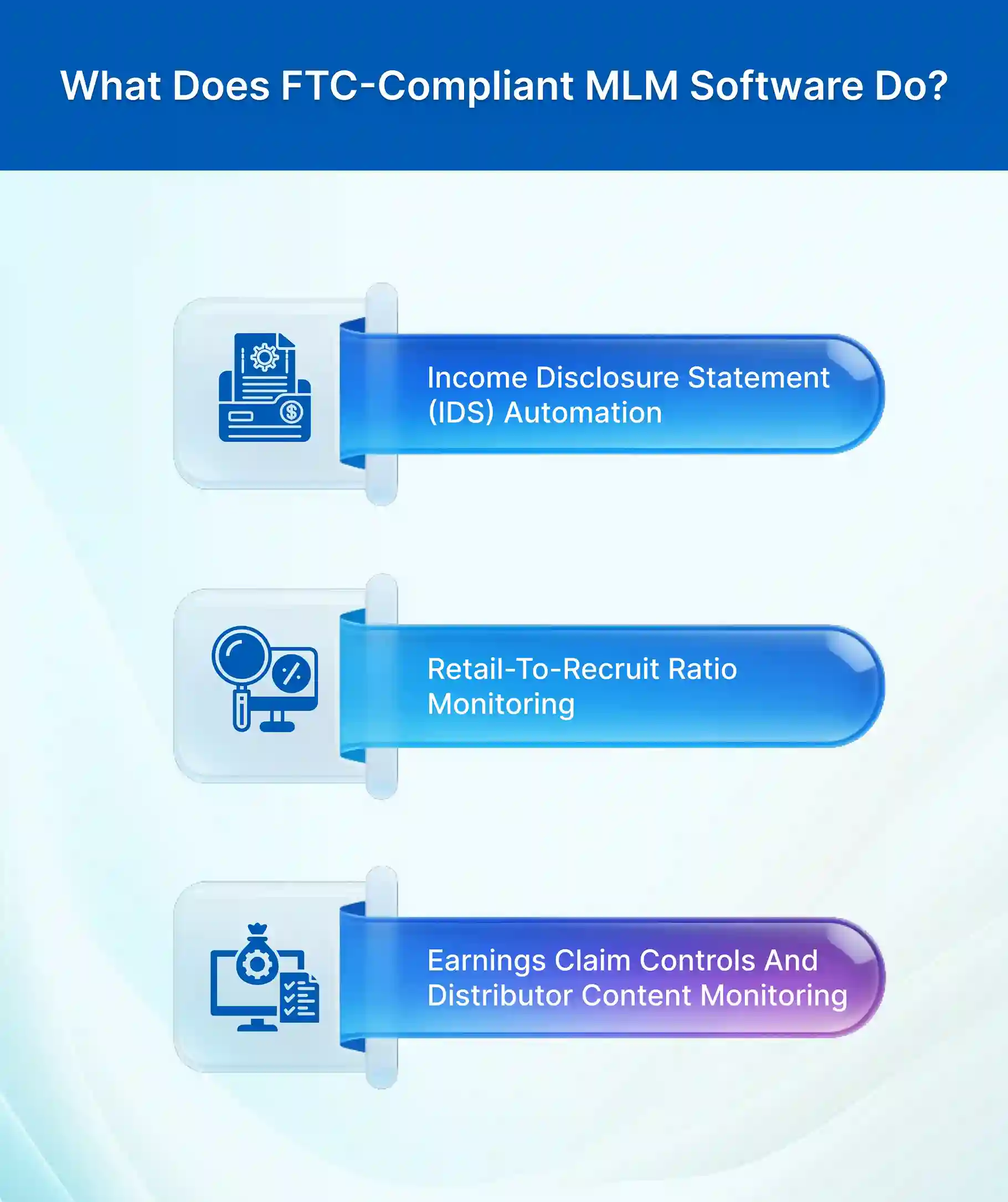
Income Disclosure Statement (IDS) Automation
An Income Disclosure Statement is an annual report that shows actual distributor earnings across your entire network. The FTC does not just recommend an IDS — it explicitly states that any earnings information you provide must accurately reflect the typical participant's experience, including participants who earned nothing.
The FTC's 2024 Business Guidance makes this requirement specific: your IDS must not exclude participants who earned zero, must not limit the data to "active" participants in a way that hides true earnings rates, must use median earnings rather than averages that can be skewed by top earners, and must disclose typical expenses — not just gross commissions.
Modern FTC-compliant MLM software generates the IDS automatically from live compensation data. It calculates median earnings, captures the percentage who earned zero, generates the earnings ranges, includes participant counts, and factors in expense estimates. The system tracks which version of the IDS was shown to each enrolling distributor, when it was displayed, and whether they acknowledged it. That acknowledgment record is your audit trail if the FTC ever comes knocking.
Retail-to-Recruit Ratio Monitoring
The FTC's primary legal legitimacy test for any MLM is simple: where does the money come from? If your distributors earn primarily by recruiting new members rather than selling products to real customers, the FTC may classify your business as a pyramid scheme — regardless of what your compensation plan document says.
FTC-compliant software monitors this ratio per distributor, per team, and across the entire network in real time. It flags individual distributors whose retail sales fall below acceptable thresholds, alerts management when a team or region shows a recruitment-heavy pattern, and generates reports that document genuine consumer demand if the FTC requests evidence.
Example of a Healthy Retail-to-Recruit Ratio
Retail Product Revenue: $18,000
Recruitment Bonuses: $2,000
Retail Revenue Share: 90%
Recruitment Revenue Share: 10%
This example demonstrates a business driven primarily by genuine customer sales rather than recruitment.
Earnings Claim Controls and Distributor Content Monitoring
The Stormy Wellington and LifeWave cases proved that distributor social media content is now a direct source of FTC liability for the parent company. When a distributor posts a video claiming "no less than six figures" or shows a luxury car as evidence of MLM income, the company can be held responsible for providing the means and instrumentalities for that deception.
FTC-compliant software addresses this through several mechanisms. First, it provides pre-approved marketing template libraries — a defined set of compliant messages, graphics, and scripts that distributors can use without creating new compliance risk. Second, it includes AI-assisted social media monitoring that scans distributor content for high-risk phrases such as "financial freedom," "quit your job," "six-figure income," and "passive income." Third, it enforces automated disclaimer insertion — ensuring that any income claim made through the company's official platforms is accompanied by the required IDS reference and disclosure language.
See How GMGO Handles FTC Compliance
IDS automation, retail-to-recruit tracking, earnings claim controls, audit logs, and distributor content management — all in one platform. See it working on your specific product and market.
Book Your Free Demo Reach Out to UsWhat FTC Rules Apply to MLM Companies in the USA in 2026?
The FTC's key MLM requirements in 2026 cover several distinct areas of your business. Understanding all of them — not just earnings claims — is essential for building a compliant foundation from day one.
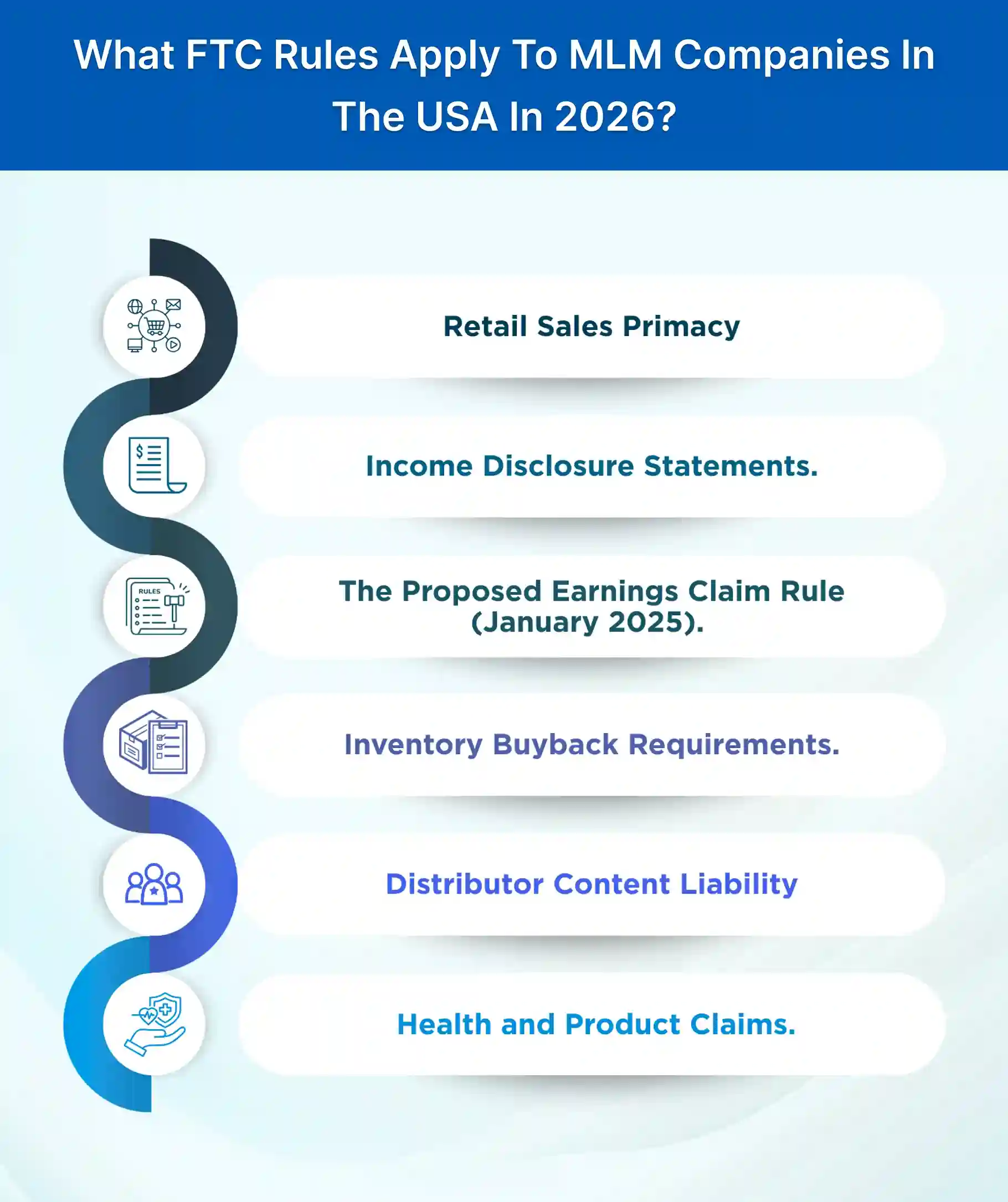
Retail Sales Primacy: The FTC's core legitimacy test is that your business generates revenue primarily from product sales to end consumers — not from recruitment fees, sign-up packs, or distributors buying inventory to qualify for bonuses. If your compensation plan rewards recruitment more than retail sales, you are operating in high-risk territory.
Income Disclosure Statements: Any earnings information you provide must be truthful, substantiated, and representative of typical participant experience. The FTC explicitly states that a "results not typical" disclaimer is not sufficient. If most participants earn nothing, your IDS must say so clearly, prominently, and unavoidably.
The Proposed Earnings Claim Rule (January 2025): The FTC's proposed rule — still under rulemaking as of July 2026 but with active enforcement of existing laws — would require MLM companies to maintain written substantiation for every earnings claim, provide that substantiation to any consumer who requests it, and retain records for a minimum of three years. The rule was proposed with a 60-day public comment period and has been paused pending regulatory review pending review, but the FTC continues to pursue enforcement under existing law regardless.
Inventory Buyback Requirements: Legitimate MLM companies must offer to repurchase unsold inventory from distributors. This requirement exists to prevent inventory loading — a scheme where distributors are pressured to buy products not to sell, but to qualify for commissions or rank advancements. Your software should track buyback requests and enforce the policy automatically.
Distributor Content Liability: Your company is legally responsible for earnings claims and product claims made by your distributors when you have provided the means and instrumentalities for those claims. This means distributor training materials, presentations, scripts, and marketing assets that include non-compliant claims create direct company liability.
Health and Product Claims: For health and wellness, beauty, and personal care MLMs — which represent the majority of the direct selling market — product claims are regulated jointly by the FTC and the FDA. Claims that a product treats, mitigates, prevents, or cures any disease require FDA approval. Claims about energy, wellness, and general health benefits must be substantiated with scientific evidence.
Can MLM Software Prevent FTC Violations?
Yes — but with an important qualification. Software does not make your business compliant on its own. It enforces compliance at the operational level, making it significantly harder for violations to occur and creating the documentation trail that demonstrates good-faith compliance effort if an investigation begins.
The distinction between software-level enforcement and policy-level enforcement matters enormously in practice. A compliance policy says: "Distributors must not make unsubstantiated income claims." Software-level enforcement says: "This marketing template has been pre-approved. This message cannot be sent without the required IDS disclosure. This dashboard will not allow a commission run to complete without an up-to-date retail sales record."
The Forever Living case illustrates what happens without system-level controls. The company had policies. It had agreements. It had training. And yet, for five consecutive years, over 77% of its participants earned nothing while the company continued recruiting. The FTC's conclusion was clear: policies alone are insufficient when the business systems enables and rewards recruitment over retail.
What to Look for in FTC-Compliant MLM Software?
Not all MLM software marketed as "FTC-compliant" provides equivalent protection. Many platforms built for Asian or European markets lack USA-specific compliance architecture entirely. Before committing to any platform, verify each of the following capabilities:
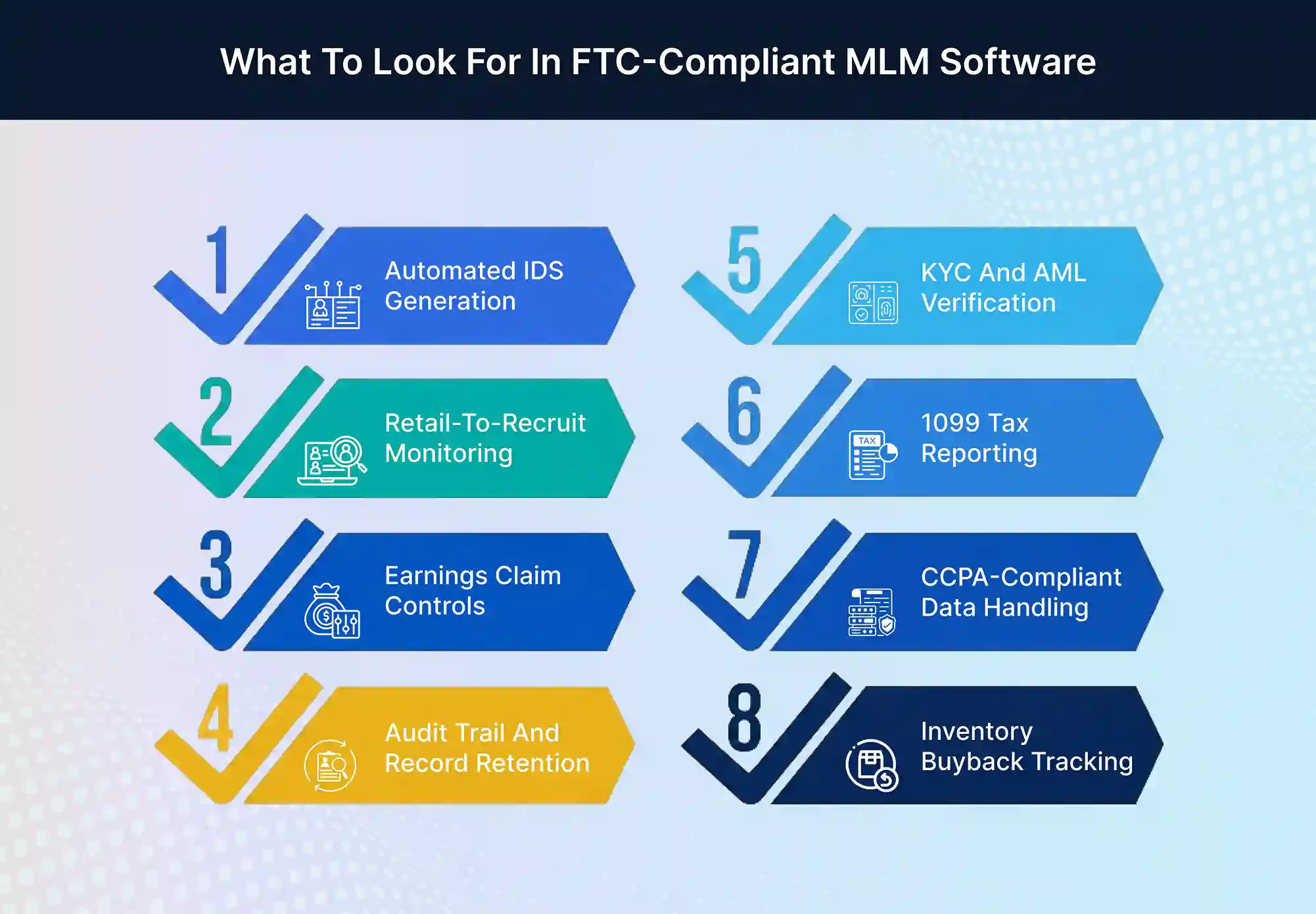
- Automated IDS Generation: The system generates a live Income Disclosure Statement from actual commission data — not a manually updated PDF. It captures all participants including zero earners, uses median earnings, and creates an acknowledgment record for each enrolling distributor.
- Retail-to-Recruit Monitoring: The platform tracks retail sales versus recruitment activity per distributor in real time. Management receives automated alerts when ratios fall outside acceptable thresholds. Reports are exportable in audit-ready format.
- Earnings Claim Controls: Non-compliant income claim templates are blocked at the system level. Approved marketing libraries are available to distributors. Required disclosure language is automatically appended to official communications.
- Audit Trail and Record Retention: Every commission run, every enrollment, every sales transaction, and every earnings claim acknowledgment is logged with a timestamp. Records are retained and exportable for a minimum of 3 years (the proposed FTC standard).
- KYC and AML Verification: Know Your Customer and Anti-Money Laundering verification processes are integrated into the enrollment flow. Required for USA financial compliance and increasingly expected in FTC investigations.
- 1099 Tax Reporting: The system generates 1099-NEC forms for distributors earning $600 or more annually. Failure to issue 1099s creates IRS exposure alongside FTC risk.
- CCPA-Compliant Data Handling: For any USA business processing consumer data, CCPA compliance is mandatory in California and increasingly expected as additional U.S. state privacy laws take effect. Verify your platform's data handling, consent management, and deletion capabilities.
- Inventory Buyback Tracking: The platform supports and documents your buyback policy, tracking repurchase requests and processing them within required timeframes.
How Global MLM Software Handles FTC Compliance?
Global MLM Software was built from the ground up to serve direct selling founders globally — with USA compliance architecture embedded in the core platform, not bolted on as an afterthought.
Automated IDS Engine
Live Income Disclosure Statements generated from real commission data. Covers all participants including zero earners. Acknowledgment records created at every enrollment.
Retail-to-Recruit Tracking
Per-distributor retail sales monitoring with automated alerts when ratios indicate recruitment-heavy activity. Exportable audit reports for any FTC review.
Earnings Claim Controls
Pre-approved marketing template library for distributors. System-level blocks on non-compliant income claim language in official communications.
3-Year Audit Trail
Complete transaction history, commission records, enrollment logs, and disclosure acknowledgments retained and exportable. Built for FTC's proposed 3-year record retention standard.
KYC / AML Integration
Identity verification built into the enrollment flow. Financial compliance controls for USA payouts and international distributor payments.
1099 Tax Reporting
Automatic 1099-NEC generation for qualifying distributors. Reduces IRS exposure and demonstrates legitimate business structure to regulators.
Beyond compliance features, Global MLM Software supports every compensation plan type — Binary, Unilevel, Matrix, Generation, Hybrid, and custom configurations — with a commission engine that processes payouts in real time rather than batch-run delays that create distributor trust issues. The platform also includes mobile apps, replicated distributor websites, e-commerce integration, genealogy management, CRM, and full reporting and analytics dashboards.
Global MLM Software supports more than 500 direct selling companies across the USA, South Africa, and global markets — including health and wellness, beauty, personal care, fitness, financial services, and affiliate marketing businesses at every stage from startup launch to enterprise scale.
The True Cost of FTC Non-Compliance: A ROI Perspective
The question founders most often ask about compliance software is: "Do I really need to invest in this at launch?" The answer is yes — and the math makes it obvious.
| Cost Category | Without Compliance Software | With GMGO Compliance Features |
|---|---|---|
| FTC Investigation Response | $50,000–$500,000+ in legal fees | Audit-ready records exported in minutes |
| FTC Settlement / Judgment | $1.5M (Publishing.com) → $795M (IM Academy) | Compliance controls reduce violation risk |
| Business Continuity | Permanent operating restrictions possible (Forever Living) | Operations continue through investigation |
| IDS Preparation (Annual) | 40–80 hours of manual data compilation per year | Automated — generated on demand in minutes |
| Distributor Trust | Compliance failures destroy network confidence | Transparent earnings data builds lasting trust |
| GMGO Software Investment | — | Starting from ~$500/month for startups |
The FTC's enforcement record makes the calculation simple. The IM Academy case generated over $1.2 billion in revenue before the FTC's $795 million judgment. The Forever Living case involved a company that had operated for years before the FTC permanently restricted its operators. In neither case did the absence of compliance software save the business. In both cases, having comprehensive compliance systems from day one would have materially reduced the risk of FTC classification as a deceptive scheme.
FTC Compliance for Health, Wellness, and Beauty MLM Founders
Health and wellness represents 29% of global direct selling sales. Beauty and personal care accounts for another 22.8%. Together, these two categories represent over half of all MLM revenue worldwide — and they also represent the FTC's most closely watched product sector.
If you are launching a health, wellness, beauty, or personal care MLM in the USA, you are operating in the FTC's highest-scrutiny environment. Here is why, and what your software must support:
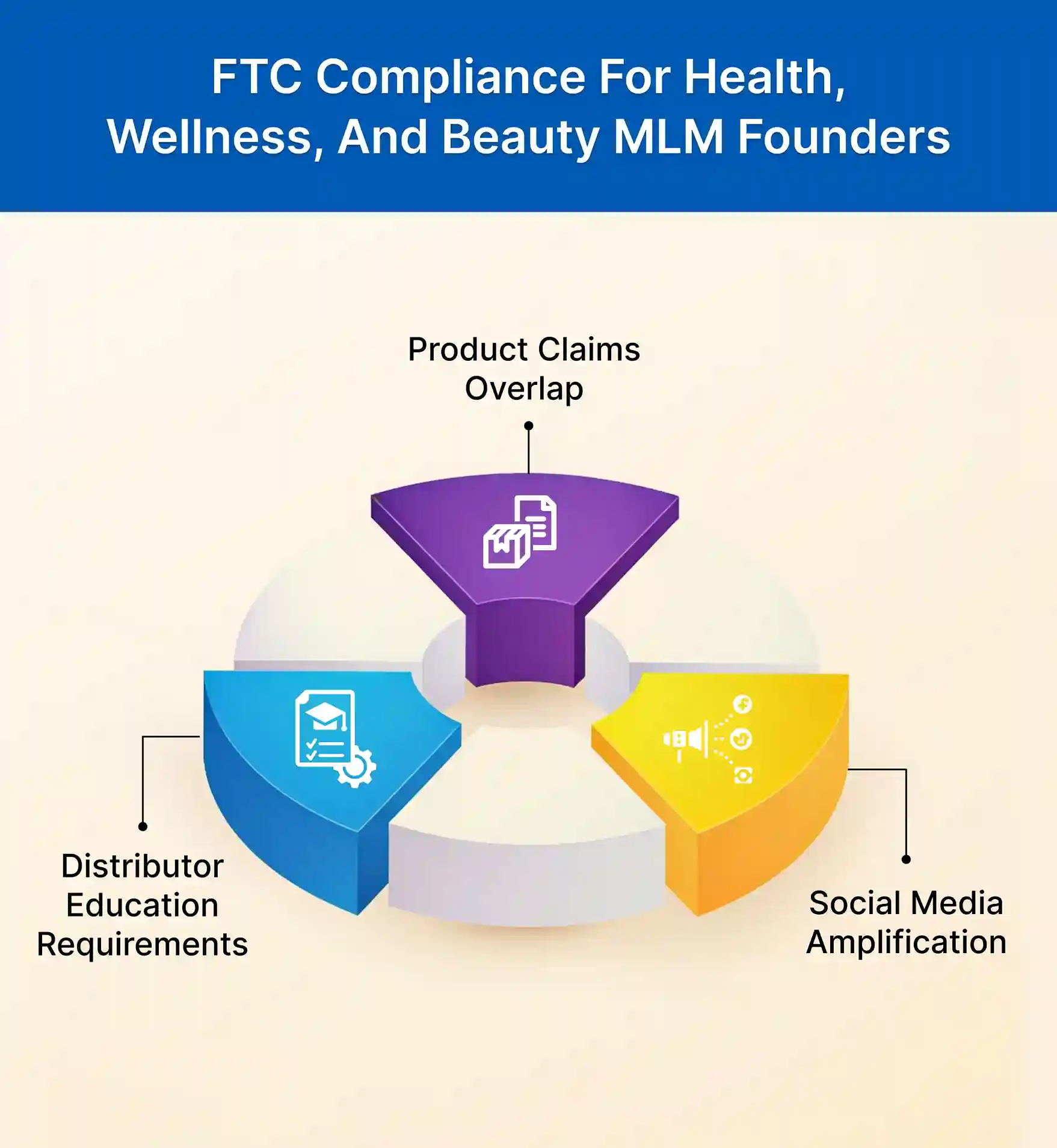
Product Claims Overlap: Health and wellness products carry a dual compliance burden. The FTC governs earnings and income claims. The FDA governs product claims. Your software must support separate approval workflows for marketing materials — one for income-related content, one for product-related content. Generic marketing template libraries that mix both are a compliance risk.
Social Media Amplification: Health and wellness MLMs disproportionately rely on social media for distributor recruitment and product marketing. The Before-and-After photo, the transformation story, the lifestyle post — these are the dominant content formats in the category. They are also the formats the FTC examines most carefully for unsubstantiated claims. Your software needs content monitoring tools that understand the nuance between a genuine product testimonial and an implied income claim embedded in a wellness transformation story.
Distributor Education Requirements: The FTC expects MLM companies to actively train distributors on compliant claims — not just distribute a policy document. Software platforms that integrate training modules, track distributor completion of compliance training, and block distribution access until training is acknowledged provide a documented compliance posture that standalone policy documents cannot match.
MLM Software Comparison: FTC Compliance Features
Not all MLM software platforms are equal on FTC compliance. This comparison evaluates the major platforms against the compliance features USA founders need.
| Platform | Auto IDS | R2R Tracking | Earnings Claim Controls | 3-Yr Audit Trail | 1099 Reporting | CCPA Ready |
|---|---|---|---|---|---|---|
| Global MLM Software | ✓ | ✓ | ✓ | ✓ | ✓ | ✓ |
| ByDesign Technologies | Partial | Partial | Partial | ✓ | ✓ | ✓ |
| Exigo | Partial | ✓ | Limited | ✓ | ✓ | ✓ |
| Infinite MLM Software | Partial | Partial | Not native | Partial | Partial | Partial |
| Epixel MLM Software | Partial | Partial | Not native | Partial | Not listed | Partial |
| Generic Asian/EU Platforms | ✗ | ✗ | ✗ | ✗ | ✗ | ✗ |
Note: This comparison is based on publicly available feature documentation and demo findings as of July 2026. Platform capabilities may vary by configuration and pricing tier. Always verify US compliance features directly with your vendor before signing. R2R = Retail-to-Recruit.

Shabana is a dynamic writer and strategist with profound expertise in network marketing. Her sharp analysis of industry trends and exceptional ability to distill complex concepts into clear, actionable insights make her content invaluable for professionals at every level. Through her writing, she empowers readers to navigate the evolving landscape of relationship-driven sales with confidence and integrity. Blending data-driven strategies with human-centric principles, Shabana provides a unique perspective that helps businesses thrive while maintaining authentic connections.
Frequently Asked Questions
1. What happened in the April 2026 FTC MLM enforcement actions?
In April 2026, the FTC took action against Forever Living (operators permanently barred from deceptive earnings claims — at least 77% of participants earned nothing), Stormy Wellington of Farmasi (prohibited from misrepresenting income potential), and LifeWave distributors Steven and Gina Merritt (banned from deceptive income claims — 79% of active participants earned nothing in 2024). A $795 million judgment against IM Mastery Academy followed in May 2026.
2. What is an Income Disclosure Statement and does MLM software generate it?
An Income Disclosure Statement (IDS) is an annual report showing actual distributor earnings including the percentage who earned nothing. Quality FTC-compliant MLM software generates IDS reports automatically from live commission data, ensures the disclosure covers all participants including zero earners, uses median earnings rather than potentially misleading averages, and makes the disclosure available before enrollment. Global MLM Software generates IDS reports automatically as a standard feature.
3. What is the retail-to-recruit ratio and how does software track it?
The retail-to-recruit ratio measures what percentage of a distributor's income comes from selling to real customers versus recruiting new members. The FTC uses this to determine whether an MLM is a legitimate business or a pyramid scheme. FTC-compliant software tracks this ratio in real time per distributor, flags imbalances automatically, and generates exportable reports that demonstrate retail-focused activity for any FTC inquiry.
4. What MLM software features are required for FTC compliance in the USA?
Required features include: automated IDS generation, retail-to-recruit monitoring, audit trail reporting with 3-year retention, KYC and AML verification, 1099 tax reporting, CCPA-compliant data handling, compliant income claim templates, distributor social media content monitoring, and enrollment cooling-off period enforcement. Many platforms built for non-US markets lack several of these capabilities. Always verify US-specific compliance features with your vendor before signing.
5. How much does FTC-compliant MLM software cost?
FTC-compliant MLM software pricing ranges from approximately $500 per month for startup configurations to $2,000–$5,000+ per month for enterprise deployments. Cost depends on network size, compensation plan complexity, compliance module depth, and customisation. Global MLM Software offers flexible pricing — book a demo at globalmlmsolution.com for a custom quote based on your product, market, and launch timeline.
6. Do I need MLM compliance software if I am just starting out?
Yes — especially in the USA. The FTC holds companies responsible for distributor earnings claims from day one. Building compliance into your software at launch is far less expensive than legal fees, FTC fines, or a business shutdown. The Forever Living case involved a company that had operated for years before facing permanent restrictions. Starting compliant is the only reliable strategy.
7. What is a pyramid scheme and how does MLM software prevent it?
A pyramid scheme generates revenue primarily from recruitment fees rather than product sales to real consumers — and the FTC classifies this as fraud. MLM compliance software prevents pyramid scheme classification by enforcing retail sales requirements per distributor, monitoring recruitment-versus-sales ratios in real time, blocking qualifying purchases that benefit only recruiters, and generating retail sales evidence that demonstrates genuine consumer demand. For a deeper comparison of the two models, see MLM vs. pyramid scheme: understanding the legal difference.
8. Can distributors make income claims on social media and how do I control it?
Distributor social media income claims create direct FTC liability for the MLM company — proven in the Stormy Wellington and Farmasi case where the FTC targeted the individual distributor and required her to notify her entire downline network. FTC-compliant MLM software addresses this through approved marketing template libraries, AI-driven content scanning for high-risk language, automated disclaimer insertion, and escalation workflows when non-compliant content is detected.
9. What is the FTC Earnings Claim Rule for MLM companies?
The FTC's proposed Earnings Claim Rule (January 2025) would require MLM companies to prohibit deceptive income claims, maintain written substantiation for any earnings claim, provide substantiation to any interested consumer upon request, and retain records for three years. As of July 2026, the rule remains proposed but the FTC is actively enforcing existing laws and took multiple significant enforcement actions in the first half of 2026 alone.
Next Steps: Build Your FTC-Compliant MLM Business
The 2026 FTC enforcement wave has changed the risk calculation for every MLM founder in the United States. Running your network on spreadsheets, manual IDS documents, and policy-based compliance is no longer an acceptable operating standard. The FTC has demonstrated — through four major enforcement actions in 90 days — that it is willing to target both companies and individual distributors, impose permanent operating restrictions, and pursue nine-figure judgments.
The good news is that FTC-compliant MLM software exists, it is accessible to founders at every stage from startup to enterprise, and it does the compliance work automatically so you can focus on building your product, recruiting distributors, and growing your network.
Global MLM Software is ready to show you exactly how our compliance architecture works for your specific compensation plan, product category, and target market — in a free 30-minute demo with no commitment required.
Talk to an MLM Compliance Expert
Book a free demo to see GMGO's FTC compliance features in action on your specific plan and market. Or schedule a consultation to discuss your compliance strategy before you launch.
Book Free Demo Schedule Consultation