Quick Answer — What is the #1 MLM trend in 2026? AI-powered personalization is the single highest-impact shift in multi-level marketing 2026. It changes how owners score leads, retain distributors, and personalise customer journeys at scale. Herbalife's reported deployment of Salesforce Einstein gave distributors real-time customer insight and is one of the most cited examples of AI applied at the field level in direct selling.
| Trend | Business Impact | Implementation Difficulty | Best For | Brand Example |
|---|---|---|---|---|
| MLM Software | 🔧 High — cuts commission errors and operational overhead | 🟢 Low | All operators | Global MLM Solution |
| AI & Automation | ⚡ Very High — personalises at scale, reduces manual workload | 🟡 Medium | Mid-to-large operators | Herbalife |
| Social Selling & Influencer Marketing | 📣 High — builds trust and drives product discovery organically | 🟢 Low | Product-led MLMs | Oriflame, Mary Kay |
| Mobile-First | 📱 High — directly affects distributor conversion and retention | 🟡 Medium | All operators | Nu Skin |
| Global Expansion | 🌍 High — opens new distributor and customer markets | 🔴 High | Scaling operators | Amway, Tupperware |
| Subscription Model | 💰 Very High — increases LTV, AOV, and reduces churn | 🟡 Medium | Product MLMs | Scentsy, Forever Living |
| Virtual Events & Live Commerce | 🎥 Medium — lowers event cost, increases reach | 🟢 Low | All operators | Plexus Worldwide |
| Compliance & Ethical Selling | ⚖️ Critical — protects against FTC action and reputational risk | 🟡 Medium | All operators | Arbonne, Primerica |
| Blockchain & Transparency | 🔗 Medium — strengthens supply chain trust and payment integrity | 🔴 High | Supply-chain-heavy MLMs | Herbalife |
| Hybrid MLM / Affiliate Models | 🤝 High — widens participation and attracts part-time sellers | 🟡 Medium | New market entrants | Young Living |
| Sustainability & ESG | 🌱 Medium — strengthens brand loyalty and product positioning | 🟡 Medium | Wellness & beauty MLMs | Arbonne |
The rules of running an MLM business have changed. Distributors expect a set of digital tools when they join an MLM company. Regulators expect transparency in operations, and customers expect personalization. In all this, the MLM business owners who have built their businesses on spreadsheets and manual operations are feeling the heat.
Over the years, the direct sales and MLM industry has undergone a digital evolution. It is changing the way MLM businesses operate today. This guide covers the 11 MLM trends for 2026 that are reshaping network marketing in the present and will continue to define it in the near future.
Key takeaways
AI-powered personalization helps MLM businesses improve lead conversion, distributor retention, and customer engagement through predictive analytics, automation, and intelligent recommendations.
Modern MLM software reduces commission calculation errors by 80–90% within 90 days while improving operational efficiency, reporting accuracy, and scalability.
Social selling, influencer partnerships, and short-form video content are attracting younger distributors and expanding organic reach beyond traditional recruitment methods.
Virtual events and live commerce generate stronger engagement than traditional selling approaches, with live shopping conversion rates reaching 9–30% in some cases.
Compliance-focused strategies, transparent compensation structures, and verified customer transactions help MLM companies build trust and reduce regulatory risks.
Top MLM Industry Trends to Watch in 2026
Trend 1: Modern MLM Software is the Operational Backbone of Direct Selling
MLM software is a purpose-built platform that automates the core operations of a direct selling business. It takes care of commission calculation, distributor management, compensation plan execution, inventory tracking, and compliance reporting.
Modern MLM management platforms are equipped with:
E-commerce and marketplace integration — distributor storefronts connected directly to inventory and order management
MLM automation tools — onboarding, rank advancement, and payout processing
Real-time reporting — network health, distributor performance, and revenue visibility
SaaS and API integrations — CRM, accounting, and marketing tools without custom development
Compensation plan flexibility — Choose the right MLM plan for your business, including binary, unilevel, matrix, and hybrid structures, without rebuilding the system.
MLM businesses that still rely on manual commission calculations are more prone to commission errors, which can damage distributor relationships. Global MLM Solution has first-hand experience in this. One thing we have observed across 400+ implementations is that software adoption cuts commission errors by 80-90% within 90 days of deployment.
Trend 2: AI in MLM 2026 is Changing How Network Marketing Businesses Operate
Artificial intelligence (AI) in MLM is the application of machine learning, predictive analytics, and generative AI (GenAI). It helps automate decisions across the distributor and customer lifecycle. It is the highest-impact operational shift available to MLM business owners in 2026.
Some common AI functions in MLM Businesses include:
AI lead scoring — machine learning ranks prospects by conversion likelihood. How AI lead scoring works in MLM
Personalisation at scale — LLMs and CRM integrations generate tailored recommendations and follow-up sequences based on individual customer behaviour
Predictive analytics for retention — AI flags distributors showing early churn signals before they go inactive
Data-driven recruiting — predictive models identify which distributor profiles convert and retain
MLM automation tools — rank qualification, bonus triggers, and payouts without manual input
AI chatbots — CRM-integrated virtual assistants handle distributor queries and onboarding around the clock
Agentic AI: The next step is agentic AI, which does not just suggest actions but executes them. Follow-up sequences, reorders, and support escalations are handled automatically, without distributor input.
While most major MLM companies are adopting AI, Herbalife is a clear example. The company deployed Salesforce Einstein to unify distributor data and deliver personalized, next-best-action recommendations directly within its distributor mobile app, per the official Herbalife press release.
Trend 3: Social Selling and Influencer Marketing Are Redefining MLM Distribution
Social selling means using social media platforms to promote and sell products directly to customers. MLM brands are combining this with influencer marketing to drive product recommendations, demonstrations, and UGC at scale.
This shift has given rise to the creator economy, where individuals monetise audiences through content and influence rather than traditional selling. According to HubSpot and Statista, over 70% Gen Z and Millennials discover products through short-form video platforms like TikTok and Instagram reels.
MLM companies are adopting these strategies to become social-first businesses:
Distributor social storefronts — replicated sites connected to inventory and orders
UGC programmes — structured incentives for distributor-produced content
Influencer partnerships — external creator collaborations beyond the existing network
Social engagement rate tracking — content performance measured at the distributor level
Short-form video — TikTok, Instagram Reels, and YouTube Shorts as organic distribution channels for product content and recruitment
Distributor-as-creator — distributors functioning as creator economy content creators, generating organic reach that paid advertising cannot replicate
Mary Kay is a direct example. The company launched its "Miss Conceptions" short-form content series on TikTok and Instagram in 2025 and introduced Mary Kay Interactive — enabling consultants to sell directly via TikTok and Instagram, per the official Mary Kay press release. In 2024, nearly 30% of new Independent Beauty Consultants were under 35.
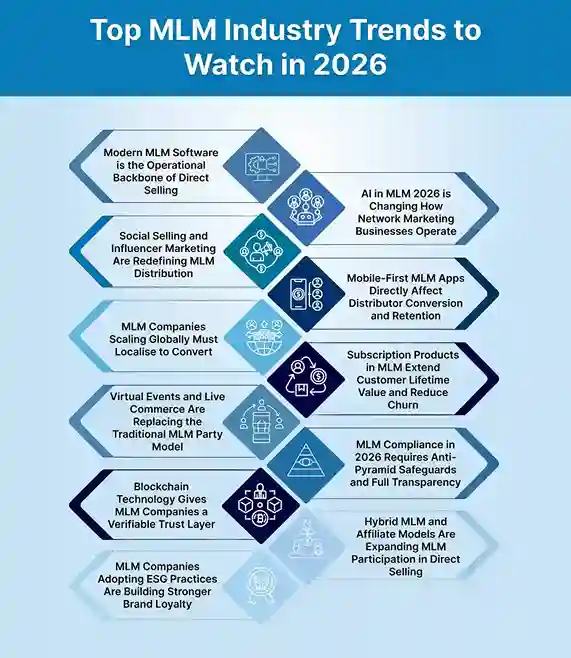
Trend 4: Mobile-First MLM Apps Directly Affect Distributor Conversion and Retention
Distributors run their businesses from their phones. If it is not mobile-accessible, it creates friction that costs retention.
Approximately 1.65 billion people globally shop via mobile as of 2025, according to Statista. This number is large enough for business owners to switch to a functional mobile-first MLM infrastructure that covers:
A distributor app with commission tracking and downline visibility
Mobile-optimized replicated storefronts
Push notifications for rank updates and reorder reminders
In-app onboarding
Mobile conversion rate tracking at the distributor level.
Nu Skin's Vera platform is a documented example. It is a mobile app that gives distributors AI-powered customer insights and business management tools directly from their phones.
Trend 5: MLM Companies Scaling Globally Must Localise to Convert
Global expansion is one of the highest-reward and highest-risk moves an MLM operator can make. But just expanding market presence alone does not produce results. Many MLM companies discover that strategies working in the US often fail in Asian or Middle Eastern markets without localization.
Localisation in MLM means adapting compensation structures, distributor onboarding, product positioning, and marketing to the cultural and regulatory context of each market. Without it, companies often struggle with customer trust, distributor engagement, and regulatory compliance.
Amway is the clearest example of localisation done right. China accounted for 46.2% of Amway's total sales in 2022, making it the company's single largest market. The company has made this possible through deep local leadership investment and market-specific product development, per Amway's company overview report.
Trend 6: Subscription Products in MLM Extend Customer Lifetime Value and Reduce Churn
Subscription -based MLM model drives recurring orders. In fact, McKinsey research shows that subscription businesses achieve 70% higher customer lifetime value (CLV) than transactional models.
For MLM operators, the model stabilises revenue and increases average order value (AOV). It also reduces distributor attrition by giving sellers a consistent customer base rather than hunting for new orders every cycle.
Tracking the right metrics determines whether a subscription model is working or quietly losing money
Retention rate
AOV (Average order value)
LTV / CLV (Lifetime Value / Customer Lifetime Value)
Distributor churn rate
Scentsy's Whiff Box, a monthly curated fragrance box, is a perfect subscription model in direct selling. Forever Living's autoship programme applies the same logic to health and wellness supplements.
Trend 7: Virtual Events and Live Commerce Are Replacing the Traditional MLM Party Model
The in-person product party is no longer the default format in direct selling. Virtual events and live commerce have replaced it in the post-COVID era. And it is trending because it works. According to Marketing LTB, live shopping conversion rates run at 9–30%, which is much higher than 2–3% for standard e-commerce.
MLM brands are tapping into this across three formats:
Virtual events — product demos and recruitment webinars on platforms like Zoom, Hopin, and StreamYard, without physical event overhead
Live commerce — scheduled, host-led selling events with real-time Q&A and direct ordering
Augmented reality (AR) — virtual product try-ons replacing physical samples in beauty and wellness categories.
While virtual events are largely used by party plan companies, others have adopted it with equal success. Plexus Worldwide, a supplements brand, has moved distributor training and launches to virtual formats to increase the effectiveness of the programs and reach a geographically wider audience.
Modern software solutions like the party plan MLM software provide an end-to-end solution that connects virtual event activity directly to orders, distributor records, and commission tracking.
Trend 8: MLM Compliance in 2026 Requires Anti-Pyramid Safeguards and Full Transparency
Compliance in MLM covers compensation plan structure, income claim disclosures, distributor conduct, and retail sales requirements. In 2026, it is not optional anymore, as regulators are paying closer attention than ever.
The FTC's April 2024 Business Guidance on Multi-Level Marketing clarified how it evaluates whether an MLM operates as an illegal pyramid scheme. The biggest deciding factor is whether compensation is driven by recruitment or genuine retail sales.
To keep your MLM business compliance-focused, make sure you have:
Anti-pyramid safeguards — Compensation plans should clearly be structured around retail sales, not recruitment rewards
Income disclosure statements (IDS) — transparent, legally required disclosures of typical distributor earnings
Compensation plan transparency — clear documentation of how every rank, bonus, and override is calculated
Recruiter-to-active ratio — The number of recruiters in the network should be lower than the number of actively selling distributors.
Consumer protection protocols — Retail customer purchases should be documented at the transaction level
KYC (know your customer) — Identity verification needs to be built into distributor onboarding
The most regulated industry is the financial MLM sector. However, companies like Primerica continue to set regulatory benchmarks by publishing detailed income disclosures and compensation plan documentation.
Furthermore, Arbonne's B.E.S.T. programme builds ethical selling standards into distributor training. It covers income claim guidelines and FTC Endorsement Guide requirements.
However, the foundation for compliance starts with the MLM software. Global MLM Solution's compliance modules have evolved across 7 years of FTC and DSA guideline changes to keep MLM businesses compliant across changing regulations over time.
Trend 9: Blockchain Technology Gives MLM Companies a Verifiable Trust Layer
Blockchain in MLM is a decentralised digital ledger that records transactions, distributor activity, and supply chain events in a tamper-proof, publicly verifiable format. It removes the need for third-party verification at multiple points in the business.
The global blockchain for supply chain market was valued at $1.17 billion in 2024 and is projected to reach $33.25 billion by 2033, per ScienceSoft.
Where blockchain adds value in MLM operations:
Smart contracts — self-executing agreements that automate commission payouts, rank advancements, and bonus triggers when predefined conditions are met — removing manual intervention and dispute risk
Supply chain transparency — every product movement recorded on-chain, giving distributors and customers verifiable proof of sourcing and authenticity
Crypto payments — distributor compensation processed in digital currency, enabling faster cross-border payouts without banking intermediaries
KYC (know your customer) — identity verification embedded into distributor onboarding via blockchain-based credential systems
Herbalife has applied blockchain to its supply chain to verify product authenticity and sourcing. This directly addresses the counterfeit product risks that affect high-value wellness and nutrition MLM categories.
Trend 10: Hybrid MLM and Affiliate Models Are Expanding MLM Participation in Direct Selling
A hybrid MLM affiliate model combines traditional multi-level marketing structure with affiliate marketing. This allows participants to earn through direct product sales and referrals without the obligation to build a downline. It introduces light participation tiers that lower the barrier to entry for part-time sellers and content creators.
MLM companies are embracing this shift mainly under regulatory pressure and changing distributor expectations. Several major direct selling companies have already switched:
BODi (formerly Beachbody) shut down its MLM structure on January 1, 2025, and replaced it with a single-level affiliate programme offering up to 50% commission, per Affiverse.
Rodan + Fields is another well-known MLM brand that shifted to an affiliate model in September 2024. Now it offers 30% commissions without downline requirements
Young Living introduced "Wyld Notes", a hybrid programme where participants can earn under both MLM and affiliate compensation structures simultaneously
USANA also launched an affiliate programme in January 2025, offering 15–20% commissions without product purchase requirements
While BODi and R+F have completely switched to affiliate models, Young Living and USANA continue to use it as an additional participation layer on top of their regular MLM opportunity.
Managing both structures includes tracking affiliate referrals, downline commissions, and retail sales. Separate systems can create operational complexity, but Global MLM Solution's hybrid MLM software handles all of it from a single platform.
Trend 11: MLM Companies Adopting ESG Practices Are Building Stronger Brand Loyalty
ESG stands for Environmental, Social, and Governance. It covers how a direct selling business handles its environmental impact, its social responsibility, and its governance standards.
And it is not just a regulatory checkbox anymore. Consumer demand is making ESG a priority. PwC's 2024 Voice of the Consumer Survey found that consumers are willing to pay approximately 9.7% more for sustainably produced or sourced goods. And per the Thomson Reuters 2024 State of Corporate ESG Report, 71% of C-suite leaders consider ESG investment a competitive advantage.
In direct selling, ESG adoption includes:
Ethical sourcing — verifiable supply chain practices, particularly relevant for health and wellness supplements and beauty and personal care product categories
Sustainable packaging — reduced plastic, recyclable materials, carbon-neutral shipping options
Carbon footprint reporting — transparent disclosure of emissions across the supply chain
B Corp certification — a third-party governance standard increasingly used by wellness MLMs as a trust signal
Emerging product categories — CBD and hemp MLM products and pet wellness are two fast-growing categories where ethical sourcing and clean ingredient standards strongly influence purchasing decisions
Arbonne's B.E.S.T. programme covers ESG alongside ethical selling. It also holds B Corp certification and publishes annual sustainability reporting. Amway has committed to net-zero emissions by 2040. It embeds sustainability into its product development and sourcing standards across all major markets.
Top Metrics MLM Leaders Watch in 2026
| Metric | What It Measures | Where It Applies |
|---|---|---|
| Retention Rate | Subscriber and distributor activity at 90, 180, and 365 days | Trend 6 — Subscription Model |
| AOV (Average Order Value) | Revenue per transaction across customer and distributor orders | Trend 6 — Subscription Model |
| LTV / CLV (Customer Lifetime Value) | Total revenue generated per customer across the full relationship | Trend 6 — Subscription Model |
| Mobile Conversion Rate | Storefront performance at distributor level on mobile devices | Trend 4 — Mobile-First |
| Social Engagement Rate | Content performance across distributor and influencer networks | Trend 3 — Social Selling |
| Recruiter-to-Active Ratio | Ratio of recruiting activity to active selling distributors | Trend 8 — Compliance |
The 11 MLM Trends 2026 Point to One Direction
Direct selling businesses in the digital era are operating smarter. Software eliminates commission errors. AI provides data to recruit and retain the right people. Compliance frameworks protect the business before regulators arrive. Subscription models stabilise revenue. And new participation structures are widening who can sell.
However, the common thread across all 11 network marketing trends 2026 is the infrastructure. Entrepreneurs who have the right software foundation can adopt any of these shifts without rebuilding from scratch.
Global MLM Solution has delivered software, compliance frameworks, and AI-powered tools to 400+ direct selling businesses across every major market. If you are ready to build a scalable infrastructure your business needs, explore our MLM software solutions and integrations designed for every MLM business.
Shabana is a dynamic writer and strategist with profound expertise in network marketing. Her sharp analysis of industry trends and exceptional ability to distill complex concepts into clear, actionable insights make her content invaluable for professionals at every level. Through her writing, she empowers readers to navigate the evolving landscape of relationship-driven sales with confidence and integrity. Blending data-driven strategies with human-centric principles, Shabana provides a unique perspective that helps businesses thrive while maintaining authentic connections.
FAQs
1. What are the top MLM trends for 2026?
The top 11 MLM trends for 2026 are:
MLM Software automation
AI-powered personalization
Social selling and influencer marketing
Mobile-first distributor tools
Global expansion with localization
Subscription-based product models
Virtual events and short-form video
Compliance and anti-pyramid safeguards
Blockchain transparency
Hybrid MLM/affiliate models
Sustainability and ESG practices.
2. Why Are MLM Companies Investing in AI in 2026?
AI helps MLM companies automate recruiting, improve distributor retention, personalise customer journeys, and reduce operational workload.
3. What are the best automation tools for MLM distributors?
The best MLM automation tool for distributors handles onboarding, rank advancement, reorder reminders, commission calculations, and lead nurturing from a single platform.
4. How do creators and influencers fit into MLM?
Creators and influencers work as external partners who drive product discovery through paid content. They also work as distributors to build audiences around the products they sell.
5. What metrics should MLM leaders track in 2026?
MLM leaders should track metrics like retention rate, AOV, LTV/CLV, mobile conversion rate, social engagement rate, and recruiter-to-active ratio.
6. Are MLMs adapting sustainability practices?
Yes. MLM companies in health, wellness, and beauty are embedding ESG standards into product sourcing, packaging, and corporate reporting. Per PwC's 2024 Voice of the Consumer Survey, consumers will pay 9.7% more for sustainably produced goods.