An MLM network is made up of hundreds and thousands of distributors, all connected through a single structure called the genealogy tree. Every distributor's position in that tree is defined by two relationships: one who sponsored them into the network, and the ones they have recruited. That's where the terms upline and downline come from.
The upline and downline both play a distinct role in how an MLM network grows, how commissions flow, and how the business scales. They also overlap with each other. That overlap is what makes multi-level marketing unique as a business model. The same person can be both a revenue source for those above them and an income earner from those below.
This means that every MLM distributor in a network, except the one at the very top, holds both positions simultaneously. They are a downline to everyone above them and an upline to everyone they recruit. This guide breaks down their definitions, functions, and responsibilities in detail.
Key Takeaways
-
MLM distributors usually hold dual roles simultaneously, earning as an upline from recruited members while contributing sales volume as a downline.
-
Sustainable MLM growth depends more on retaining active distributors across deeper levels than rapidly recruiting large numbers of inactive members.
-
Clear onboarding, structured training, documented responsibilities, and consistent communication significantly reduce distributor attrition and strengthen long-term network performance.
-
Commission earnings are typically calculated from personal sales and group volume, making active downline development essential for higher override income.
-
Regularly auditing genealogy structures, rank requirements, retention rates, and compliance policies helps prevent disputes, legal risks, and network instability.
Upline
In MLM, an upline refers to the distributor who recruited a member into the network, along with every distributor above them in the sponsorship chain. All of them earn a percentage of commissions from that member's sales activity.
Downline
In MLM, a downline refers to every distributor recruited by a member, along with every distributor those recruits bring in across all levels beneath them. Their combined sales activity contributes to the commissions earned by everyone above them in the chain.
This Article Contains:
What is an Upline in Network Marketing?
In network marketing, an upline is not just one person. It is an entire chain of distributors extending from a member's direct sponsor all the way to the top of the network.
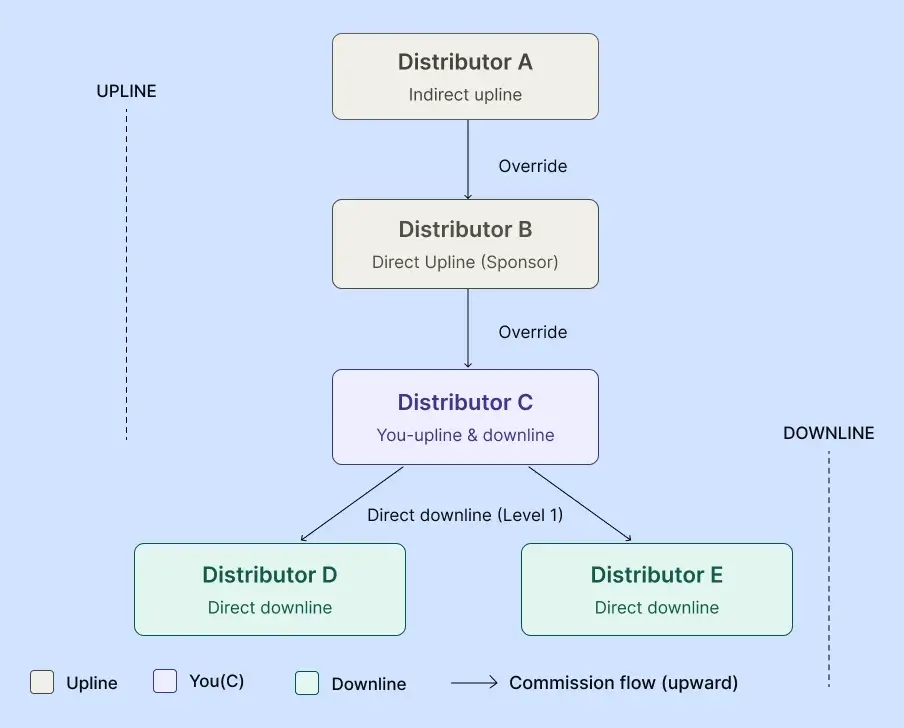
The distributor who personally enrolls a new member is called the direct upline or sponsor. All distributors above the sponsor, at every level up, form the indirect upline. Together, they make up the complete upline of any given distributor.
A distributor's upline is established at the moment of enrollment. It is recorded permanently in the company's genealogy tree, which is a visual representation of the entire upline-downline network. It does not change unless the company has a specific policy that permits sponsor transfers.
What is Downline in Network Marketing?
A downline is everyone placed beneath a distributor in the network. It includes every person they have personally recruited, and every person those recruits have recruited, across all levels. The distributors a member personally enrolls are their direct downline or Level 1. Everyone beyond that forms their indirect downline, or Level 2, Level 3, Level 4, and deeper.
A downline’s depth is based on the compensation plan of the MLM company. It is a structure that defines how uplines earn from downline sales. Most MLM companies set a depth cap based on their plan type, which will be explained in sections below.
The combined sales volume generated by a distributor's entire downline is called their group volume (GV). This metric is commonly used to calculate commissions, determine rank advancement, and measure team performance.
How Do Commissions Flow Through Upline and Downline?
In MLM, commissions flow upward, starting from the distributor who made the sale, through each upline, level by level.
The flow is usually determined by an MLM company’s genealogy tree, which is a chain that connects every upline and downline into a network. Every sale made anywhere in the network triggers a chain of earnings that moves upward in the tree. It starts from the distributor who made the sale, through their upline, level-by-level.
Let’s take a simple example: Distributor A recruits B, who recruits C. This is how commissions flow upward in this network:
When C makes a sale, C earns a direct commission.
B earns an override commission — a percentage of C's sales volume — because C is in B's downline.
A earns an override on both B and C's volume, because both sit in A's downline.
This is how every sale in an MLM network generates earnings across multiple levels simultaneously. The deeper the network, the more volume flows upward — and the more every upline benefits from an active, selling downline.
One important distinction is that not all of this volume is equal. Each distributor's personal volume (PV) counts only their own sales. Their group volume (GV) is the combined sales of their entire downline. Upline override commissions are calculated on GV — which is why building a deep, active downline directly impacts what every upline earns.
Lastly, the depth of commissions depends on the compensation plan that your MLM company runs.
| Plan | How deep commissions travel |
|---|---|
| Unilevel | Fixed depth — typically 5–7 levels |
| Binary | Unlimited depth — weekly earnings cap may apply |
| Matrix | Fixed by grid size — e.g., 3×5 = 5 levels |
Upline and Downline Responsibilities
Upline and downline responsibilities are too often treated as cultural expectations. They are assumed, communicated informally, and never enforced. As a company owner, these must be defined in writing and built into your distributor agreement before you scale.
| Upline | Downline | |
|---|---|---|
| Onboarding | Personally walk every direct recruit through the getting-started process | Complete onboarding within the timeframe set by company policy |
| Training | Provide access to training materials, product knowledge, and selling systems | Attend training sessions and apply what is taught |
| Marketing support | Share approved marketing resources and tools with the team | Use only company-approved marketing materials |
| Communication | Maintain consistent contact with direct downline — especially in the first 90 days | Respond to upline communication and flag issues early |
| Accountability | Monitor downline activity and intervene when volume or recruitment stalls | Hit personal volume minimums every qualification period |
| Rank & title | Uplines typically hold higher ranks — advancing in rank can trigger breakaway upline status, changing who earns overrides on whom | Focus on rank advancement — moving up reduces compression risk for the uplines above them |
| Compression | Stay active to avoid being skipped — an inactive upline loses their override to the next active distributor above them | Stay active to protect their upline's override earnings — inactivity triggers compression and removes them from the commission chain |
| Team building | Support and participate in team events, calls, and recognition | Participate in team events and support peers in the network |
| Growth | Develop leaders within the downline — not just recruits | Build their own downline when they are ready to move up |
Downline Recruitment and Retention
Once the upline and downline members have a clear understanding of what their roles entail, the next priority is ensuring that the network grows and stays active at every level.
Recruitment may get a distributor into your network, but retention is what makes them stay. Here, depth matters more than width. A wide network with very few active distributors is more likely to collapse.
If your top distributors fail to develop leaders beneath them, your network will entirely depend on a small group of high performers. When they leave, the entire network collapses. But active distributors at levels 2,3 and beyond will create a sustainable network.
Distributors may leave for a number of reasons. You must identify and address them before they compound into attrition. This table will help you identify some common causes of distributor dropouts and how to address them effectively.
Common Causes of Distributor Dropouts
Even the strongest MLM network can experience distributor dropouts if common operational issues are not addressed early. Understanding these challenges helps company owners build better support systems, improve retention, and create a more stable downline structure.
| Cause | What it signals to a company owner | How to address it |
|---|---|---|
| Poor onboarding | The upline did not follow through — or your onboarding system is too informal to enforce | Build a structured onboarding checklist into your distributor agreement — make it a requirement, not a suggestion |
| Weak upline support | No training, no communication, no resources — new distributors disengage within the first 90 days | Implement an LMS so training is delivered systematically and does not depend on upline effort alone |
| Unclear expectations | Distributors do not know what they are supposed to do, sell, or earn — ambiguity drives dropout | Document role expectations, PV minimums, and rank requirements clearly in your policies and welcome materials |
| Slow income | Compensation plan takes too long to pay out at early ranks — motivation stalls before momentum builds | Review your early rank thresholds — ensure a new distributor can earn a meaningful commission within their first 30 days |
| Upline conflict | Crossline poaching, placement disputes, or commission complaints erode trust faster than any other factor | Use mlm downline tracking software to flag placement disputes and track genealogy changes in real time. |
Common Upline Downline Conflicts
While most retention problems can be fixed with better systems, upline-downline conflicts can be harder to track and repair.
Conflicts most commonly arise from gaps in company policy. The most effective way to prevent and resolve them is through a written policy. Every conflict type below should have a corresponding clause in your distributor agreement before your network scales.
| Conflict | What causes it | How to prevent it |
|---|---|---|
| Crossline poaching | A distributor recruits or solicits members from another distributor's downline — cutting across genealogy lines | Define crossline solicitation explicitly in your distributor agreement and specify the penalty for violation |
| Spillover disputes | In Binary and Matrix plans, auto-placed recruits land in unexpected positions — creating resentment over who benefits | Explain spillover rules clearly in the compensation plan before distributors join the network. |
| Placement favoritism | Company or upline places stronger recruits under favored distributors — others feel disadvantaged | Set a written placement policy that applies uniformly across all distributors with no exceptions |
| Commission complaints | Distributors dispute override calculations, matching bonus triggers, or compression outcomes | Publish a clear commission calculation guide and give distributors access to real-time earnings data through your MLM software |
Legal and Compliance Considerations
As regulations around MLMs tighten, the upline-downline structure is the 1st thing regulators look at when assessing your MLM’s legality. It is important to understand where the legal boundaries sit, and you must design your compensation plan to stay well within them.
1. The 1st and foremost rule that the Federal Trade Commission (FTC) requires is that income in an MLM network should come from product sales to end consumers and not from recruitment. If your compensation plan overrides primarily on recruitment activity rather than retail sales, you are legally exposed. This applies even if your plan looks legitimate on paper.
The clearest test to determine this is to check if every override, matching bonus, and depth-based commission in your plan is traceable back to actual sales volume. This is the line that separates a legitimate MLM from a pyramid scheme in the eyes of the FTC.
2. Another thing to focus on is how your compression is working. When an inactive distributor is skipped, and their commissions roll upward, it can make your network look more sales-driven than it actually is. If too many overrides are moving up through compression rather than genuine sales activity, auditors may flag it. Have your compression logic reviewed by legal counsel before your plan goes live.
3. Finally, publish a transparent income disclosure statement that reflects actual distributor earnings across all ranks. FTC income disclosure data consistently shows that most distributors earn little to nothing. Consider the Direct Selling Association (DSA) certification, too. It certifies MLM companies that meet ethical compensation standards. This signals to regulators and recruits that your structure has been independently reviewed.
How to Audit Your Upline-Downline Structure?
Legal compliance aside, your upline-downline structure needs to be structurally sound, too. Your plan can pass regulatory review and still have design flaws that can silently drain volume, accelerate attrition, and reward wrong behavior. Before your network scales, run these six checks against your current structure:
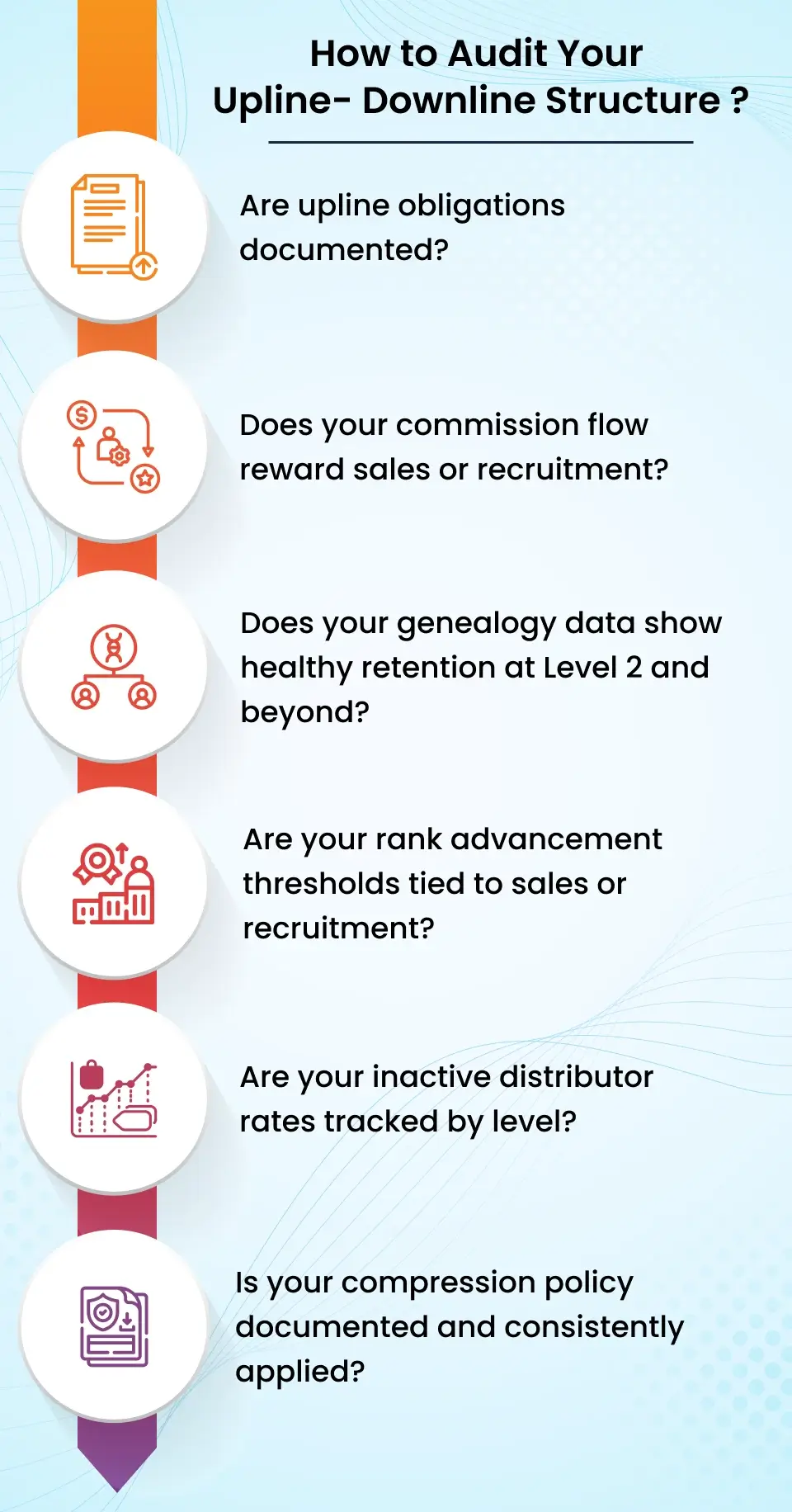
Are upline obligations documented? Review your distributor agreement. Does it have onboarding, training, and support expectations written in, or assumed? If upline responsibilities exist only as cultural norms, they will not survive leadership turnover.
Does your commission flow reward sales or recruitment? Pull your top earners' income breakdown. What percentage comes from override commissions vs. retail sales volume? If the majority of upline income traces back to recruitment activity, your structure is legally exposed.
Does your genealogy data show healthy retention at Level 2 and beyond? Use your MLM software to check active distributor rates at Level 2, 3, and 4. If activity drops sharply below Level 1, your network is wide but not deep. One upline exit can collapse volume.
Are your rank advancement thresholds tied to sales or recruitment? If distributors advance primarily by recruiting rather than selling, the pyramid scheme risk is baked into your rank system, and not just your commission structure.
Are your inactive distributor rates tracked by level? Check where the distribution attrition happens the most. Is it level 1, 2, or 3? This will tell you exactly where your onboarding or support system is failing and where intervention is needed most.
Is your compression policy documented and consistently applied? Undocumented compression logic is one of the most common sources of commission disputes and auditor flags. If your compression rules exist only in your software settings and not in your distributor agreement, that is a gap worth closing immediately.
Closing Thoughts
The upline-downline relationship in your network shouldn't be treated as a structural feature only. It is a mechanism through which volume flows, and commissions are earned. Getting it right means documenting responsibilities, designing for retention, staying within legal boundaries, and auditing your structure before problems surface. Every decision covered in this guide has a direct impact on the long-term health of your network.
If you are building or restructuring an MLM company, Global MLM Solution provides the software infrastructure to manage every layer of your upline–downline network, from genealogy tracking to commission automation. See how other MLM companies have built sustainable networks in our case studies, or book a free demo to see the platform in action.

Shabana is a dynamic writer and strategist with profound expertise in network marketing. Her sharp analysis of industry trends and exceptional ability to distill complex concepts into clear, actionable insights make her content invaluable for professionals at every level. Through her writing, she empowers readers to navigate the evolving landscape of relationship-driven sales with confidence and integrity. Blending data-driven strategies with human-centric principles, Shabana provides a unique perspective that helps businesses thrive while maintaining authentic connections.
FAQs
1. What is upline and downline?
Upline and downline describe a distributor's position in an MLM network relative to everyone else in the sponsorship chain. The upline is the distributor who recruited them, along with every distributor above in the chain. The downline is every distributor they have recruited, along with every distributor those recruits bring in beneath them.
2. What is the meaning of upline?
An upline in MLM is the distributor who personally enrolled a member into the network, along with every distributor above them in the sponsorship chain. All of them earn a percentage of commissions from that member's sales activity.
3. What is the meaning of downline?
A downline in MLM is every distributor a member has recruited, along with every distributor those recruits bring in across all levels beneath them.
4. What is a direct upline?
A direct upline is the specific individual who personally enrolled a distributor into the network, also called the sponsor. They are the immediate upline and the first person in the chain to earn an override on that distributor's sales.
5. What is downline in network marketing?
A downline in network marketing is the entire network of distributors recruited beneath a member. It includes direct recruits at Level 1 and every distributor they recruit at Level 2, 3, and beyond. Their combined sales volume contributes to the member group's volume and determines their commission eligibility.