Genuine AI in MLM software means three things: predictive analytics that flag at-risk distributors before they go inactive, commission anomaly detection that catches errors before payouts run, and adaptive onboarding that adjusts to each distributor's real behavior. Automated emails, scheduled reports, and threshold-based alerts are automation, not AI — regardless of what a vendor's marketing calls them. Ask any vendor to demonstrate each feature live before signing.
Global MLM Software has configured AI-powered direct selling platforms for founders across the USA and seven other markets. In July 2026, Direct Selling News published "Everybody Gets a Promotion: The New Rules of AI Leadership" as its Q3 cover editorial — the most authoritative signal the industry has produced that AI is now a standard expectation in direct selling platform evaluation, not a differentiating feature to be impressed by.
The challenge for founders evaluating software: every MLM platform vendor claims AI features in 2026. Most mean automated email sequences, basic dashboard charts, or rule-based alerts that fire when a distributor hits a threshold. That is not AI. It is automation with an AI label. This guide separates the two, names the five AI capabilities that actually affect distributor retention and commission accuracy, and provides the exact demo questions that expose whether a vendor's AI claim is genuine.
What AI in MLM Software Actually Means — And What Vendors Just Call AI
Genuine AI has three markers: it predicts events before they happen (not after a threshold is crossed), it learns from historical data (not fixed rules), and it improves with more data over time. The fastest way to test a vendor's claim: ask what training dataset powers their predictive features and how the model generates risk scores. A specific, The technical answer means real AI. A vague answer means automation.
Genuine AI in a direct selling platform means three specific capabilities. The distinction from automation is not semantic — it determines whether the platform can actually improve distributor retention and protect commission accuracy, or whether it is offering better-looking automation.
Predictive Analytics
Algorithms that identify which distributors are likely to go inactive before they do — based on order frequency, login patterns, team engagement, and rank progression velocity. The system surfaces risk scores, not just activity reports.
❌ Not AI: "Last login more than 30 days ago" alert
Anomaly Detection
Real-time identification of commission calculation errors, unusual volume patterns, and payout amounts that fall outside expected ranges for a given rank and volume — flagged before payouts process, not after complaints arrive.
❌ Not AI: "Commission report shows totals" dashboard
Adaptive Sequencing
Onboarding and engagement sequences that adjust based on a new distributor's actual behaviour patterns in the first 30 days — not a fixed module sequence that every distributor receives identically regardless of activity.
❌ Not AI: "Day 1 email, Day 3 email, Day 7 email" sequence
The demo question that reveals the difference: Ask any vendor: "What is the training dataset for your predictive features, and how does the model generate risk scores?" A credible answer is specific and technical — it names data signals, model type, and retraining cadence. A vague answer ("our AI analyses your distributor data") is the answer. It means the feature is automation.
The 5 AI Features A Direct Selling Platform Must Have in 2026
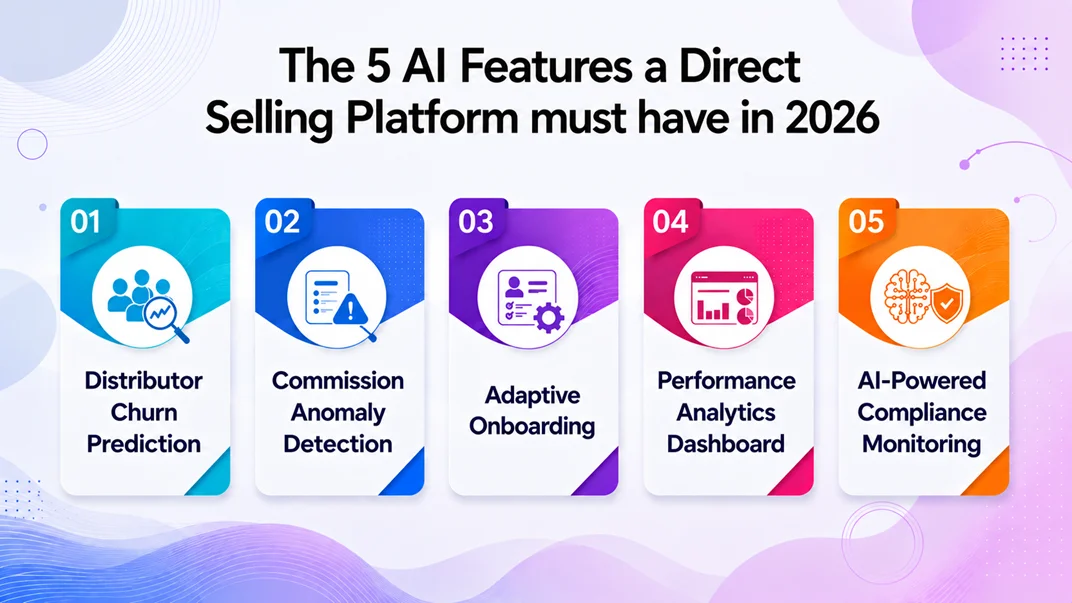
The 5 AI features every direct selling platform should have in 2026:
1. Distributor churn prediction,
2. Commission anomaly detection,
3. Adaptive onboarding,
4. a performance analytics dashboard
5. AI-powered compliance monitoring.
Each should be verifiable live in a demo — not described in a slide deck.
Direct Selling News named AI leadership the defining Q3 2026 operational theme for direct selling executives. These five features are the translation of that editorial priority into specific platform requirements. Every feature in this table includes the exact demo verification question — ask each one live, require a demonstration, and get written confirmation before signing.
| AI Feature | What It Actually Does | Demo Verification Question | What a Good Answer Looks Like |
|---|---|---|---|
| Distributor Churn Prediction | Identifies distributors statistically likely to go inactive within 30–90 days based on behavioural pattern analysis. Surfaces risk scores to upline leaders for proactive intervention before churn occurs. | Show me your current at-risk distributor list and explain which data signals generated each risk score. | A live, populated risk list with named data signals — order frequency drop, login decline, team engagement reduction. Scores are percentages, not categories. The list updates daily. |
| Commission Anomaly Detection | Flags unusual commission calculation patterns — edge case errors, volume spikes inconsistent with rank, payouts outside expected ranges — before the payout batch runs. Not a post-payout audit tool. | Trigger a test commission anomaly live during this demo and show me exactly what the admin sees. | A live demonstration where a deliberate error or unusual pattern is created and the system flags it with specific detail — which rule triggered, what the expected value was, what action is required. |
| Adaptive Onboarding | Adjusts the new distributor's first-30-day experience based on their actual activity signals rather than following a fixed sequence. High-activity distributors receive advanced content; low-activity distributors receive simplified first actions and a mentorship connection. | Show me two new distributor journeys that diverged because of different activity patterns in their first 7 days. | Two visible distributor profiles with different onboarding paths taken — demonstrating that the platform read their activity and served different sequences, not that both received the same modules. |
| Performance Analytics Dashboard | Identifies which specific distributor behaviours — sharing frequency, customer acquisition rate, mentorship activity, product use — statistically correlate with long-term retention and high volume in this company's network. | Show me which behaviours your platform identifies as the strongest predictors of 12-month distributor retention in a network like mine. | A specific behaviour correlation report — not generic best practices, but data from actual distributor cohorts showing which activities predict retention vs. churn in that platform's dataset. |
| AI-Powered Compliance Monitoring | Tracks retail-to-recruit ratios in real time, scans distributor social content for unapproved income claims, and automates Income Disclosure Statement generation from actual earnings data — not manually curated figures. | Generate a live IDS report and show me the real-time retail-to-recruit ratio dashboard for a test company. | A live IDS generated from the platform's earnings data and a retail-to-recruit dashboard that updates as transactions occur — not a static report that runs on a weekly schedule. |
Verify All 5 AI Features Live — Free 30-Minute Demo
Bring this table to every vendor demo. We walk through all 5 features live, configured to your specific model, and confirm each one in writing before you sign anything.
Book Your Free DemoHow AI-powered churn prediction works in practice
Distributor churn prediction is the AI feature with the most direct impact on network revenue. The practical value is simple: a distributor who goes inactive has already made the decision to leave. An intervention at that point is expensive, low-probability, and disruptive. A prediction 45 days earlier — when the behavioural signals are present but the decision has not yet been made — is actionable.
The model trains on historical distributor behaviour across the platform's dataset. It identifies the combination of signals that, in the past, preceded distributor churn: a specific pattern of order frequency reduction, combined with a decline in login activity, combined with reduced team engagement. When a current distributor's behaviour matches that pattern, the system generates a risk score and surfaces the distributor to their upline leader or company admin.
The Intervention Window: In well-configured churn prediction systems, the gap between the earliest detectable risk signal and actual churn is typically 30 to 90 days. That window is the period in which a leader-initiated conversation, a personalised product offer, or a community re-engagement event can reverse the trajectory. A risk score without a clear intervention workflow is data without value — the platform must surface the risk to the right person with a recommended action.
What separates genuine churn prediction from a standard inactivity alert: a basic alert fires when a threshold is crossed — "this distributor has not placed an order in 30 days." Churn prediction fires before the threshold is crossed — "based on this distributor's declining trajectory compared to the historical pattern of distributors who went inactive, their probability of churn in the next 45 days is, for example, 74% — an illustrative figure; actual risk percentages depend on each platform's model and historical data." The first is reactive. The second is predictive. The demo question is the test: if a vendor cannot show you a live risk list with percentage scores and named data signals, they have an alert system, not a prediction model.
Commission Anomaly Detection — What it is and What To Ask in a Demo
Commission calculation in a multi-level compensation plan is mathematically complex. Binary trees, unilevel depth limits, rank qualification thresholds, breakaway legs, matching bonuses, generation overrides — each combination creates edge cases that straightforward calculation engines eventually handle incorrectly at scale. Commission errors identified after a payout run create distributor trust damage that is disproportionately expensive to resolve: correcting a $200 error in a distributor's payout requires a conversation that costs far more than $200 in relationship capital.
AI-powered commission anomaly detection identifies unusual patterns in the calculation before the payout batch runs. Specifically: edge case errors where the compensation plan logic produces an unexpected result, volume spikes in a distributor's downline that are inconsistent with their historical pattern (which may indicate self-purchasing or volume manipulation), payout amounts that fall outside the expected range for a distributor's rank and volume, and rank qualification patterns that deviate from what distributors at similar stages have historically produced.
The pre-payout distinction: A commission audit tool that reviews payouts after they have processed is not anomaly detection — it is reconciliation. The value of anomaly detection is specifically that it flags issues before distribution, not after. In a demo, the verification question is not "show me a commission report" — it is "trigger a deliberate calculation error and show me how the system flags it before the payout runs."
How to Evaluate AI Features Before DSU Fall 2026 — October 6
DSU Fall 2026 is October 6–8 at The Westin Galleria in Dallas, Texas. It is the premier direct selling company leadership education event of Q4 2026 — attended by founders and executives making platform decisions before year-end. The practical implication: founders who arrive at DSU with their platform's AI features verified are in a different position than founders who arrive with open platform questions. One group is ready to decide. The other group is still in evaluation. The six steps below are the evaluation framework to complete before October 6.
Request live demonstrations only
For every AI feature — no descriptions, no screenshots, no slide decks. A live demo where the feature is triggered in real time in the platform you are evaluating. If a vendor cannot demonstrate a feature live, it is not operational in their platform regardless of what the marketing materials say.
Request the at-risk distributor list live
For churn prediction: ask to see the current at-risk distributor list in a live account — not a mock or a template. Ask which data signals generated each risk score. A credible answer names specific signals: "this distributor's order frequency dropped by 60% over 3 weeks while their team's growth rate slowed by 40% — the combination matches our historical churn precursor pattern."
Trigger a commission anomaly live
For commission anomaly detection: ask the vendor to create a deliberate calculation error or unusual volume pattern during the demo and show you how the system flags it. What does the admin see? What action is prompted? How much lead time before the payout batch runs?
See two diverged onboarding journeys
For adaptive onboarding: ask to see two new distributor profiles — one who was active in their first 7 days and one who was not — and show the different content sequences they received. If both distributors received identical sequences regardless of their activity, the onboarding is fixed, not adaptive.
Generate a live IDS and retail-to-recruit dashboard
For compliance monitoring: request a live Income Disclosure Statement generated from the platform's earnings data and a real-time retail-to-recruit ratio dashboard. Ask how frequently both update. A static weekly report is not AI-powered compliance monitoring — it is scheduled reporting.
Ask for training data volume and retraining cadence
Ask: "What is the training dataset for your churn prediction model, and when was it last retrained?" Platforms with fewer than 12 months of training data at meaningful scale will have low-accuracy predictions. A credible answer gives a specific data volume and a retraining schedule. An answer of "our AI learns continuously from your data" describes a marketing claim, not a model architecture.
DSU Fall 2026 Is 43 Days Away
Founders who arrive at DSU with their platform's AI features verified arrive as decision-makers. Those who arrive with open platform questions arrive as prospects. Complete your AI evaluation before October 6.
Book a Demo Before October 6AI vs. Automation — The Difference That Matters for Platform Decisions
The distinction between AI and automation is the most practically important concept for a founder evaluating MLM software in 2026 — it determines what the platform can actually do for distributor retention — and whether the additional cost of an AI-positioned platform is justified.
Standard Automation
Follows rules defined by humans. Responds to events that have already happened. Accuracy is limited by the rules someone wrote.
Fires when a threshold is crossed: "30 days no login → send email"
Requires manual rule creation for every scenario
Cannot identify patterns humans did not define
Consistent but rigid — the same trigger produces the same response
Does not improve with more data
Genuine AI
Learns patterns from historical data. Predicts events before they occur. Improves as more data becomes available.
Predicts before a threshold: "74% churn probability in 45 days"
Discovers patterns humans would not identify manually
Identifies the specific combination of signals that precedes churn
Adaptive — different inputs produce different outputs based on learned patterns
Becomes more accurate with more training data
The practical test: a platform that describes "AI" as automated email sequences, scheduled reports, or threshold-based alerts is delivering automation. The marketing language may say AI. The underlying technology is rule-based. The demo question that reveals the difference: "What is the training dataset for your predictive features, and how does the model generate risk scores?" A vendor with genuine AI can answer this question specifically. A vendor with automation cannot — because there is no model and no dataset.
The cost consideration: AI-powered platforms typically cost 20–40% more than standard automation platforms at equivalent distributor volumes. The cost difference is justified when the churn prediction and anomaly detection features are genuinely operational — because a 10% improvement in 90-day distributor retention across a network of 1,000 distributors retains 100 additional active distributors per cohort. At any realistic commission rate, that retention impact far exceeds the additional platform cost.
AI and FTC compliance — what AI-powered monitoring looks like in 2026
The DSA's hiring of Lee Lonsberry as Senior Director of Government Relations in August 2026 signals an intensifying regulatory engagement posture heading into 2027. Direct Selling Day on the Hill — September 23, 2026 in Washington DC — will address FTC enforcement priorities, income claim regulation, and independent contractor classification. For software buyers: FTC compliance tools are increasingly a non-negotiable platform requirement, not a premium add-on.
AI-powered compliance monitoring addresses three specific FTC exposure areas that manual monitoring cannot handle at scale:
Retail-to-recruit ratio monitoring — the FTC's primary test for whether a direct selling company generates genuine retail sales or operates primarily as a recruitment mechanism. AI tracks this ratio in real time across every distributor in the network, not in weekly batch reports that reflect last week's posture rather than today's.
Income claim monitoring — automated scanning of distributor social content for claims that exceed the company's approved income disclosure. At scale, no compliance team can manually monitor the social activity of 500 distributors. AI does it continuously.
IDS generation and accuracy — automated Income Disclosure Statement generation that reflects actual distributor earnings distribution rather than manually curated figures. The FTC has cited misleading IDS presentations in enforcement actions. AI-generated IDS statements that pull directly from platform earnings data eliminate manual curation bias.
For the full FTC compliance software guide — including the 7-point compliance checklist and the specific platform features that satisfy FTC safe harbour standards — see FTC-Compliant MLM Software: What USA Founders Need in 2026.
📋 Free: AI MLM Platform Evaluation Scorecard 2026
25 verification criteria across 5 categories — AI core features, data infrastructure, demo verification, FTC compliance, and implementation support. Score every vendor. Sign only when they reach 45 out of 50. Global MLM Software scores 50/50.
Download Free ScorecardFAQ: AI-Powered MLM Software 2026
1. What does AI in MLM software actually mean — and what are vendors just calling AI?
AI in MLM software means three specific capabilities: predictive analytics that identify at-risk distributors before they go inactive, commission anomaly detection that flags calculation errors before payouts process, and adaptive onboarding that adjusts the new distributor experience based on early activity signals. Vendors who describe AI as automated email sequences, basic dashboards, or rule-based alerts are describing automation — not AI. The distinction matters because genuine AI requires data infrastructure that many platforms do not have. Demo question: "What is the training dataset for your predictive features, and how does the model generate risk scores?"
2. What are the 5 AI features a direct selling software platform must have in 2026?
The 5 AI features that directly affect distributor retention and revenue:
Distributor churn prediction — surfaces at-risk distributors 30–90 days before churn;
Commission anomaly detection — flags calculation errors before payout runs;
Automated onboarding adaptation — personalises the new distributor experience based on activity signals;
Performance analytics dashboard — identifies which behaviours predict retention;
AI-powered compliance monitoring — tracks retail-to-recruit ratios, income claims, and IDS accuracy in real time. Direct Selling News named AI leadership the defining Q3 2026 theme for direct selling executives.
3. How does AI-powered churn prediction work in MLM software?
Churn prediction trains on historical distributor behaviour — order frequency, login activity, team engagement, rank velocity — and identifies the combination of signals that precede churn in that platform's dataset. When a current distributor's behaviour matches the pattern, the system generates a risk score and surfaces the distributor to their upline leader. The intervention window is typically 30–90 days. Demo verification: ask to see a live at-risk distributor list with specific data signals behind each risk score. If the vendor cannot show this live, the feature is not operational.
4. What is AI-powered commission anomaly detection and why does it matter?
Commission anomaly detection identifies unusual patterns in calculations before payouts process — edge case errors, volume spikes inconsistent with rank, payouts outside expected ranges. The key is pre-payout detection: errors identified after distribution create distributor trust damage that is expensive to resolve. Demo verification: ask the vendor to trigger a deliberate test anomaly live and show what the admin sees. A post-payout audit tool is reconciliation, not anomaly detection.
5. How should a direct selling founder evaluate AI features before DSU Fall 2026?
Six steps: (1) Request live demonstrations only — no descriptions or screenshots; (2) See the at-risk distributor list live with named data signals; (3) Trigger a commission anomaly live; (4) See two diverged onboarding journeys based on activity patterns; (5) Generate a live IDS and retail-to-recruit dashboard; (6) Ask for training data volume and retraining cadence. DSU Fall 2026 is October 6–8. Founders who complete this evaluation before the event arrive as decision-makers, not prospects.
6. What is the difference between AI-powered MLM software and standard automation?
Automation follows rules — if a distributor has not logged in for 30 days, send an email. AI learns patterns — based on this distributor's activity profile compared to thousands of historical cases, they have a 74% probability of churning in 45 days. Automation requires humans to define every scenario. AI discovers patterns humans would not identify. A platform claiming AI that cannot generate predictions from historical data is delivering automation with an AI label. Test question: "What is the training dataset for your churn prediction model and when was it last retrained?"
7. Does AI in MLM software replace distributors or human leaders?
No. AI in direct selling software makes human leaders more effective — it identifies who needs attention so leaders can provide it. Churn prediction surfaces at-risk distributors to their upline leader. Performance analytics identifies which behaviours to teach and celebrate. Direct Selling News named its Q3 2026 AI Leadership cover "Everybody Gets a Promotion" — the framing was explicit: AI elevates human roles in a direct selling company; it does not replace them.
8. How does AI help with FTC compliance in direct selling software?
AI-powered compliance monitoring covers three FTC exposure areas: real-time retail-to-recruit ratio tracking (the FTC's primary legitimacy test), automated income claim monitoring across distributor social content, and IDS generation from actual earnings data. The DSA's hiring of Lee Lonsberry as Senior Director of Government Relations in August 2026 signals intensifying regulatory engagement. AI compliance tools are becoming a non-negotiable requirement for USA direct selling companies.
9. What is automated distributor onboarding adaptation in MLM software?
Adaptive onboarding adjusts the new distributor's first-30-day experience based on their actual activity signals — not a fixed module sequence. A distributor who completes all training in 48 hours receives advanced content and a faster path to their first sharing activity. A distributor who has not logged in after 7 days receives a simplified first action and a mentorship connection. Early activity is the strongest predictor of 90-day retention. Adaptive onboarding increases the proportion of distributors who complete a meaningful first action within 30 days.
10. How much does AI-powered MLM software cost compared to standard platforms?
AI-powered platforms typically cost 20–40% more than standard automation platforms at equivalent distributor volumes. The cost difference is outweighed by retention impact: a 10% improvement in 90-day retention across 1,000 distributors retains 100 additional active distributors per cohort — a revenue impact that exceeds the additional platform cost at any realistic commission rate. Global MLM Software provides a written cost breakdown scoped to your specific model and volume within 24 hours of a demo.
11. Can I add AI features to my existing MLM software, or do I need a new platform?
Whether AI can be added depends on the platform's data infrastructure. Genuine AI requires 12+ months of distributor activity data at scale, real-time data pipelines, and API infrastructure for surfacing predictions. Many traditional MLM platforms were built before these requirements were considered and cannot support AI without significant re-architecture. Ask your vendor: "What is your AI training data infrastructure and how are predictions generated?" A credible answer is specific and technical. A vague answer is the answer.
12. What does Global MLM Software's AI capability include?
Global MLM Software's AI features include distributor churn prediction with daily risk score updates, commission anomaly detection before every payout batch, adaptive onboarding that adjusts based on first-30-day activity, performance analytics identifying retention-predicting behaviours, and AI-powered compliance monitoring including real-time retail-to-recruit tracking and automated IDS generation. All USA configurations include FTC compliance tools as standard. Book a free 30-minute demo at globalmlmsolution.com/demo — every feature demonstrated live, written quote within 24 hours.