A social-first direct selling company gives every distributor a personal storefront link, cross-platform referral tracking, and real-time commissions from day one — not after a rank threshold. The software must support all of this natively, verified live in a demo, not described in a sales deck.
The direct selling industry spent years debating whether social media was a real distribution channel or a marketing supplement. That debate is over. Direct Selling News dedicated a full executive event — the Social Commerce Deep Dive on September 15, 2026 at Young Living Global Headquarters in Lehi, Utah — to how direct selling companies build and operationalise social-first models. The 5,500+ distributors who attended DSN's Social Media Day Field Edition earlier in 2026 confirmed the same thing from the field side: social selling is not a tactic. It is the primary mechanism through which growing direct selling companies recruit distributors and sell products.
For a founder launching a direct selling company in 2026, the question is no longer whether to build a social-first model. The question is how — and what software makes it possible.
This guide gives you both answers. Every section is practical. By the end you will know exactly what social commerce means for your company, what five software features your platform must have, how to set up your distributor social selling system, and how to verify that your platform supports it all before you sign anything.
DSN Social Commerce Deep Dive, Young Living HQ, Lehi Utah
Distributors at DSN Social Media Day Field Edition 2026
Social selling software features to verify in every platform demo
When every distributor must have their personal storefront active
Key Takeaways :
Make social selling part of the business model, not just the marketing strategy — Build your direct selling company around how modern customers discover, evaluate, purchase, and recommend products through social platforms.
Give distributors the tools to sell immediately — Personal storefronts, referral links, ready-to-use content, mobile access, and social-selling capabilities can reduce the friction between distributor onboarding and their first sale.
Turn content into a measurable revenue channel — Track referrals, customer activity, sales, and commissions so your company can identify which social activities are actually generating business.
Build community alongside technology — A social-first company needs more than software; distributors need ongoing engagement, training, recognition, and a sense of belonging to remain active.
Design compliance into every social-selling activity — Approved content, transparent income claims, transaction records, and proper customer-versus-recruitment tracking help the company scale without creating unnecessary compliance risks.
What Social Commerce Means for Direct Selling in 2026
Social commerce in direct selling enables MLM businesses to turn distributors’ social media networks into measurable sales channels by using trackable links or digital storefronts to monitor customer purchases, sales performance, and commissions.
In practice, this means three things are true simultaneously:
Every distributor has a personal digital storefront with a unique URL that they share in their social content and bio links.
Every click on that link — from Instagram, TikTok, YouTube, LinkedIn, or Facebook — is tracked back to the specific distributor who shared it.
Every resulting sale or enrollment generates an immediate commission that the distributor can see in real time.
This is different from simply encouraging distributors to post on social media. Traditional direct selling companies told distributors to "share on social" and hoped for the best. Social-first direct selling companies build the infrastructure that makes every social share a measurable, trackable, commissionable business action.
The distinction matters because it determines your software requirements. A company that treats social as a marketing channel needs social media management tools. A company that treats social as a distribution channel needs a fundamentally different platform — one that handles personal storefronts, referral tracking, content libraries, and real-time commission attribution from the day the first distributor joins.
Why September 15 matters: The DSN Social Commerce Deep Dive on September 15, 2026 is an executive-level event — company founders and leaders, not distributors, are the primary audience. If you are evaluating software for a social-first launch, this event represents the most concentrated gathering of social commerce expertise in the direct selling industry this year. Your platform decision should be made before, not after, that event.
How Direct Selling Distributors Sell Through Social Media in 2026
Social-first distributors use three mechanisms simultaneously. Understanding all three tells you exactly what your software must support.
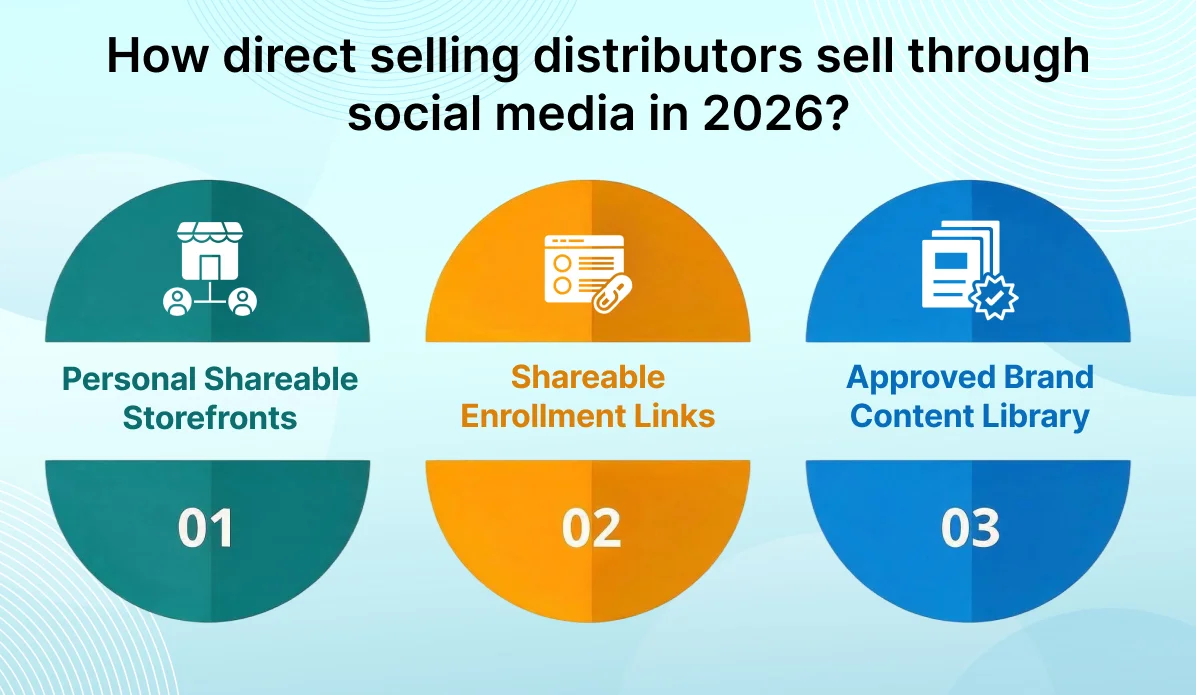
Personal Shareable Storefronts
Each distributor has a branded, replicated digital page with their name, a unique URL, and the company's full product catalogue. This URL goes in their Instagram bio, TikTok profile link, YouTube channel description, and LinkedIn profile. Every visitor arrives at a page that feels personal to that distributor — not a generic company website.
Shareable Enrollment Links
This is a unique link that allows a new customer or distributor to enroll, with their sign-up attributed to the specific distributor who shared it. Distributors drop this link into social posts, Stories, Reels, and DMs. The link works across every platform — attribution follows the click regardless of where it came from.
Approved Brand Content Library
This is a bank of brand-approved product images, video clips, lifestyle photos, and caption copy that distributors access from within the platform and share directly to their social accounts. This solves two problems simultaneously: it gives distributors who are not natural content creators the tools to post consistently, and it ensures all product claims in distributor social content stay within regulatory guidelines.
All three mechanisms must be available from the day a distributor joins — not after they reach a rank or volume threshold. A distributor whose first week in the company includes sharing their personal storefront link and posting their first brand content piece is a distributor who immediately understands how the business works. A distributor who has to "qualify" for their link first is a distributor whose early momentum stalls.
The day-one principle: In a social-first direct selling company, a new distributor's first experience after joining should produce their personal storefront link, their first shareable content piece, and their first commission-eligible action — all within five minutes of enrollment. Your software must support this. Any platform that requires a distributor to complete training modules, reach a sales threshold, or wait for manual approval before getting their social selling tools is not built for a social-first model.
The 5 Social Selling Software Features Every Platform Must Have
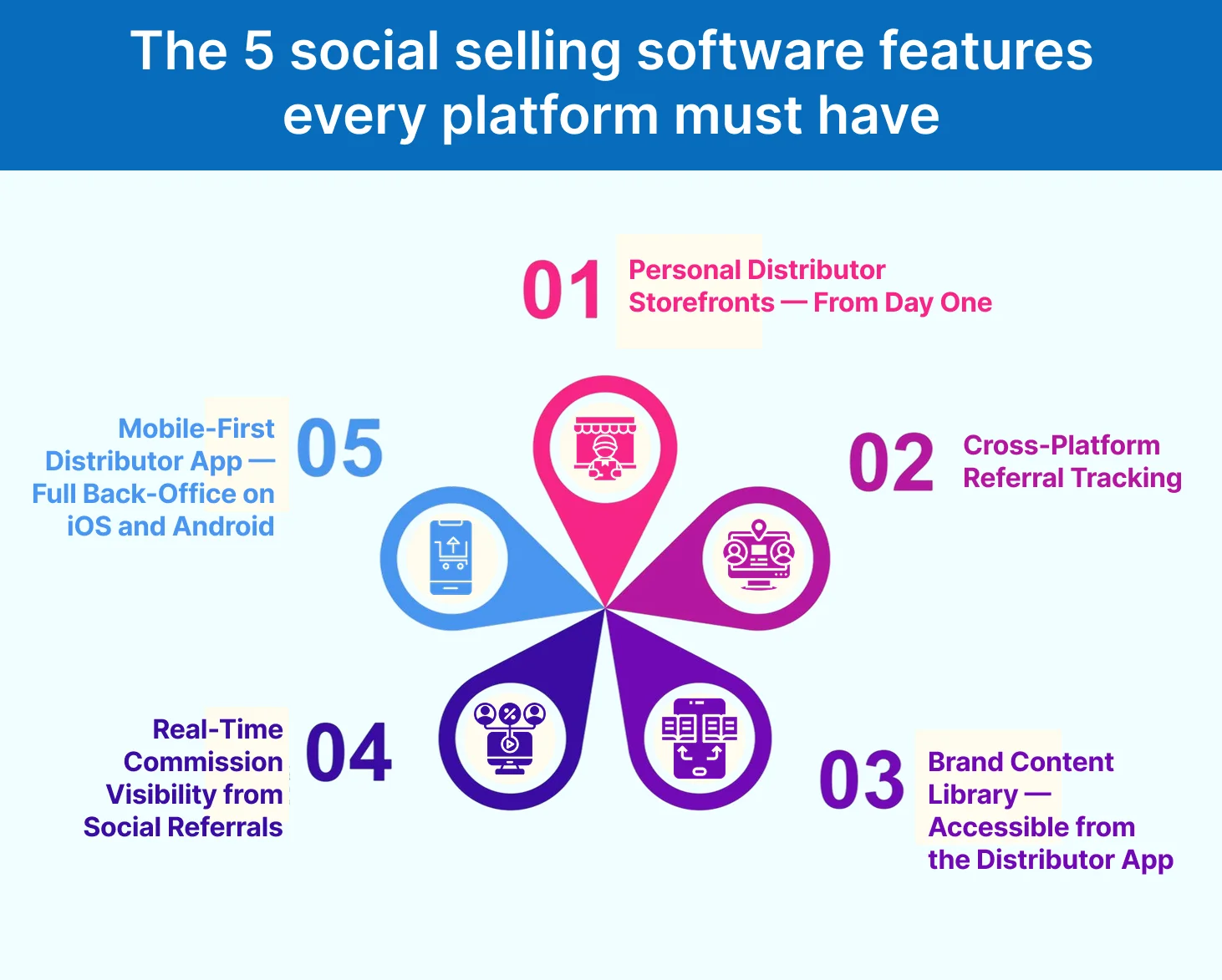
The five must-have software features are:
Day-one personal storefronts
Cross-platform referral tracking
An in-app brand content library
Real-time commission visibility
A full-function mobile app for iOS and Android.
Before you commit to any MLM software platform for a social-first direct selling launch, verify these five features live in a demo — not in a feature list, not in a sales conversation. In a live, working demonstration configured to your specific model.
| Feature | What It Does | Why It Matters for Social-First DS | How to Verify in Demo |
|---|---|---|---|
| Personal Distributor Storefronts — From Day One
Verify: no rank or volume threshold required
|
Each distributor gets a branded replicated website with their name, a unique URL, and the full product catalogue — active from the moment they enroll, before any rank or sales milestone. | A distributor who cannot share their personal link on day one cannot participate in social selling from day one. The storefront is the entire social selling infrastructure — without it, every other mechanism fails. | Ask to see a brand-new distributor account created live during the demo. Their personal storefront link should be active and shareable within 60 seconds of enrollment. If the vendor says "they need to qualify first" — this platform is not built for social-first. |
| Cross-Platform Referral Tracking
Verify: tracks Instagram, TikTok, YouTube, Facebook separately
|
Unique tracking parameters in each distributor's link capture the originating distributor ID regardless of which social platform the click came from. Attribution persists even if the customer browses multiple pages before purchasing. | Without accurate cross-platform referral tracking, distributors cannot prove their social content generates sales. When distributors cannot see the direct connection between their sharing activity and their commission earnings, they stop sharing. | Ask to simulate a purchase that originates from a social platform link. Confirm the originating distributor's dashboard shows the sale and commission in real time. Ask specifically: does attribution persist if the customer clicks, leaves, and returns later? |
| Brand Content Library — Accessible from the Distributor App
Verify: shareable directly to social platforms from within the app
|
A brand-managed bank of approved product images, video clips, lifestyle content, and caption templates. Distributors access this library from their phone and share content directly to their social accounts without leaving the platform. | It serves two functions simultaneously: it gives distributors who are not content creators the tools to post consistently, and it ensures all product and income claims in distributor social content are pre-approved and within FTC guidelines. The content library is also the compliance tool. | Ask to share a piece of content from the library directly to a social platform from within the distributor mobile app. The share should happen without the distributor leaving the app or manually downloading and re-uploading. If they have to download and re-upload — the integration is not native. |
| Real-Time Commission Visibility from Social Referrals
Verify: commission appears in distributor dashboard within seconds of sale
|
Every sale or enrollment that originates from a distributor's social link appears in their earnings dashboard in real time — not in a nightly batch report, not in a monthly statement. Immediate visibility, immediate reinforcement. | The feedback loop between sharing and earning is the primary motivation mechanic in a social-first model. A distributor who shares a post at 9pm and sees a commission notification by 9:05pm is a distributor who shares another post tomorrow. A distributor who sees their commission two days later in a report is a distributor who questions whether it worked at all. | Trigger a test sale from a social link during the demo. Ask the vendor to show the distributor dashboard updating in real time. Time it. If it takes more than 30 seconds — ask why. Nightly batch processing is a legacy architecture that breaks the social selling feedback loop. |
| Mobile-First Distributor App — Full Back-Office on iOS and Android
Verify: complete enrollment, check commissions, share content — all from the app
|
A native iOS and Android app that gives distributors full back-office functionality on their phone — not a mobile-optimised website, not a limited dashboard view. Enroll a new distributor, check commission earnings, share content, view team activity, manage personal details — all without opening a laptop. | Social selling happens on phones. A distributor who meets a potential recruit at an event and cannot enroll them on the spot from their phone loses that recruit. A distributor whose commission dashboard requires a laptop is a distributor who checks their earnings less often — and therefore feels less connected to the business. | Ask the vendor to complete a full new distributor enrollment using only the mobile app. No laptop, no desktop. The enrollment should produce the new distributor's storefront link within the app immediately upon completion. If any step requires switching to a desktop browser — the app is not truly mobile-first. |
Verify All 5 Social Selling Features in a Free 30-Minute Demo
We configure the platform live to your specific model — and show you a distributor's day-one experience, from enrollment to shareable storefront, in real time. Written quote within 24 hours.
Book Your Free Demo Schedule a ConsultationHow To Set Up A Social Selling System For Your Distributor Network
The five software features above are the technical infrastructure. A social selling system is what you build on top of that infrastructure — the processes, culture, and onboarding flow that make every distributor an effective social seller from day one.
A complete social selling system has four components.
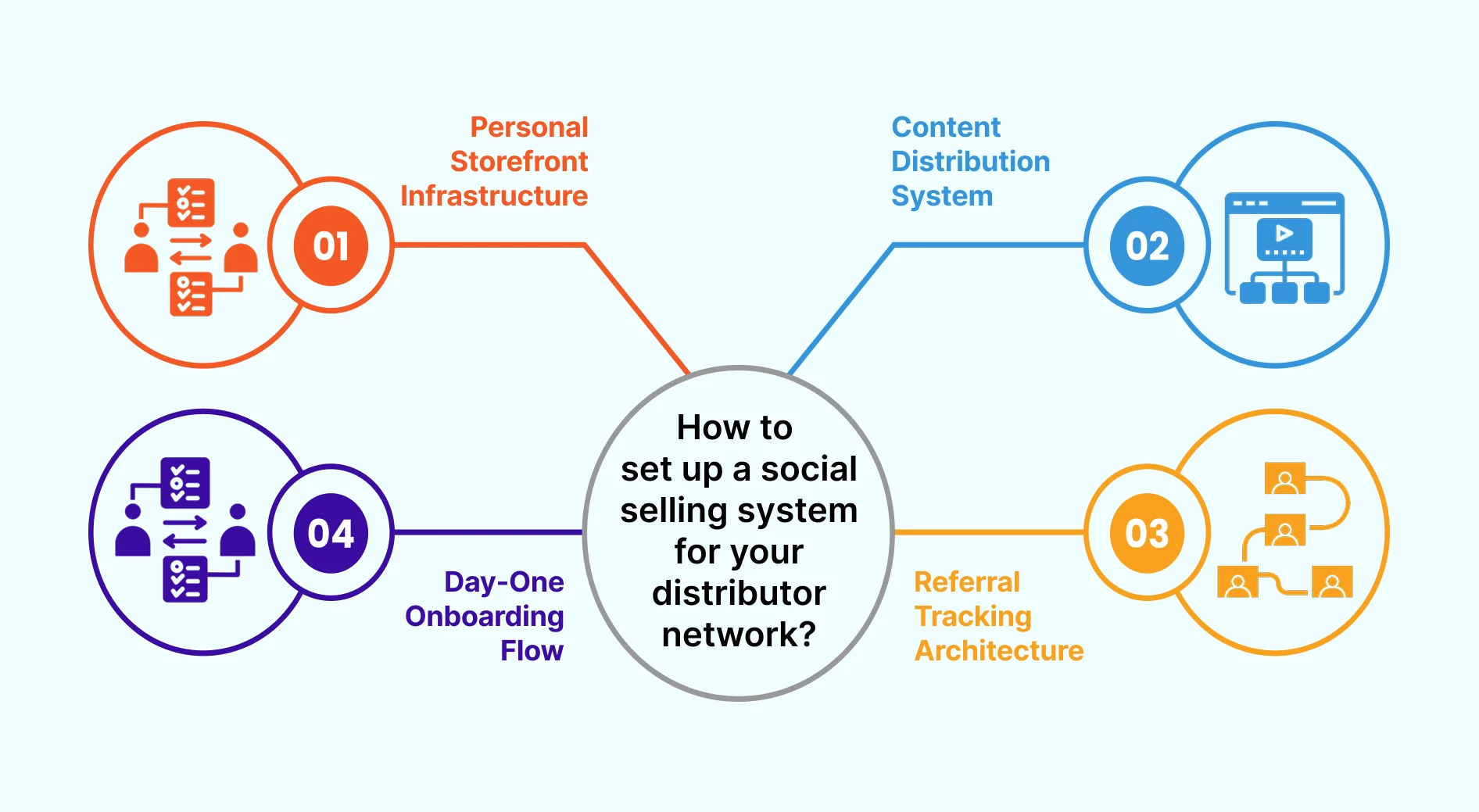
Component 1 — Personal Storefront Infrastructure
Every distributor's personal storefront link must be active, personalised, and shareable on the day they join. The link goes in their social bio immediately — not after training, not after qualification.
The onboarding flow should produce three things within the first five minutes of enrollment: a personal storefront link, a first piece of shareable brand content, and a notification showing how commissions are earned when that content generates a sale.
Component 2 — Content Distribution System
Your brand content library should launch with at least 30 pieces of ready-to-share content — product images, lifestyle photos, short video clips, and pre-written caption templates for different product benefits and use cases.
Update the library weekly with fresh content. Distributors who run out of things to share stop sharing. The content library is a recurring publishing commitment, not a one-time setup task.
Component 3 — Referral Tracking Architecture
Every distributor gets one master link and platform-specific variants for Instagram, TikTok, YouTube, and Facebook. The tracking must persist through browser sessions — if a customer clicks, leaves, and returns to purchase 48 hours later, the attribution must still be correct.
Review referral attribution data weekly in the first 90 days. Identify which platforms are generating the most sales for each distributor and coach accordingly.
Component 4 — Day-One Onboarding Flow
The social selling system lives or dies in the first week. Design an onboarding sequence that gets every new distributor their social selling tools active and their first post shared within 24 hours of joining.
Week 1 target: personal storefront link active and in social bio, first brand content piece shared, first personal product story drafted, first enrollment link sent to at least one contact.
Design Your Social Selling System Before Choosing Software
A consulting session reviews your social-first model, your distributor onboarding flow, and your content strategy before we configure any platform. The system design comes before the software selection.
Book a Free Consulting SessionSocial-First vs. Traditional Direct Selling — What Changes in your Software
If you are evaluating software for the first time, or switching from a traditional model to a social-first model, this comparison shows exactly which software capabilities you need beyond the standard MLM platform baseline.
| Capability | Traditional MLM Platform | Social-First Platform — Required |
|---|---|---|
| Distributor websites | Replicated website — often available after a rank or purchase threshold | Personal storefront — active from day one, no threshold |
| Referral tracking | Basic referral link — often tracks one platform only | Cross-platform tracking — Instagram, TikTok, YouTube, Facebook separately |
| Content distribution | None, or PDF resource library | In-app content library — shareable directly to social from within the distributor app |
| Commission visibility | Daily or weekly batch reports | Real-time — commission appears within seconds of sale |
| Mobile app | Mobile-optimised website or limited app | Full back-office on iOS and Android — complete enrollment from phone |
| Genealogy management | Full tree — required for both models | Full tree — required for both models |
| Commission engine | Multi-level commissions — standard | Hybrid — affiliate tier + MLM tier running simultaneously |
| Auto-ship / subscription | Often available — verify it is native, not a plugin | Native auto-ship — essential for product-first social selling models |
| FTC compliance tools | Often available as a paid add-on | Standard — IDS generation, retail monitoring, content claim tracking |
The gaps between traditional and social-first are not minor feature differences. They represent a fundamentally different architecture. A traditional platform built without social commerce in mind will require integration work, workarounds, and manual processes to support a social-first distributor network — and that friction shows up directly in distributor retention numbers.
Platform evaluation principle: When evaluating any MLM software vendor, every capability in the "social-first required" column above must be demonstrated live in a demo — not described verbally, not shown in a screenshot. Ask the vendor to perform each action during the session. The ones they cannot demonstrate are the ones they do not have.
How to Prepare For The DSN Social Commerce Deep Dive 2026
Upcoming Direct Selling Events — Q3/Q4 2026
The DSN Social Commerce Deep Dive on September 15, 2026 is an executive-level event at Young Living Global Headquarters in Lehi, Utah. Company founders and leaders — not distributors — are the primary audience. The event covers how direct selling companies build, operationalise, and scale social-first distribution models.
If you are attending, monitoring, or influenced by this event — your platform evaluation should be completed before September 15, not after. Three questions to answer before the event:
Does your current or planned platform give every distributor a personal storefront from day one — with no rank or volume threshold?
Does it track social referrals from Instagram, TikTok, YouTube, and Facebook back to the originating distributor accurately?
Does it include a brand content library that distributors can share directly from their phone without downloading and re-uploading?
If any answer is no — a demo before September 15 shows you exactly what a social-commerce-ready platform looks like. Book a free 30-minute demo here.
FTC Compliance For Social-First Direct Selling Companies
FTC compliance for a social-first MLM requires businesses to monitor distributor social media claims and ensure that income-related posts comply with applicable income-claim and disclosure requirements, alongside the company’s broader MLM compliance obligations.
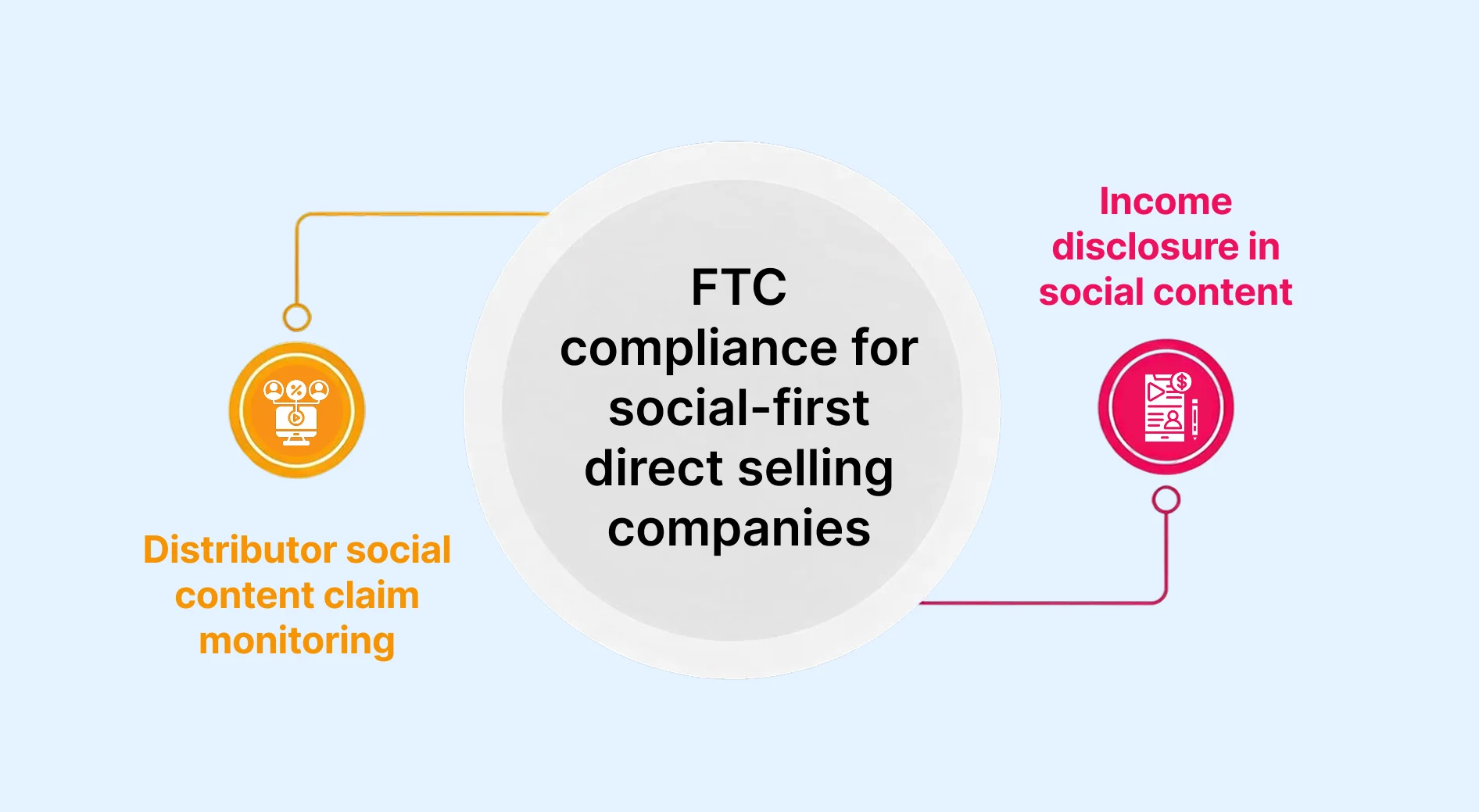
Distributor social content claim monitoring: When distributors share product content on social media, they may make claims about product results, health benefits, or income potential that create regulatory risk for the company. Your platform's content library is the first line of defence — it ensures distributors have access to pre-approved, compliant content and reduces the pressure to improvise claims in the field. Your distributor agreement should explicitly define which claims are permitted and prohibited in social content, and your compliance tools should flag patterns that suggest unapproved claims are being made at scale.
Income disclosure in social content: When distributors share income-related content on social media — including lifestyle posts that imply a direct selling income — the FTC's endorsement and testimonial guidelines require clear disclosure of the business relationship. The standard disclosure format ("I earn commissions as a [Company] independent distributor") must be clearly visible in the post, not buried in hashtags or comments. Your distributor code of conduct must address this explicitly, and your onboarding materials should include specific social media disclosure guidance.
-
IDS Generation — Standard in All USA Configurations
Income Disclosure Statements must be automatically generated by your platform, updated quarterly, and available for distributors to reference and share. Any distributor who makes an income claim in their social content must be able to link to the current IDS. This is treated as a baseline requirement across the industry, not an optional add-on — Global MLM Software, for example, includes IDS generation as standard in all USA configurations.
-
Retail-to-Recruit Monitoring — Active from Day One
Your platform must track the ratio of retail customer sales to distributor recruitment activity and flag when the balance shifts toward recruitment-dominant revenue. This is the primary signal the FTC uses to evaluate whether a direct selling company is operating as a legitimate retail business or as a pyramid scheme.
-
Three-Year Audit Trail — Every Transaction Logged
All distributor transactions, commission payments, and enrollment activity must be logged and accessible for regulatory review. Three years is the minimum retention period the FTC expects. Your platform must store this data natively — not require manual export and external storage.
Full FTC compliance guide: See the complete framework for FTC-compliant direct selling operations — including income claim policy templates, state registration requirements, and distributor code of conduct guidance — at globalmlmsolution.com/blog/ftc-compliant-mlm-software.
Shabana is a dynamic writer and strategist with profound expertise in network marketing. Her sharp analysis of industry trends and exceptional ability to distill complex concepts into clear, actionable insights make her content invaluable for professionals at every level. Through her writing, she empowers readers to navigate the evolving landscape of relationship-driven sales with confidence and integrity. Blending data-driven strategies with human-centric principles, Shabana provides a unique perspective that helps businesses thrive while maintaining authentic connections.
FAQ: Social Commerce in Direct Selling 2026
1. What is social commerce in direct selling?
Social commerce in direct selling is the integration of social media into the distributor recruitment, customer acquisition, and product selling process — so that every distributor's social presence becomes a fully functional sales channel. It means personal digital storefronts shared on social media, enrollment links tracked back to the originating distributor, and a commission system that attributes sales to social shares in real time. Direct Selling News dedicated its Social Commerce Deep Dive event on September 15, 2026 to how companies build this model.
2. How do direct selling distributors sell through social media in 2026?
Through three mechanisms: personal shareable storefronts with a unique URL in their social bio, shareable enrollment links embedded in social posts and Stories, and approved brand content shared directly from the company's content library. The software platform must support all three from day one — no rank threshold, no qualification period. A distributor who cannot share their personal link on their first day cannot participate in social selling on their first day.
3. What software features does a social-first direct selling company need?
Five features that any capable platform should be able to demonstrate: personal distributor storefronts from day one with no threshold, cross-platform referral tracking across Instagram, TikTok, YouTube, and Facebook, a brand content library shareable directly from within the distributor app, real-time commission visibility within seconds of a social referral sale, and a mobile-first distributor app with full back-office functionality on iOS and Android. A vendor who cannot show all five in practice does not have the platform a social-first launch requires.
4. How do I set up a social selling system for my direct selling company?
Four components: personal storefront infrastructure (every distributor's link active on day one), a content distribution system (at least 30 pieces of ready-to-share brand content at launch, updated weekly), a referral tracking architecture (cross-platform, session-persistent attribution), and a day-one onboarding flow that produces a shareable storefront link, first content piece, and first enrollment link within five minutes of joining.
5. What is a distributor personal storefront in MLM software?
A branded, replicated digital page unique to each distributor — with their name, a personalised URL, the full product catalogue, and an enrollment link that attributes purchases to that distributor. In a social-first company, this URL lives in a distributor's Instagram bio, TikTok profile link, YouTube channel description, and every social post they share. Every click and purchase through that link is tracked and generates a commission in real time.
6. How does social referral tracking work in MLM software?
Each distributor is assigned a unique URL with a tracking parameter. When a customer clicks that link from any social platform, the platform captures the originating distributor ID and attributes the resulting purchase to them — even if the customer browses multiple pages or returns 48 hours later. The commission appears in the distributor's dashboard in real time. Without accurate referral tracking, distributors cannot see the connection between sharing and earning — and they stop sharing. This is the most critical technical component of a social-first direct selling model.
7. Can traditional MLM software support social commerce?
Many traditional platforms were built before social commerce became a primary distribution channel. They often lack: personal storefronts without rank thresholds, native cross-platform referral tracking, in-app content libraries, and real-time commission visibility. Before assuming your platform supports social commerce, verify three things: Can every distributor get their storefront on day one? Does it track referrals from TikTok and Instagram separately? Can distributors share brand content directly from the app?
8. What role does mobile play in social-first direct selling?
Mobile is the operating environment. Every key distributor action happens on a phone: sharing to Instagram or TikTok, sending their storefront link, checking commissions, enrolling a new distributor, managing team activity. MLM software must provide full back-office functionality on iOS and Android — not a mobile-optimised website or a limited dashboard view. The DSN Social Media Day Field Edition attracting 5,500+ distributors confirms that the social selling audience lives on phones and expects their business tools to match that reality completely.
9. How does FTC compliance work for a social-first direct selling company?
Two specific requirements beyond standard MLM compliance: distributor social content claim monitoring (a content library ensures distributors share only pre-approved claims) and income disclosure in social content (FTC endorsement guidelines require clear disclosure when distributors share income-related posts). Standard compliance requirements also apply: IDS generation, retail-to-recruit monitoring, and a three-year transaction audit trail.
10. How do I prepare for the DSN Social Commerce Deep Dive 2026?
The DSN Social Commerce Deep Dive on September 15, 2026 at Young Living Global Headquarters in Lehi, Utah is an executive-level event. Prepare by answering three questions before September 15: Does your platform give every distributor a personal storefront from day one with no threshold? Does it track social referrals accurately from all major platforms? Does it include a brand content library accessible from a phone?
11. What is the difference between a social-first and a traditional direct selling model?
Traditional direct selling uses in-person events and one-to-one outreach as the primary distribution mechanism. Social-first uses social media content, personal storefronts, and shareable links as the primary channel — with in-person as a supplement. The software requirements differ significantly: social-first requires personal storefronts from day one, cross-platform referral tracking, an in-app content library, real-time commission visibility, and a fully functional mobile app. Global MLM Software supports both architectures and all hybrid combinations.
12. How do I get a demo of Global MLM Software's social selling features?
Book a free 30-minute demo at globalmlmsolution.com/demo. We configure the platform live to your model — personal storefronts, enrollment links, content library, referral tracking, real-time commissions. You will see a distributor's day-one experience: from enrollment to shareable storefront in under five minutes. Written quote within 24 hours, scoped to your distributor volume and feature requirements. If you are still designing your social selling system, you can also start with a consulting session at https://www.globalmlmsolution.com/contact-us.
13. How much does social-first MLM software cost?
Pricing typically scales with active distributor count rather than a flat license fee. Ask any vendor to quote against your actual — not aspirational — distributor volume, and confirm whether storefronts, content libraries, and mobile access are included or billed as add-ons.
14. How long does it take to launch a social selling system?
A platform configured for an existing distributor base typically takes 4–8 weeks to launch, depending on how much historical commission and genealogy data must migrate.
15. What happens to a distributor's storefront and content history if they leave the company?
This depends on the platform's data-retention policy — confirm before launch whether storefront links, content history, and referral data are archived, reassigned, or deleted when a distributor exits.
16. Can I add social commerce features to my existing MLM platform, or do I need to switch entirely?
Some capabilities (like a content library) can sometimes be added on top of an existing platform; day-one storefronts, cross-platform tracking, and real-time commissions usually require a native rebuild rather than a plugin.