Beauty and skincare is one of the two largest direct selling categories in the USA — and the category most naturally aligned with social-commerce distribution. Beauty distributors are already social media creators. They already produce tutorial content, before/after demonstrations, and product reviews. The direct selling model gives them a financial infrastructure around what they are already doing organically.
The software challenge is specific. A direct selling platform built for supplement brands — monthly single-product auto-ship, text-heavy community posts, wellness-focused content templates — will not serve a beauty brand distributor network without significant configuration. The four differences between beauty and wellness direct selling are not cosmetic. They require different software features, different compliance monitoring, and a different approach to distributor onboarding and social selling tools.
Beauty Direct Selling Requires Industry-Specific Software: Beauty and skincare businesses have different distributor behaviors, purchasing patterns, social-selling methods, and compliance requirements than wellness businesses. The software should therefore be configured specifically for beauty brands.
Visual-First Social Selling Is Essential: Beauty distributors rely heavily on tutorials, application demonstrations, before-and-after content, and social media. A strong platform should provide visual storefronts and an in-app video content library that supports social sharing.
Multi-Product Subscriptions Can Drive Repeat Purchases: Skincare customers often use multiple products such as cleansers, serums, moisturizers, and SPF. Multi-SKU auto-ship with usage-based reorder reminders can help beauty brands manage recurring purchases more effectively.
Social Recruitment and Referral Attribution Need to Be Built In: Distributor enrollment should work seamlessly through social-media bio links, while referral tracking should identify which platforms and individual posts generate sales and distributor enrollments.
Compliance Must Cover Cosmetic and Income Claims: Beauty brands need to distinguish permissible cosmetic claims from prohibited drug claims while also managing FTC-related income claims. A compliance library and content monitoring can help distributors use approved product messaging.
Beauty direct selling software differs from wellness MLM platforms in five ways: visual-first storefronts, video-first content sharing, multi-SKU daily auto-ship, social bio-link enrollment, and cosmetic (not drug) claim compliance monitoring. Verify all five live in a demo — and get pricing and a timeline in writing — before DSU Fall 2026 (Oct 6–8, Dallas).
How Beauty Direct Selling Works Differently Than Wellness — the 4 Genuine Differences
The wellness article focuses on the health supplement model, while this article examines the beauty industry. The differences between these two models are significant, and each has direct implications for the software features your distributor programme requires.
- Distributors: Health-conscious adults, mix of genders, age 30–55, community and event-driven recruitment
- Consumption: Monthly supplement bundle — single auto-ship cycle every 28–30 days
- Social selling: Product testimonials, health results, lifestyle content — text-heavy community posts
- Compliance: FDA wellness support claims + FTC income claim rules
- AOV: $80–$200/month supplement bundle
- Distributors: Social-media-native females aged 22–45, many already micro-influencers — recruiting through Instagram DMs and TikTok
- Consumption: Daily skincare routine — cleanser, serum, moisturiser, SPF — multiple SKUs, run-out-based reorder triggers
- Social selling: Tutorial videos, application demos, before/after visuals, product layering content — video-first
- Compliance: FDA cosmetic claims (not drug claims) + FTC income claim rules — stricter product claim environment
- AOV: $150–$400/month for a full skincare routine
Note: AOV ranges above reflect typical figures observed across the beauty and wellness brands we've configured; individual brand performance varies by price point, market, and distributor activity level. These are not guarantees of revenue. Higher AOV, daily repurchase, video-first social — the software must be built for this profile specifically.
The practical implication: if you are launching a beauty direct selling company on a platform configured for wellness supplement brands, you will face three specific problems on launch day. Your distributors will not be able to share tutorial videos from within the app. Your auto-ship system will not support a daily multi-SKU skincare routine. And your compliance monitoring will flag wellness-oriented alerts rather than cosmetic drug-claim violations. These problems are cheaper to identify before platform selection than after.
The 5 Software Features Every Beauty Brand Distributor Programme Must Have in 2026
These five features are specific to beauty and skincare brand direct selling. They differ from the generic MLM software feature list and from the AI features covered in our AI-Powered MLM Software guide. Verify each one live in every vendor demo — not from a description, not from a screenshot, live.
| Feature | Why It Matters for Beauty | Demo Verification Question | Red Flag |
|---|---|---|---|
| Visual-First Personal Storefronts | Beauty distributors share their storefront link in Instagram bio, TikTok bio, and YouTube description. The page must reflect the brand's visual identity — image-rich, video-enabled, aesthetically consistent. Active from day one, no rank threshold. | Show me a sample beauty-brand storefront live. Can a distributor add their own photo and bio while the brand's fonts, colours, and product images stay locked? | Generic product listing template. No video embedding. Brand customisation requires a developer. |
| In-App Video Content Library | Tutorial videos, application demos, and Reel-format content are the primary selling tool for beauty distributors. They must be shareable directly to Instagram, TikTok, and YouTube from within the distributor app — without downloading the file first. | Share a tutorial video from the content library to Instagram Stories right now, without downloading it to a device first. | Videos must be downloaded before sharing. Content library is image-only. No native TikTok or Reel format support. |
| Multi-SKU Daily Auto-Ship | A beauty distributor's repeat customers are on a full skincare routine — cleanser, serum, moisturiser, SPF — multiple products on a single subscription. Auto-ship must support this with run-out-based reorder reminders, not a fixed monthly calendar. | Set up a 4-product daily skincare routine auto-ship for a test customer. What triggers the reorder reminder — a date or a usage estimate? | Auto-ship supports only one product per subscription. Reorder is date-triggered only. No multi-SKU routine logic. |
| Social Platform Enrollment Links | Beauty distributors recruit through Instagram bio links and TikTok bio links. The enrollment link must work natively in these bio tools — not redirect to a generic website homepage that breaks the social experience. | Place a distributor's enrollment link in an Instagram bio right now. Does the landing page load as a mobile-native, brand-consistent enrollment experience? | Enrollment link goes to a desktop-optimised website. Bio link tool compatibility not tested. No mobile-first enrollment flow. |
| Cosmetic Claim Compliance Library | Beauty distributors face FDA cosmetic claim rules in addition to FTC income claim requirements. The platform must store pre-approved cosmetic claim language and flag drug claims (treating conditions) in distributor social content before it is published. | Show me the cosmetic claim library — how does a distributor access pre-approved claim language? Show me what happens when a distributor drafts a post with a drug claim like 'treats eczema'. | No cosmetic claim library. Compliance monitoring covers income claims only. Drug claim detection is not included. |
Verify All 5 Beauty Features Live — Free 30-Minute Demo
We configure a sample beauty-brand storefront, video content library, multi-SKU auto-ship, and social platform enrollment links live during your demo. Every feature demonstrated, not described.
Book Your Free Beauty Brand DemoSocial Selling Mechanics For Beauty Distributors — What the Software Must Support
Beauty sells through three social selling mechanisms that wellness brands rarely use at the same intensity. Understanding these mechanisms tells you exactly what the software must support — and reveals which platforms are configured for a wellness model and marketed to beauty brands without the underlying infrastructure.
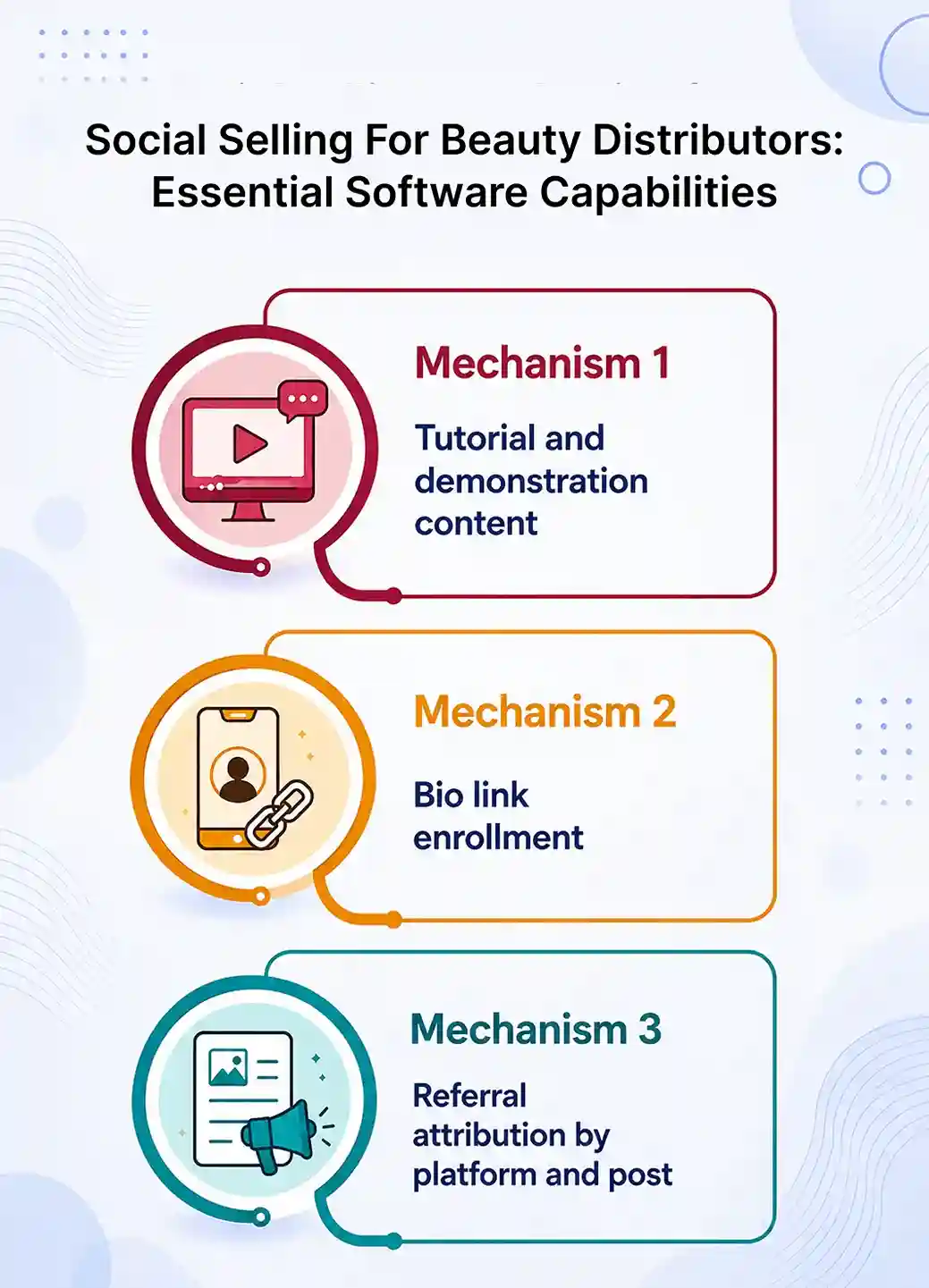
Mechanism 1: Tutorial and demonstration content- Beauty distributors produce how-to videos — how to apply the serum, how to layer products for morning and evening routines, and how to achieve a specific look using the cosmetics range. These videos are the primary content format for beauty social selling. The software's brand content library must store these videos in shareable formats and allow distributors to share them directly to Instagram Reels, TikTok, and YouTube Shorts from within the distributor app. A content library that stores only images and PDFs is not a beauty-brand content library — it is a supplement brand content library.
Mechanism 2: Bio link enrollment- A beauty distributor posts a tutorial. The video caption says "products linked in bio." The viewer clicks the bio. They land on the distributor's personal storefront, choose their products, and either purchase as a retail customer or enroll as a distributor. This flow requires: an enrollment link that works in Instagram and TikTok bio tools, a mobile-native storefront landing page that loads fast and looks like the brand (not like a 2018 MLM website), and a checkout experience that works on a phone screen without a desktop layout.
Mechanism 3: Referral attribution by platform and post- Beauty distributors post on multiple platforms simultaneously. The software must tell each distributor — and the brand — which platform generated which sale. Not just "Instagram generated $2,400 this month" but "this specific Reel generated 14 sales and 3 enrollments." This granular attribution allows distributors to optimise their content strategy and allows the brand to identify which content formats drive the highest quality customers.
The DSN Social Commerce Deep Dive connection: The DSN Social Commerce Deep Dive on September 15 specifically features beauty and skincare brands as the category most aligned with social commerce distribution mechanics. The three mechanisms above are why: beauty content is already social by nature, beauty consumers already discover products through social platforms, and beauty purchases already happen through social commerce flows. The software infrastructure described in this section is what enables a beauty brand to systematically monetise what its distributors are already doing organically on social media.
For a detailed breakdown of social commerce infrastructure requirements, see our Social Commerce Direct Selling Software guide. The beauty model is the specific implementation of the social commerce model in the highest-performing category for this distribution type.
What Beauty Distributors Can Say on Social Media — and What is Prohibited
Quick rule: Cosmetic claims describe visible changes to appearance ("reduces the appearance of fine lines"). Drug claims describe treating or curing a medical condition ("treats eczema") and are prohibited for products marketed as cosmetics. When in doubt, treat the claim as a drug claim until compliance review confirms otherwise.
Beauty distributors operate under two regulatory frameworks simultaneously: FDA cosmetic claim rules and FTC income claim rules. Most direct selling compliance guides cover FTC income claims in detail. The FDA cosmetic claim rules receive significantly less attention — and this is where beauty brands face their most specific regulatory exposure.
The core distinction: a cosmetic claim describes what a product physically does to the body's appearance. A drug claim describes what a product does to the body's function or treats a medical condition. The FDA regulates drug manufacturing, labelling, and marketing far more strictly than cosmetic manufacturing. A beauty product positioned as a cosmetic that distributors are making drug claims about is a regulatory exposure for both the company and the distributor making the claim.
| ✅ PERMITTED — Cosmetic Claims | ❌ PROHIBITED — Drug Claims |
|---|---|
| "Hydrates and firms skin" | "Treats eczema" |
| "Reduces the appearance of fine lines" | "Cures acne" |
| "Provides SPF 30 broad-spectrum sun protection" | "Reduces skin inflammation" |
| "Cleanses and balances skin tone" | "Repairs damaged skin cells" |
| "Improves skin texture and radiance" | "Heals rosacea" |
| "Minimises the appearance of pores" | "Treats hyperpigmentation" |
The drug claim risk for beauty brands: When a distributor posts "this serum healed my rosacea" — even as a genuine personal testimonial — they have made a drug claim on behalf of a cosmetic product. The company is associated with that claim. The FDA's enforcement posture on cosmetic drug claims has intensified as social commerce has made individual distributor content visible at scale. Your platform's compliance library must contain pre-approved claim language for every product, and your distributor social monitoring must flag drug claim language before it is published — not after it has been reported.
The FTC income claim requirements for beauty brands are identical to all other direct selling categories: no specific income representations without referencing the Income Disclosure Statement, no lifestyle income implications without disclosure, and retail sales must be primary. For the full FTC compliance framework, see our FTC-Compliant MLM Software guide — updated with DSA Capitol Hill Day (September 23) context.
Disclaimer: This section is for general educational purposes and does not constitute legal advice. Cosmetic vs. drug claim classification can be fact-specific and product-specific. Review the FDA's guidance on cosmetics labeling (fda.gov/cosmetics) and the FTC's Business Guidance Concerning Multi-Level Marketing, and consult qualified legal counsel before finalizing distributor claim policies or product marketing language.
How to Add a Distributor Channel to an Existing Beauty Brand
Adding a distributor channel to an existing D2C beauty brand means managing three risks — channel conflict, brand consistency at scale, and compliance from day one — each of which has a specific software requirement.
Many beauty brands considering direct selling have an existing D2C business — their own website, an Amazon presence, potentially a retail footprint. Adding a distributor channel to an existing beauty brand creates three specific risks that a new-brand launch does not face. Each risk requires a software solution.
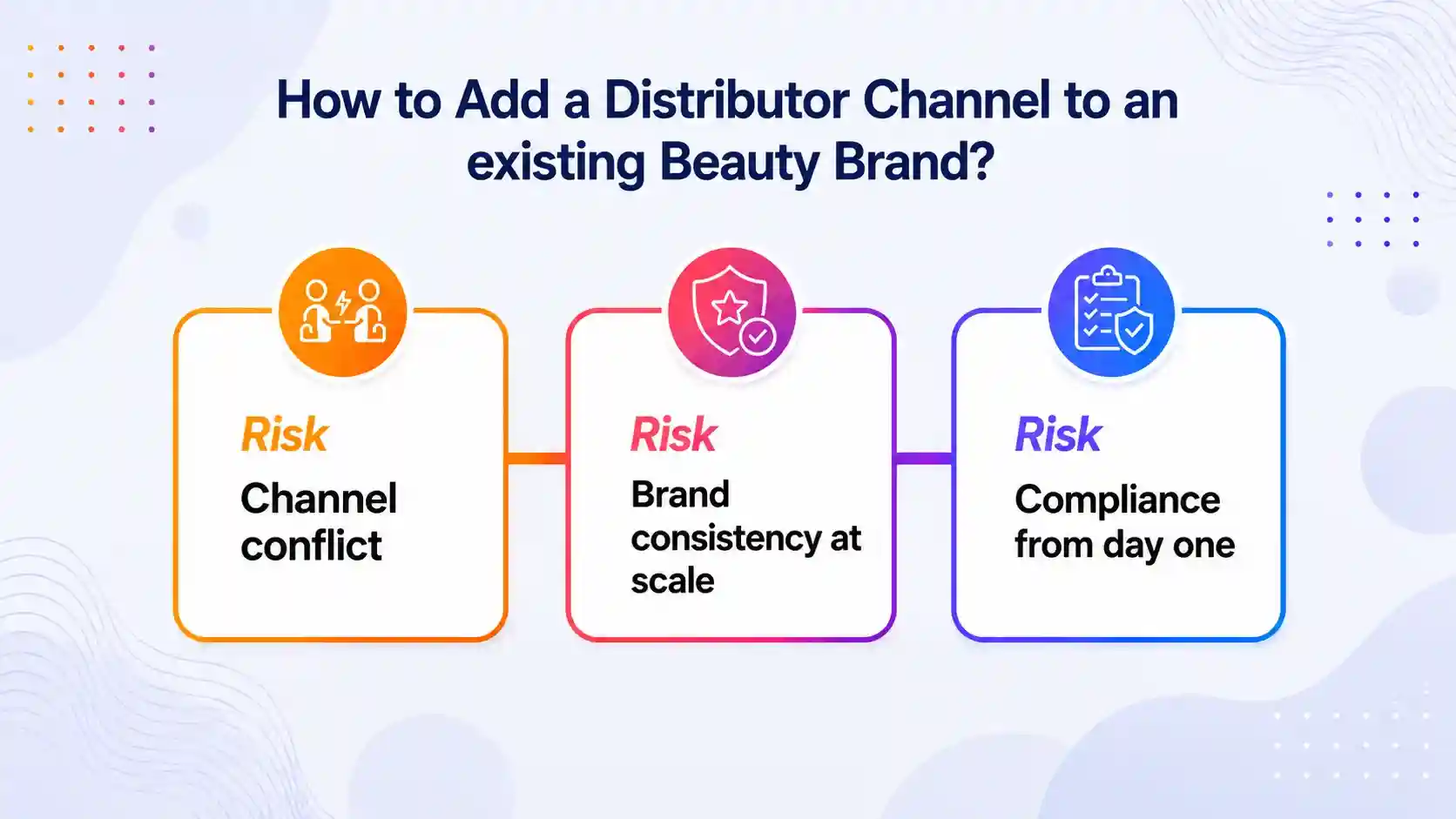
Risk 1: Channel conflict- When a distributor sells the same product your D2C website sells, at the same price, the question becomes: who gets credit for the sale? And more importantly, does the distributor commission create a margin problem if a customer who was buying directly now buys through a distributor? Your software must be able to track direct D2C orders and distributor-referred orders in separate channels, with a clear commission attribution rule that does not create margin erosion.
Risk 2: Brand consistency at scale- Your existing brand has a visual identity. Your marketing team controls it. When 200 distributors each create social content about your products, they will inevitably drift — different fonts, different colour grades, different image styles, different tone. The distributor personal storefronts and content library must enforce your visual identity within a defined template. Distributors can personalise (their name, their photo, their bio) but the brand's visual parameters must be locked.
Risk 3: Compliance from day one- Your existing brand's marketing content has been reviewed by your legal team. Your distributors' social content has not. The moment your first distributor posts about your products, they are creating marketing materials your brand is legally associated with. Automated compliance monitoring must be active before your first distributor's first post — not implemented after the first complaint.
API integration requirement: Clean channel separation requires API integration between your direct selling platform and your existing ecommerce stack. If you are running Shopify, WooCommerce, or a custom D2C platform, confirm that your direct selling software can connect to it via API before you select a platform. Vendors who cannot demonstrate a live API integration with your existing ecommerce setup during the demo are telling you that clean channel separation will require custom development work — which has a cost and a timeline. Ask for this in writing.
What Beauty Direct Selling Software Costs, and How Long Implementation Takes
Cost and timeline depend on distributor volume, SKU count, and how much custom compliance and API work is required — but founders should expect a written quote, not a fixed public price, and a typical configuration window of 4–8 weeks before launch.
Most direct selling software providers, including us, price beauty brand configurations based on factors like: number of active distributors, number of SKUs in the auto-ship system, whether API integration with an existing ecommerce stack is required, and the level of compliance monitoring needed (basic keyword flagging vs. full drug-claim detection with human review). Because these variables differ so much brand to brand, a generic price list would be misleading — this is why every reputable vendor should give you a written quote scoped to your specific model rather than a headline number.
On timeline: a straightforward beauty brand configuration — storefront setup, video library, multi-SKU auto-ship, and compliance library — typically takes 4–8 weeks from kickoff to launch-ready. Brands requiring custom API integration with an existing Shopify or WooCommerce store, or a more extensive cosmetic claim review process, should budget closer to 8–12 weeks. Founders targeting a specific event or launch date, such as DSU Fall 2026, should build in buffer time for compliance review and distributor onboarding materials, not just platform configuration.
| Factor | Basic Configuration | Custom Configuration |
|---|---|---|
| Typical timeline | 4–8 weeks | 8–12 weeks |
| Distributor volume | Small–mid launch | Larger or multi-market launch |
| SKU count | Standard skincare routine (3–5 SKUs) | Extended product line / multiple routines |
| API integration | Not required | Shopify / WooCommerce / custom D2C integration |
| Compliance monitoring | Basic keyword flagging | Full drug-claim detection + human review |
Note: The ranges above are general estimates based on typical project scopes and are not a quote or guarantee for any specific brand. Request a written, scoped quote for accurate pricing and timeline for your business.
What to Verify in a Beauty Software Demo Before DSU Fall 2026 — October 6
Before DSU Fall 2026, verify six things live in a demo: the storefront, video sharing, multi-SKU auto-ship, bio-link enrollment, the cosmetic claim compliance report, and a written quote.
DSU Fall 2026 is October 6–8 at The Westin Galleria in Dallas, Texas. Founders attending DSU who have not yet selected a beauty direct selling platform will encounter vendors at the event. Founders who have already completed their platform evaluation — and know exactly what their platform does and does not do — are in a fundamentally different position. Six verification points to complete before October 6.
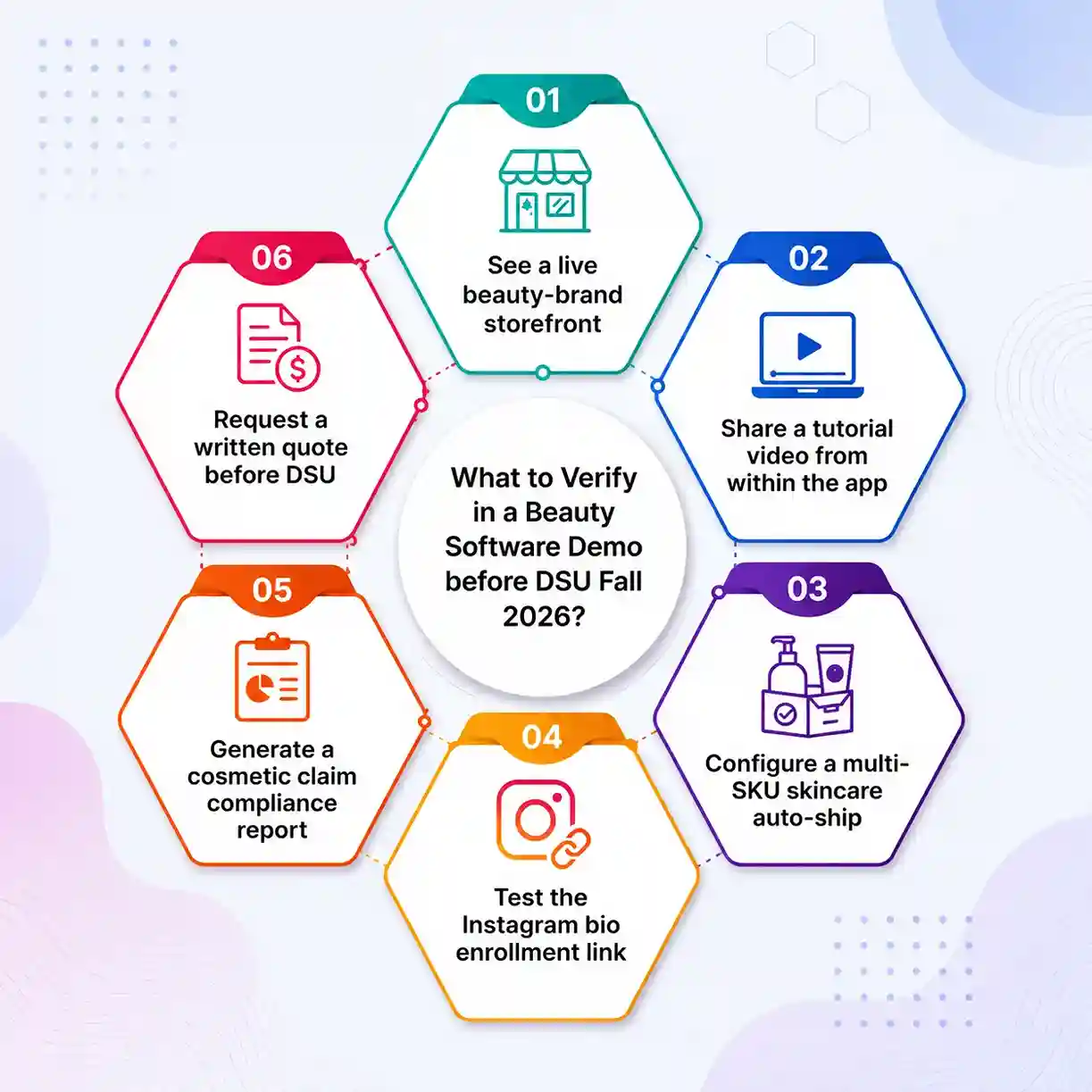
Ask to see a storefront configured for a beauty or skincare brand — not a generic template. The storefront must be image-rich, video-enabled, and visually consistent with a brand identity. Confirm it is active from day one without any rank or volume threshold.
Ask the vendor to share a tutorial video from the content library to Instagram Stories during the demo — without downloading it first. If this requires leaving the app, downloading the file, and re-uploading it to Instagram, the in-app sharing feature is not operational.
Set up a 4-product daily skincare routine — cleanser, serum, moisturiser, SPF — on a single customer subscription. Trigger a test renewal. Confirm the system handles each SKU's reorder independently and that the reorder reminder can be triggered by a usage estimate, not just a calendar date.A correctly configured system should display something like "Cleanser: 12 days left, Serum: 28 days left" for each SKU independently — not a single shared reorder date for the whole bundle.
Place a distributor's enrollment link in an Instagram bio link tool (Linktree or native Instagram link-in-bio). Click through on a mobile device. Confirm the landing page is mobile-native, loads within 3 seconds, and presents a brand-consistent enrollment experience — not a desktop website layout on a phone screen.
Ask to see the cosmetic claim compliance library — the pre-approved claim language for products. Then ask what happens when a distributor writes a post containing a drug claim like "treats eczema" or "cures acne." The system must flag this before the post is shared, not after it has been reported.
Request a written quote scoped to your specific beauty brand: product count, SKU structure, estimated distributor volume, and target markets. Verbal pricing is not a commitment. A written quote is. Founders who arrive at DSU with a written quote in hand are ready to decide — not ready to start the process.
DSU Fall 2026 — Beauty Platform Evaluation Deadline
Founders attending DSU who have already verified their beauty platform's 5 features arrive as decision-makers. Those who have not arrive as prospects. Complete your beauty brand demo before October 6.
Book a Beauty Brand Demo Before October 6
Shabana is a dynamic writer and strategist with profound expertise in network marketing. Her sharp analysis of industry trends and exceptional ability to distill complex concepts into clear, actionable insights make her content invaluable for professionals at every level. Through her writing, she empowers readers to navigate the evolving landscape of relationship-driven sales with confidence and integrity. Blending data-driven strategies with human-centric principles, Shabana provides a unique perspective that helps businesses thrive while maintaining authentic connections.
📋 Free: Beauty Direct Selling Launch Checklist 2026
5 stages, 40 action items for beauty and skincare brand founders. From product validation through model design, social selling system setup, software selection, and compliance launch. Gate questions at every stage — know exactly where your gaps are before you spend on software.
FAQ: Beauty Direct Selling Software 2026
1. How is launching a beauty direct selling company different from launching a wellness MLM?
Four genuine differences: distributor demographics (social-media-native females aged 22–45 vs wellness-focused adults mix of genders); product consumption (daily multi-SKU skincare routine vs monthly single supplement); social selling mechanics (tutorial videos and visual demos vs text-heavy community posts); and compliance (FDA cosmetic claim rules in addition to FTC income claim requirements). Each difference has a direct implication for the software features your programme requires.
2. What are the 5 software features a beauty direct selling company must have in 2026?
Visual-first personal storefronts active from day one; in-app video content library shareable to Instagram, TikTok, and YouTube; multi-SKU daily auto-ship supporting full skincare routines; social-platform enrollment links compatible with Instagram and TikTok bio tools; and cosmetic claim compliance library with pre-approved claim templates and drug claim monitoring. Verify all five live in every vendor demo — not from a description.
3. What can beauty distributors say on social media — and what is prohibited?
Permitted cosmetic claims: "hydrates and firms skin," "reduces the appearance of fine lines," "provides SPF 30 broad-spectrum protection," "cleanses and balances skin tone," "improves texture and radiance," "minimises the appearance of pores." Prohibited drug claims: "treats eczema," "cures acne," "reduces skin inflammation," "repairs damaged skin cells," "heals rosacea," "treats hyperpigmentation." Beauty distributors must also comply with FTC income claim rules and reference the company's Income Disclosure Statement in any income representation.This is general guidance, not legal advice — confirm specific claim language with legal counsel and the FDA's cosmetics guidance.
4. How does a beauty brand add a distributor channel without disrupting its existing D2C business?
Three risks require software solutions: channel conflict (direct vs distributor-referred orders must be tracked separately with consistent pricing), brand consistency (every distributor storefront must enforce the brand's visual identity within a defined template), and compliance from day one (automated monitoring of distributor social content must be active before the first distributor's first post). API integration between the direct selling platform and the existing ecommerce stack is required for clean channel separation.
5. How many distributors does a beauty direct selling company need to be profitable?
Beauty brands typically have higher average order values ($150–$400 for a full skincare routine) than supplement brands, meaning fewer distributors are needed to reach profitability. The key metric is active retail customer count per distributor. A distributor with 10 repeat retail customers purchasing a full routine monthly generates significantly more revenue than 50 one-time customers. Your software must surface retail customer count and repeat purchase rate per distributor as primary dashboard metrics.
6. Is beauty direct selling still growing in the USA in 2026?
Beauty and personal care remains one of the two largest direct selling categories in the USA. The DSN Social Commerce Deep Dive on September 15, 2026 specifically highlighted beauty and skincare brands as the category most aligned with social commerce distribution mechanics. For founders with a quality beauty product and a social-media-native distributor community, direct selling remains one of the most effective distribution channels available in 2026.
7. What is the difference between a beauty direct selling company and a beauty ambassador programme?
A beauty ambassador programme is an affiliate model — flat commission on personal sales, no recruiting obligation, no downline. A beauty direct selling company adds a builder tier — distributors recruit and earn overrides on their team. Both require software: ambassador programmes need referral tracking and flat commission automation; direct selling companies need full genealogy management, rank-based compensation, and team analytics. Many beauty brands start with an ambassador programme and add the builder tier once they have product-market fit established.
8. How does social selling work for a beauty direct selling company?
Three mechanisms: content sharing (distributors share brand-approved tutorial videos from the content library to their social channels, every piece including their storefront link), social-native enrollment (potential distributors and customers click the bio link and complete enrollment on a mobile-native page without leaving social media), and referral attribution (the software tracks which platform and which specific post generated each sale and enrollment, enabling distributors to optimise their content strategy).
9. What does beauty brand visual consistency mean for direct selling software?
Every distributor's personal storefront, every piece of shared content, and every social post must look like it came from the same brand — same fonts, same colour palette, same image aesthetic. The software must enforce brand-approved templates on every distributor storefront, store only brand-approved assets in the content library, and provide customisation within brand boundaries. Distributors can add their name and photo — but the brand's visual identity is locked.
10. Can an existing beauty brand launch a direct selling programme without disrupting its retail presence?
Yes, with the right software architecture. The key is clean channel separation: direct retail customers must be tracked separately from distributor-referred customers with consistent pricing across channels. API integration between the direct selling platform and the existing ecommerce stack is required. Brands that launch without this separation create channel conflict that damages both the distributor programme and the retail business.
11. What should a beauty brand founder verify in a software demo before DSU Fall 2026?
Six verification points: see a live beauty-brand storefront configured with visual brand consistency; share a tutorial video from within the app to Instagram without downloading; set up a multi-SKU skincare auto-ship and test a renewal; test the Instagram bio enrollment link on a mobile device; generate a cosmetic claim compliance report showing drug claim detection; and request a written quote scoped to your specific model. Complete all six before October 6.
12. How much does beauty direct selling software cost, and how long does implementation take?
Cost depends on distributor volume, SKU count, and how much custom API and compliance work is needed, so pricing is quoted per brand rather than published as a flat rate. A typical configuration takes 4–8 weeks; brands needing custom ecommerce API integration or extensive compliance review should budget 8–12 weeks. Request a written quote and a project timeline before committing.
13. What does Global MLM Software provide for beauty direct selling companies?
Global MLM Software configures direct selling platforms for beauty and skincare brands including: visual-first personal distributor storefronts with video embedding, active from day one; in-app video content library shareable to Instagram, TikTok, and YouTube; multi-SKU daily auto-ship supporting full skincare routines; social-platform enrollment links for Instagram and TikTok bio tools; cosmetic claim compliance monitoring and pre-approved claim library; and full FTC compliance tools including retail-to-recruit monitoring and IDS generation. Book a free 30-minute demo — written quote within 24 hours.
General disclaimer: This guide is for general informational purposes only and does not constitute legal, financial, or regulatory advice. Direct selling compliance requirements (FDA cosmetic claim rules, FTC income claim rules, and state-level regulations) can vary and change over time. Consult qualified legal and compliance counsel before launching or modifying a distributor programme.