Key Takeaways
Cost & timeline: Launching a USA MLM costs roughly $15K–$75K in year one and typically takes 60–120 days, covering legal setup, compensation plan design, software, inventory, and compliance.
Legal essentials: Requires forming an LLC/corporation, getting an EIN, filing in 5 specific states (GA, MA, WY, LA, MT), and meeting FTC rules (IDS, retail-sales primacy, 90-day buyback policy).
Compensation plan choice matters: Unilevel (or a Unilevel-based Hybrid) is recommended for first-time US launches — considered the most FTC-friendly structure vs. Binary/Matrix.
Software must-haves: Choose a platform with 8 core features — automated IDS, retail-to-recruit tracking, earnings-claim controls, 3-year audit trail, KYC/AML, 1099 reporting, CCPA compliance, and AI analytics.
AI is now standard: AI-powered tools (commission automation, churn prediction, compliance content-scanning) are described as essential in 2026, letting small founding teams manage larger distributor networks efficiently.
Starting a direct selling or MLM company in the United States in 2026 is one of the most strategic business decisions a founder in health, wellness, beauty, personal care, or fitness can make.The traditional retail model is under increasing pressure, while social commerce continues to accelerate. The direct selling channel gives founders the ability to scale a product business through a motivated network of distributors — without the overhead of retail distribution.
But starting an MLM company in the USA also means navigating FTC regulations, state registration requirements, compensation plan design, software selection, and distributor recruitment — all at the same time. Done wrong, it is an expensive and legally exposed path. Done right, it is one of the most capital-efficient go-to-market strategies available in 2026.
This guide walks you through every step of launching an MLM company in the USA. By the end, you will know exactly what it costs, what the law requires, which software to choose, and how to recruit your first distributors.
North America direct selling market 2025
Active direct sellers worldwide
Global DS sales from health & wellness
Global wellness industry 2026
Typical launch timeline with the right software
What Does It Cost to Start an MLM Company in the USA?
Starting an MLM company in the USA typically costs between $15,000 and $75,000 in the first year, depending on product type, distributor network size, and compliance requirements.Here's how that budget is typically allocated.
| Cost Category | Starter Budget | Full-Scale Budget | Notes |
|---|---|---|---|
| Legal Setup (LLC + MLM Attorney) | $3,000 | $8,000+ | Entity formation, EIN, MLM-specific contracts, policies & procedures |
| Compensation Plan Design | $2,500 | $10,000+ | Work with a specialist consultant or attorney—this is not a step you should skip. |
| MLM Software | $500/mo | $3,000/mo | AI-powered platforms with FTC compliance tools |
| Product Inventory (Year 1) | $5,000 | $30,000+ | Depends heavily on product category and MOQ |
| FTC Compliance Setup | $1,500 | $5,000+ | IDS preparation, state registration filings, compliance policies |
| Website & Marketing | $2,000 | $15,000+ | Brand identity, distributor portal, launch marketing |
| DSA Application | $0 | $2,500+ | Optional Year 1 — apply once launched and eligible |
| TOTAL YEAR 1 | ~$15,000 | ~$75,000+ | Budget conservatively. Prioritise legal and software first. |
Common Founder Mistake: Many first-time MLM founders spend heavily on product branding and marketing before investing in legal setup and software. The result is a launch that is immediately non-compliant and expensive to fix. Always spend on legal and software first — these protect everything else.
The biggest variable in Year 1 budget is product. A health supplement business sourcing from a contract manufacturer has very different inventory economics than a digital product or coaching program. If you are in the early product planning stage, structure your compensation plan and choose your software before committing to large inventory orders — your software will determine how your product catalog, inventory, and e-commerce must be structured.
Our Experience: "After helping launch hundreds of MLM businesses across different industries, we've noticed that many founders spend heavily on branding before investing in legal compliance and software. In our experience, companies that prioritize compliance and system setup early avoid costly restructuring later."
What Are the Legal Requirements to Start an MLM Company in the USA?
US legal requirements for starting an MLM include forming a legal entity, registering with the IRS, complying with state-specific MLM laws, meeting FTC requirements for earnings disclosures, creating a buyback policy, and retaining documentation for at least three years. If you're still asking, Is MLM legal in the USA?, the answer depends on meeting these legal and regulatory requirements. Here is every requirement broken down.
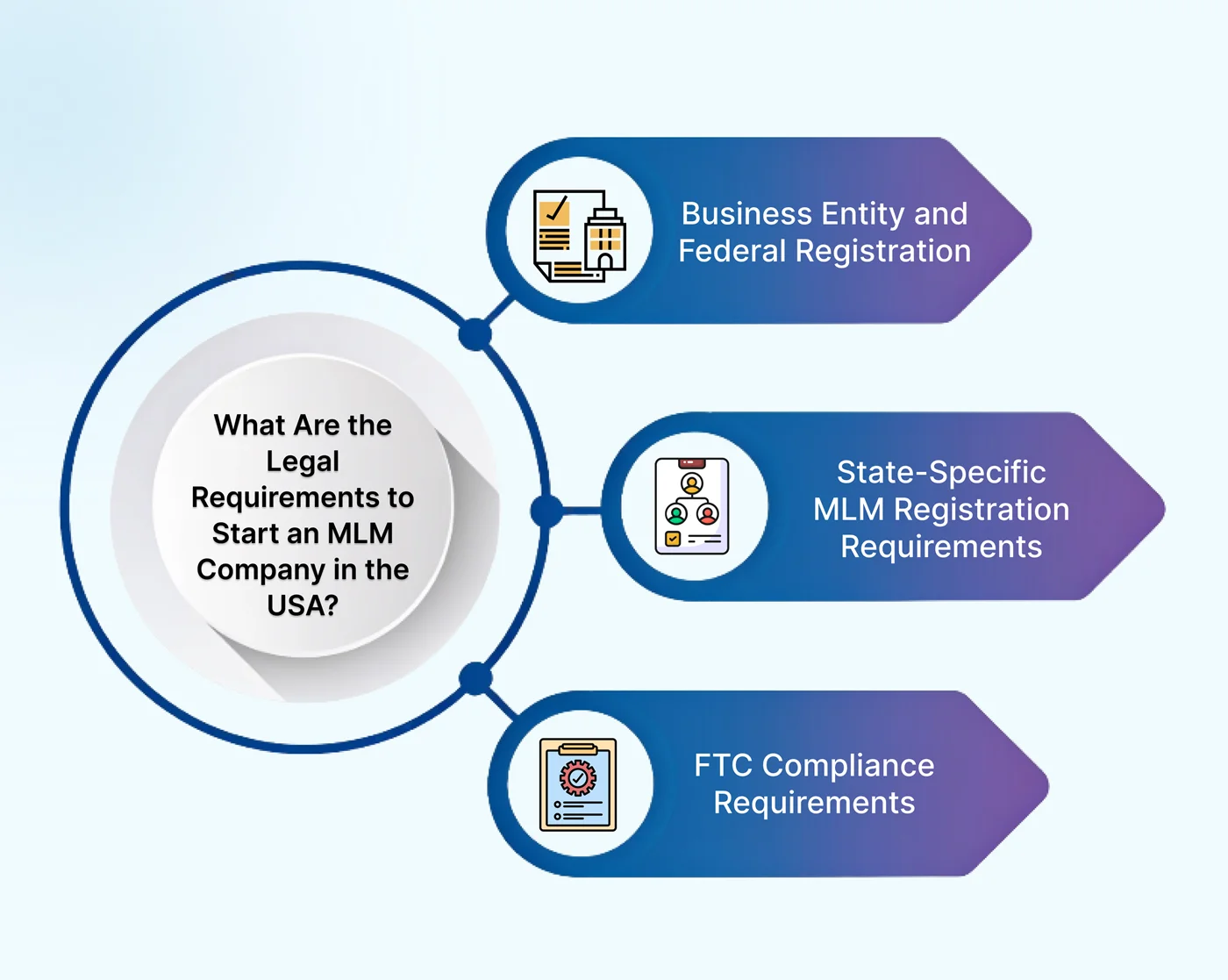
Business Entity and Federal Registration
Form a Limited Liability Company (LLC) or corporation in your home state. Most startup MLM founders choose an LLC for liability protection and tax flexibility. File your Articles of Organization (LLC) or Articles of Incorporation (corporation) with your state's Secretary of State. Obtain an Employer Identification Number (EIN) from the IRS — this is required for 1099 reporting and business banking.
State-Specific MLM Registration Requirements
The USA has a patchwork of state laws that apply specifically to multi-level marketing companies. Five states require action before you recruit a single distributor in those states:
Advance notice filing required before operating. Violation of law to skip this step.
Advance notice filing required before recruiting distributors in the state.
Advance notice filing required. Similar to GA and MA requirements.
Full registration required. State reviews your materials before you can operate.
Full registration and Order of Registration required before recruiting.
Important Note: Operating in Georgia, Massachusetts, Wyoming, Louisiana, or Montana without completing the required filing or registration is a violation of state law — even if your company is legally incorporated elsewhere. Work with an MLM-specialised attorney to manage these filings as part of your launch checklist.
FTC Compliance Requirements
The Federal Trade Commission governs MLM companies at the federal level. Key requirements in 2026 include:
FTC Business Opportunity Rule (16 CFR Part 437): Requires specific disclosures. for any business opportunity involving required purchases of more than $500.
Income Disclosure Statement (IDS): Any earnings information provided to prospective distributors must accurately represent typical participant experience — including what percentage did not earn any income.
Retail Sales Primacy: Compensation must be driven primarily by retail sales to genuine end consumers, not by recruitment activity or internal distributor purchases.
Proposed Earnings Claim Rule (January 2025): If finalized, the proposed rule would require written substantiation for all earnings claims and 3-year record retention. Currently under rulemaking, but the FTC is enforcing existing laws actively — as demonstrated by three enforcement actions in April 2026 alone.
90-Day Inventory Buyback Policy: Legitimate MLM companies must offer to repurchase unsold inventory from departing distributors at a minimum of 90% of the original purchase price.
For a full breakdown of the April–May 2026 FTC enforcement actions and what they mean for software selection, read our companion guide: FTC-Compliant MLM Software: What USA Founders Need in 2026 →
What Compensation Plan Should I Use for My MLM Company?
The most common MLM compensation plans in 2026 are Binary, Unilevel, Matrix, Generation, and Hybrid. Explore various network marketing plans to understand their unique strengths and choose the right fit for your business. Hybrid plans combining two or more structures are the fastest-growing design trend in 2026, offering both recruitment width and deep network rewards. For a first-time USA launch in health, wellness, or beauty, a Unilevel or simple Hybrid plan is recommended.
Structure: Two legs — left and right. Commission paid on the weaker leg.
Best for: Fast growth, recruitment-focused networks.
FTC note: Binary plans require careful retail sales monitoring — the weaker-leg structure can incentivise recruitment over retail. Pair with strict retail-to-recruit tracking in your software.
Structure: Unlimited width, fixed depth (typically 5–9 levels). Commission on each level.
Best for: USA startup launches in H&W, beauty, and personal care.
FTC note: Widely regarded as the most FTC-compliant structure. Rewards retail sales and personal recruiting equally. Simpler to explain to new distributors.
Structure: Combines two plan types — e.g. Unilevel for retail, Binary for leadership bonuses.
Best for: Companies wanting flexibility to reward both retail and network building.
FTC note: Requires careful design — each component must meet FTC retail primacy requirements independently. Specialist consultation is essential.
Structure: Fixed width and depth (e.g. 3×9 matrix). Spillover from upline fills open positions.
Best for: Subscription-based or digital product businesses with predictable reorder cycles.
FTC note: Spillover mechanics can incentivise joining over selling. Retail sales enforcement is essential.
| Compensation Plan | Best For | Retail Sales Focus | Recruitment Focus | FTC Risk Level | Difficulty to Manage | Recommended For |
|---|---|---|---|---|---|---|
| Unilevel | Startups & new MLM companies | High | Moderate | Low | Easy | First-time founders launching in the USA |
| Binary | Fast network expansion | Moderate | Very High | Medium | Medium | Companies focused on rapid distributor growth |
| Matrix | Subscription & digital product businesses | High | Moderate | Medium | Medium | Businesses wanting controlled expansion |
| Generation | Leadership-driven organizations | High | High | Low-Medium | High | Established MLM businesses with experienced leaders |
| Hybrid | Large scalable businesses | High | High | Low (if properly designed) | High | Companies seeking long-term growth and flexibility |
Compensation Plan Consulting: Do not design your compensation plan without specialist guidance. An incorrectly structured plan can create FTC exposure, distributor dissatisfaction, and commission calculation errors that are expensive to correct after launch. Global MLM Software's consulting team provides compensation plan review as part of the pre-launch process. Book a consultation →
See How Global MLM Software Handles Your Compensation Plan
Binary, Unilevel, Matrix, Generation, and Hybrid plans — all supported with AI-powered commission automation, real-time payout processing, and FTC compliance tools built in.
Book Your Free Demo Schedule a ConsultationHow Do I Choose MLM Software for My USA Launch?
When choosing MLM software for a USA launch, verify these eight essential capabilities before signing any contract. Most platforms built outside the USA lack several of these features entirely — and the gaps only become visible after you have already committed.
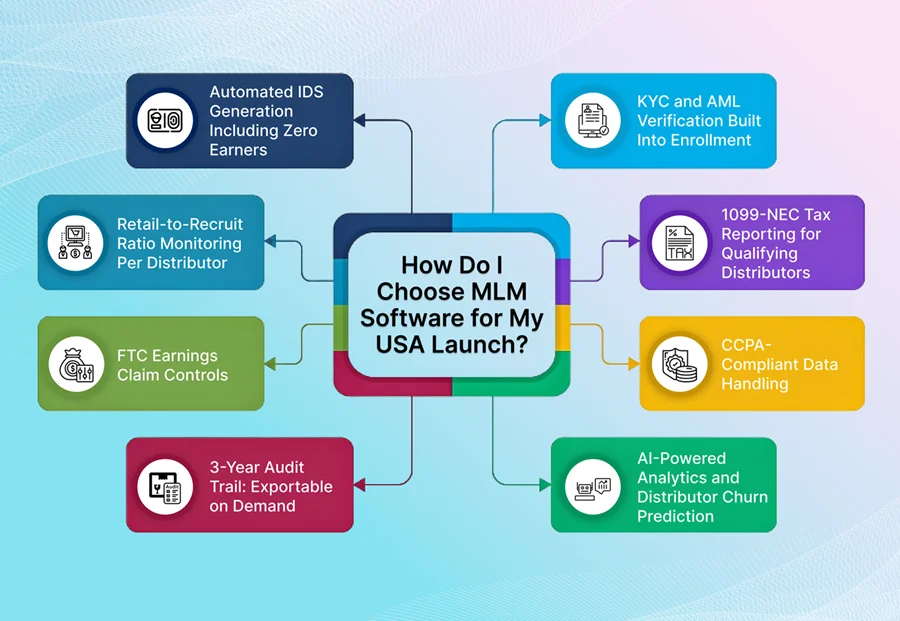
Automated IDS Generation Including Zero Earners. The Income Disclosure Statement must be generated from live commission data — not a static PDF. It must include every distributor, including those who earned nothing. The FTC found this specific gap in three 2026 enforcement actions.
Retail-to-Recruit Ratio Monitoring Per Distributor. The FTC's primary pyramid scheme test. Your software must track retail sales versus recruitment activity per distributor in real time, flag imbalances automatically, and generate exportable audit reports.
FTC Earnings Claim Controls. Pre-approved marketing template library for distributors. System-level blocks on non-compliant income claim language. Automated disclaimer insertion on official communications.
3-Year Audit Trail — Exportable on Demand. Every commission run, enrollment, and disclosure acknowledgment must be logged with a timestamp and exportable as a CSV or PDF for FTC review. The proposed Earnings Claim Rule sets 3 years as the retention standard.
KYC and AML Verification Built Into Enrollment. Know Your Customer and Anti-Money Laundering controls protect your business from fraudulent registrations and are increasingly expected in FTC inquiries into legitimate business practices.
1099-NEC Tax Reporting for Qualifying Distributors. Automatic generation of 1099-NEC forms for any distributor earning $600 or more annually. Failure creates IRS exposure alongside FTC risk.
CCPA-Compliant Data Handling. California Consumer Privacy Act compliance is mandatory for any USA business processing consumer data. Covers consent management, data access requests, and deletion.
AI-Powered Analytics and Distributor Churn Prediction. In 2026, AI analytics are no longer a premium feature—they are now considered a standard expectation. See Step 5 for why this matters for your launch.
| Feature | Why It Matters | Global MLM Software | Generic Platforms |
|---|---|---|---|
| Automated IDS (incl. zero earners) | FTC enforcement gap in 3 of 4 April 2026 cases | ✓ Standard | Often absent |
| Retail-to-Recruit Monitoring | Primary FTC pyramid scheme test | ✓ Real-time | Manual / absent |
| Earnings Claim Controls | Social media liability (Stormy Wellington case) | ✓ Template library | Absent |
| 3-Year Audit Trail | Proposed FTC Earnings Claim Rule standard | ✓ Exportable PDF/CSV | Partial |
| KYC / AML Verification | Fraud protection + FTC legitimacy signal | ✓ Built-in | Often add-on |
| 1099-NEC Tax Reporting | IRS legal requirement | ✓ Automatic | Partial |
| CCPA Compliance | California privacy law | ✓ Built-in | Varies |
| AI Analytics + Churn Prediction | 2026 distributor retention standard | ✓ Included | Rare |
How Does AI Software Help You Launch an MLM Company Faster in 2026?
$31 Billion
The Global AI Direct Selling Market in 2026
Growing at 44.9% annually to $875 billion by 2035. AI is no longer considered a premium feature for modern MLM software — it is the new baseline expectation for founders launching in 2026.
AI-powered MLM software accelerates your launch and reduces operational risk across five areas that would otherwise require significant manual effort or human oversight. Here is what AI does in a modern MLM platform:
AI Commission Automation
Automatically calculates commissions, bonuses, and rank advancements across Binary, Unilevel, and Hybrid plan rules in real time — with zero manual calculation errors. Distributors receive accurate payouts faster, which builds trust and reduces attrition.
Predictive Distributor Analytics
AI dashboards identify top-performing distributors, detect early churn signals (declining activity, reduced engagement, falling sales), and trigger automated re-engagement before a distributor goes inactive. Retention is more profitable than constant recruitment.
Automated Compliance Monitoring
AI scans distributor marketing content for high-risk language patterns — income claims, lifestyle promises, unsubstantiated product statements — and flags them before they create FTC liability for your company.
AI Lead Scoring
Identifies which prospects are most likely to become active distributors based on engagement patterns, demographic signals, and network data — allowing your founding team to focus recruiting energy where it converts best.
Automated IDS Generation
AI pulls live commission data to generate Income Disclosure Statements automatically — including zero earners, median calculations, and earnings ranges. No manual data compilation. No FTC compliance gap.
Personalised Distributor Experience
AI-driven dashboards show each distributor their personal performance insights, rank advancement progress, and next best actions — reducing the coaching burden on your leadership team during the first 90 days of launch.
"Businesses that implement business management software with AI capabilities have reported a 20% increase in productivity and a 15% reduction in operational costs within the first two years. In 2026, AI-powered MLM platforms are redefining what's possible at the startup stage." — Direct Selling Industry Analysis, 2026
The practical implication for a founding team of two or three people: AI means you can manage 50 to 100 distributors with the operational capacity that previously required a team of 10. This is the operational advantage AI provides during the launch phase in 2026.
How Do I Register My MLM Company and Set Up FTC Compliance?
Before recruiting your first distributor in any US state, the following must be completed — in order. This is not optional, and none of it can be done retroactively once a distributor complaint or FTC inquiry begins.
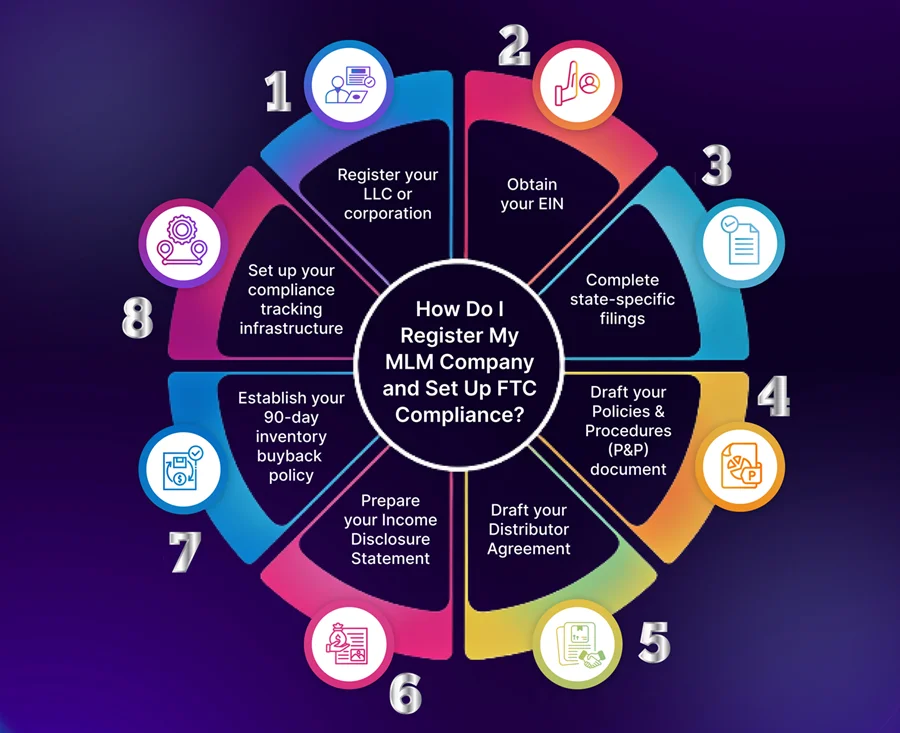
Register your LLC or corporation with your home state's Secretary of State. Choose your state based on business and tax considerations — Delaware and Wyoming are popular for MLM companies, but your MLM attorney can advise based on your specific structure.
Obtain your EIN from the IRS (irs.gov — free and immediate online). This is your federal tax identification number. Required for business banking and 1099 reporting.
Complete state-specific filings in Georgia, Massachusetts, Wyoming, Louisiana, and Montana before recruiting in those states. Retain copies of all filings and confirmation letters.
Draft your Policies and Procedures (P&P) document with your MLM attorney. This governs distributor conduct, income claims, product claims, social media guidelines, and termination provisions. It is your primary legal protection against distributor misconduct.
Draft your Distributor Agreement — the contract each distributor signs on enrollment. Must include: earnings claim disclosure, buyback policy, dispute resolution, and compliance obligations.
Prepare your Income Disclosure Statement before your first enrollment. Your MLM software should generate the initial IDS from your compensation plan modeling data. Update it quarterly as real distributor earnings data accumulates.
Establish your 90-day inventory buyback policy in writing and build the process into your software. Distributors must be able to return unsold inventory at a minimum of 90% of the purchase price within 90 days of purchase in most states.
Set up your compliance tracking infrastructure in your MLM software — retail sales monitoring, IDS acknowledgment logging, earnings claim controls, and audit trail.
Global MLM Software Compliance Setup: Our USA onboarding process includes a compliance infrastructure review — ensuring your IDS, retail tracking, audit trail, and distributor controls are configured correctly before your first enrollment. This is included in the standard implementation at no additional cost. Book a demo to see this in action →
How to Recruit Your First MLM Distributors?
Recruiting the first 10 to 20 distributors is the most critical and most underestimated step in launching an MLM company. These founding distributors shape your network culture, set the retail sales standard, and determine whether your launch creates momentum or stalls in the first 90 days.
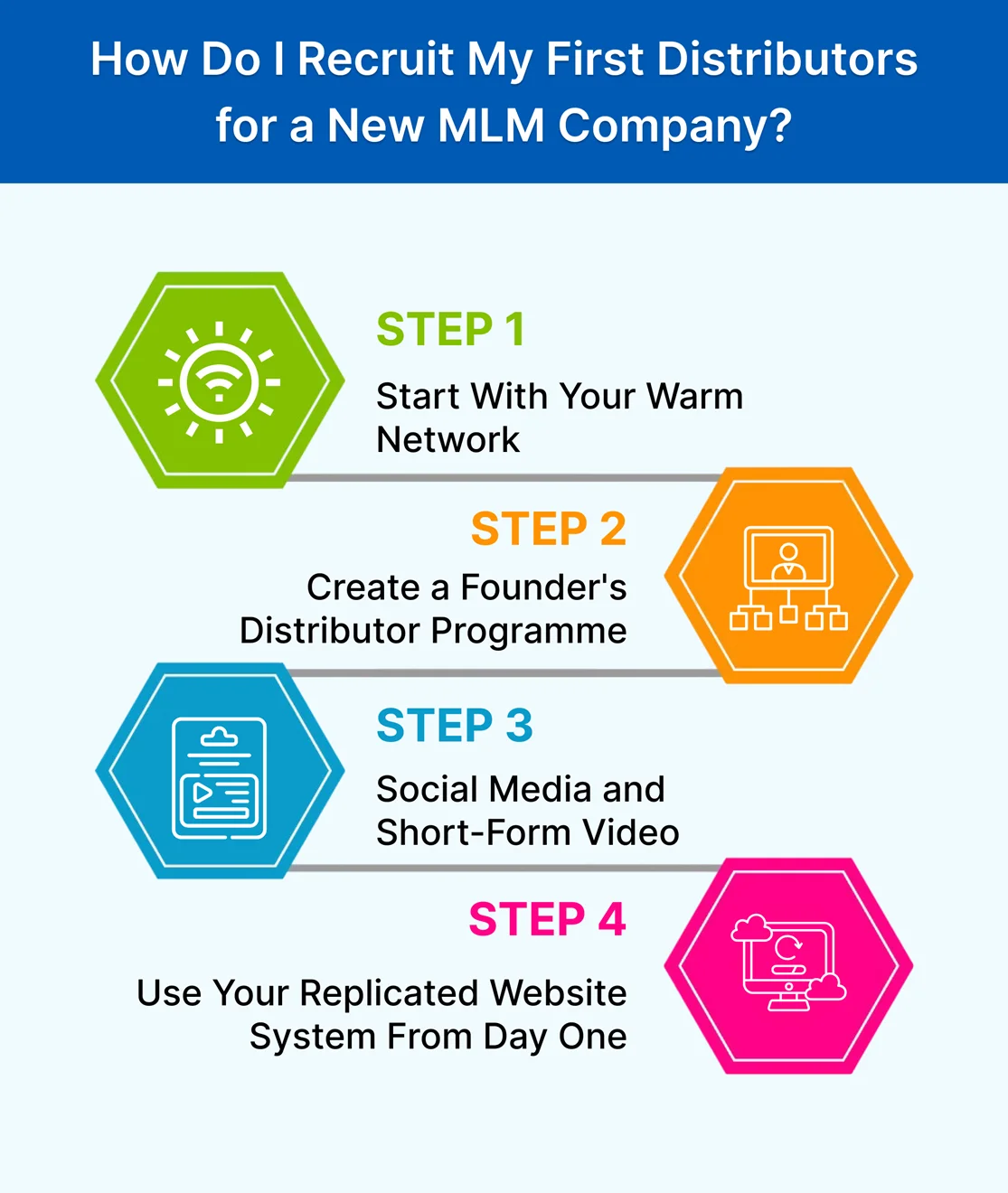
Start With Your Warm Network
Your first distributors should be people who already trust you and who genuinely use and love your product. Cold recruiting in the first 30 days is inefficient and produces lower-quality distributors. Focus your initial 100% of energy on your personal network — friends, professional contacts, former colleagues, and existing customers of your product.
Create a Founder's Distributor Programme
Offer the first 20 to 50 distributors enhanced early-stage commission rates, founding recognition titles, and permanent recognition as founding members. Create genuine scarcity — this programme closes once you hit 50 founding distributors. Your MLM software should support configurable commission tiers so the founding programme runs automatically without manual tracking.
Social Media and Short-Form Video
In 2026, 63% of web traffic comes from mobile devices. TikTok, Instagram Reels, and YouTube Shorts are the primary channels where new distributors first discover MLM opportunities. Your founding distributors should create authentic short-form content showing how they use the product — not income claims, not lifestyle imagery, but genuine product experience. Your MLM software's approved marketing template library ensures this content stays FTC-compliant.
Use Your Replicated Website System From Day One
Every distributor who enrolls in your platform immediately receives a personalised replicated website with their own enrollment link. This is your primary distributor recruitment infrastructure. Each founding distributor shares their link immediately — on social media, in messages, and in their content. Your software tracks which enrollments come through which link for commission attribution.
Critical Recruiting Rule: Train every distributor on compliant income claims before they post anything on social media. The Stormy Wellington case (April 2026) established that the company is liable for earnings claims made by individual distributors using company materials. Your approved marketing library must be ready before your first distributor posts anything with your brand.
Your 90-Day MLM Launch Timeline
This is the recommended timeline for a founder who has a product, a budget, and is beginning the launch process today. Adjust based on product sourcing lead times and legal complexity.
📋 Free Download: MLM FTC Compliance Checklist 2026
15 compliance items every USA MLM company must have in place — including which ones Global MLM Software handles automatically. One page. Print and use today.

Shabana is a dynamic writer and strategist with profound expertise in network marketing. Her sharp analysis of industry trends and exceptional ability to distill complex concepts into clear, actionable insights make her content invaluable for professionals at every level. Through her writing, she empowers readers to navigate the evolving landscape of relationship-driven sales with confidence and integrity. Blending data-driven strategies with human-centric principles, Shabana provides a unique perspective that helps businesses thrive while maintaining authentic connections.
Frequently Asked Questions
1. What does it cost to start an MLM company in the USA?
Starting an MLM company in the USA typically costs between $15,000 and $75,000 in the first year. Core costs include legal setup ($3,000–$8,000), compensation plan design ($2,500–$10,000), MLM software ($500–$3,000/month), product inventory ($5,000–$30,000), FTC compliance setup ($1,500–$5,000), and initial marketing. Budget conservatively and prioritise software and legal compliance before product launch.
2. What are the legal requirements to start an MLM company in the USA?
US legal requirements include: forming an LLC or corporation, registering your EIN with the IRS, filing advance notices in Georgia, Massachusetts, and Wyoming and registering in Louisiana and Montana before operating there, complying with the FTC Business Opportunity Rule (16 CFR Part 437), creating an accurate Income Disclosure Statement, adopting a 90-day inventory buyback policy, and ensuring all earnings claims are substantiated with 3-year record retention. Consult a qualified MLM attorney before recruiting your first distributor.
3. What compensation plan should I use for my MLM company?
For a first-time USA launch in health, wellness, or beauty, a Unilevel or simple Hybrid plan is recommended. Unilevel plans are the most FTC-compliant structure — they reward retail sales and personal recruiting equally, are simpler to explain to new distributors, and reduce the retail-to-recruit ratio risk that Binary plans can create. Hybrid plans combining Unilevel with Binary leadership bonuses are the fastest-growing structure in 2026.
4. How do I choose MLM software for my USA launch?
Verify eight capabilities: automated IDS generation including zero earners, retail-to-recruit monitoring per distributor, FTC earnings claim controls, 3-year audit trail exportable on demand, KYC/AML verification built into enrollment, 1099 tax reporting, CCPA-compliant data handling, and AI-powered analytics. Most platforms built outside the USA lack several of these features. Book demos with at least two vendors and ask specifically about each of the eight capabilities before signing.
5. How does AI software help you launch an MLM company faster in 2026?
AI-powered MLM software automates commission calculations across complex hybrid plans, distributor onboarding and identity verification, income disclosure statement generation from live data, distributor churn prediction, and social media content monitoring for FTC compliance. The global AI direct selling market is $31 billion in 2026 growing at 44.9% annually. A founding team of 2–3 people with AI-powered software can manage 50–100 distributors with the operational capacity that previously required a team of 10.
6. How long does it take to launch an MLM company in the USA?
A well-prepared MLM company can launch in 60 to 120 days from initial planning to first distributor enrollment. Key timeline drivers: legal setup (2–4 weeks), compensation plan design (2–6 weeks), software implementation (3–8 weeks), and product sourcing (varies). AI-powered platforms reduce implementation by automating distributor onboarding and commission configuration. Global MLM Software typically implements in 21–30 days.
7. Which states require MLM companies to register before operating?
Five states require action before recruiting: Georgia, Massachusetts, and Wyoming require advance notice filings. Louisiana and Montana require full registration and state review of compensation plan materials. Operating without completing these filings is a violation of state law in each of these states. Work with a qualified MLM attorney to manage state registrations as part of your launch legal checklist.
8. What is the difference between an MLM and a pyramid scheme?
A legitimate MLM generates income primarily from retail product sales to real end consumers. A pyramid scheme generates income primarily from recruitment fees without genuine retail sales. The FTC uses the retail-to-recruit ratio as its primary test. MLM software that monitors this ratio per distributor in real time, enforces retail sales requirements, and generates documented retail evidence provides the strongest legal protection against pyramid scheme classification.
9. Do I need DSA membership to start an MLM in the USA?
DSA membership is not legally required, but it provides significant benefits: the code of ethics signals legitimacy to consumers and regulators, membership provides compliance resources and legal guidance, and DSA membership is viewed positively in FTC evaluations. Many founders apply within their first 12 months once they meet membership criteria, including demonstrating a genuine retail sales model.
10. What products sell best through direct selling in the USA?
Health and wellness products represent 29% of global direct selling sales and lead in the USA. Beauty and personal care accounts for 22.8% globally and 30.3% in the Americas. The best direct selling products have recurring purchase cycles, consumable nature, and authentic personal transformation stories distributors can share on social media. Supplements, skincare, essential oils, fitness nutrition, and gut health products are the top performing USA MLM categories in 2026.
11. How much does MLM software cost in the USA?
MLM software pricing ranges from $500/month for startup configurations to $3,000–$5,000+/month for enterprise deployments. Cost factors include network size, compensation plan complexity, compliance module depth, AI features, and customisation. Most founders in the $0–$5M revenue phase budget $500–$1,500/month. Global MLM Software offers flexible pricing — book a demo at globalmlmsolution.com/demo for a custom quote based on your product, market, and timeline.
Ready to Launch Your MLM Company in the USA?
Global MLM Software supports Binary, Unilevel, Matrix, Generation, and Hybrid compensation plans with AI-powered commission automation, FTC compliance tools, real-time payout processing, distributor mobile apps, and e-commerce integration — all in one platform built for USA founders.
Book Free Demo Schedule Consultation