Summary
This blog highlights the importance of the Infinity Bonus in driving long-term distributor motivation and sustainable MLM business growth. It covers how to design an effective infinity bonus structure, what steps to take after implementation, and how it works through a practical case study. The blog also addresses common challenges of Infinity Bonus and provides clear solutions to ensure profitability, scalability, and compliance.
Traditional compensation plans are declining slowly. Different ways of keeping distributors motivated are evolving, and the MLM infinity bonus is one of them.
Generally, MLM businesses provide fast start bonuses, generation bonuses, leadership bonuses, and various other types. On top of these bonuses, the MLM infinity bonus is provided, which is a modern bonus form still considered “new” in the industry.
So, why is it so important?
That’s what we will uncover in this article, along with its design process and how it functions.
This Article Contains:
What Is the Infinity Bonus in MLM?
The MLM Infinity Bonus is an additional amount paid as a specific percentage of the sales volume earned by a distributor’s downline and their teams. Those downline and team members must have a lower rank than the sponsor. If a downline member or any of their team members reaches a higher rank than the sponsor, their sales are no longer included in that sponsor’s infinity bonus calculation.
The MLM Infinity Bonus is a types of MLM bonus that expands distributors' earning possibilities by going beyond the limits of traditional generational bonuses. Here, the depth can reach till the end of the downline.
Why Is the Infinity Bonus Important in MLM Business?
Rather than considering it just an “extra payout,” it’s a behavior-shaping mechanism. It influences how top distributors build, support, and stabilize their teams to maximize earnings.
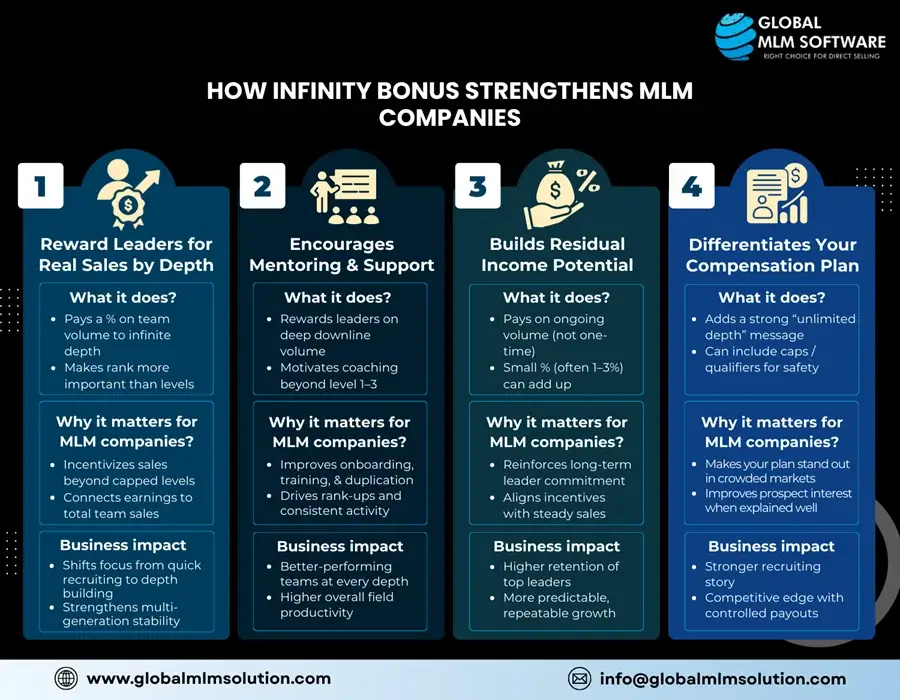
Reward Leaders for Encouraging Real Sales by Depth
Whether it’s a level-based bonus or matching bonus, most MLM companies pay commission to a certain level. Sponsors get no compensation for the sales made by distributors below those levels. Infinity bonus changes that as the level becomes irrelevant and only the rank matters, encouraging the sponsor to focus on depth too.
It pays a fixed percentage on team sales volume to infinite depth.
It links a significant part of the leader’s earnings to the total sales made by the team rather than the first few levels.
Overall, it shifts the sponsor’s behavior from short-term person recruitment to long-term depth management across multiple generations.
Encourage Mentoring, Coaching, and Operational Support
The MLM infinity bonus includes a calculation on the deep downline volume. Therefore, sponsors have a direct financial interest in:
Ensuring recruitment, distributor onboarding, MLM training, and the duplication process are done accurately for all the members in the downline.
Supporting rank advancement and sales activity of mid-level and deep-level downline members.
Monitoring activities and providing feedback to deep-level members to improve their sales rather than focusing on the first 2-3 levels.
Create Long-Term, Residual Income Potential for Top Leaders
The primary driving factor that attracts distributors is long-term residual income. They only need to maintain their ranks and ensure the downline performs as expected:
The bonus is computed on ongoing sales volume, and it’s not a one-time event. So, if the sales occur, the MLM infinity bonus is provided.
Even though the MLM infinity bonus is typically 1% to 3%, the total amount can be significant, as there is no limit on the depth.
Differentiate Your Compensation Plan in a Competitive Market
Very few companies have implemented an infinity bonus in the MLM sector. All compensation plans may appear the same at the surface level: type of plan, retail earnings, team building, etc. However, when an infinity bonus is designed well and communicated thoroughly with the prospects, it can become a key differentiating factor.
Promotes your plan and helps distributors build teams.
You can introduce caps to avoid financial instability and still provide an advantage to prospects that other MLM businesses can’t.
How to Design an Infinity Bonus in MLM That Works?
While the compensation plan of every business varies, the MLM infinity bonus follows a similar structure. However, there are certain aspects on which you need to decide, such as the bonus percentage for each rank, integration with the matching bonus, and qualification criteria. Once you define these parameters, MLM software takes over. It tracks qualified distributors across unlimited levels, applies rank-based percentages, and processes payouts accurately every cycle.
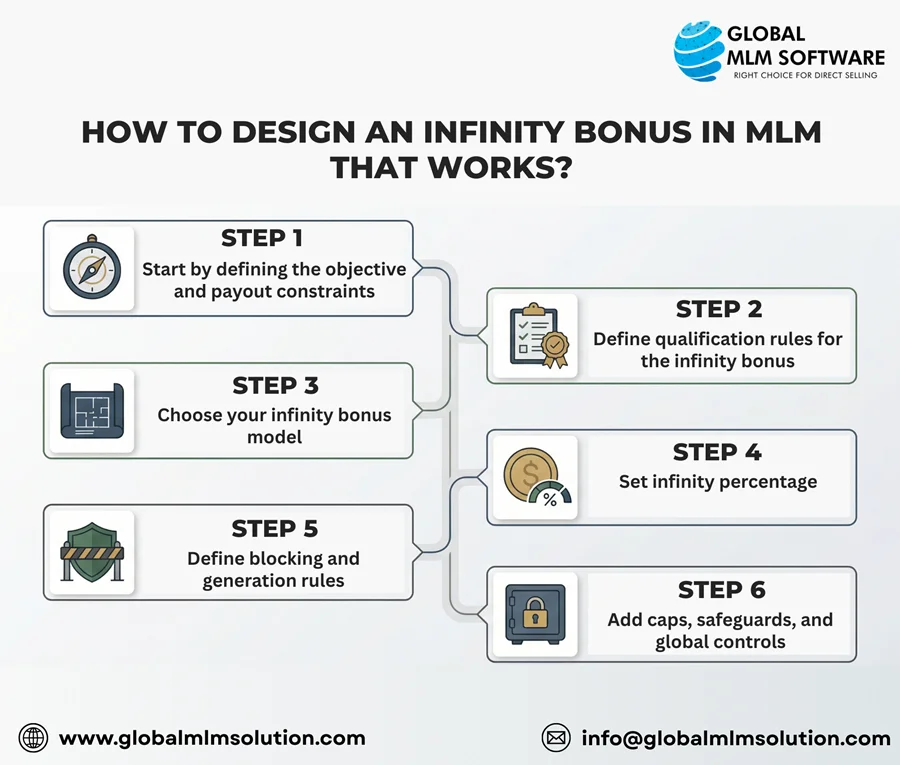
Start by defining the objective and payout constraints
It’s not necessary that you implement the MLM infinity bonus. If you have crossed your payout budget, you should not overdo it.
However, if you have an objective, such as:
Stable and deep team development
Improving the mentorship and leadership skills
Improving retention on top rankers
Then, you should consider implementing the MLM infinity bonus.
As mentioned, you must decide how much you can certainly expend for the MLM infinity bonus purpose.
For instance, if the average profit margin is 50%, and out of this, you allocate 30% to commissions and bonuses. 10% of the allocated 30%, which is 3% of the total selling cost, is allocated for leadership components such as the MLM pool bonus and infinity bonus.
So, the share of the infinity bonus should come from this 3%. According to the amount, you decide the infinity bonus percentage for each rank and introduce caps wherever required.
Define qualification rules for the infinity bonus
The MLM infinity bonus is not for every distributor. It’s a benefit for leadership roles to keep them motivated and inspire others to achieve the rank. Therefore, you must set straightforward qualification criteria, which are not so easy that everyone achieves them and not so hard that no one can achieve their benefits.
Let’s discuss different qualification components:
Minimum rank requirement: Set the rank required to get the infinity bonus benefit. For instance, if your MLM compensation plan has 10 ranks, the top 4 should be eligible for the infinity bonus.
Personal PV: You must ensure that distributors don’t rely completely on team sales and the infinity bonus for their earnings. They must ensure they are making personal sales and earning personal volume.
Group sales: You can also necessitate earning a minimum group sales so that sponsors don’t get the benefit of deep-level distributors even when their own team is inactive.
Rank maintenance: Once the distributor achieves a rank, they must hold it for a certain period before receiving the MLM infinity bonus.
Choose your infinity bonus model
The overall amount you pay as an infinity bonus significantly depends on the model you select.
a) Pure Infinity Override
In this model, the infinity bonus percentage remains the same for all the qualified ranks. The payment is made on the earnings of all active members until the downline is blocked by an inactive member. This model is useful when you want to keep the payout controlled and expenditure low.
b) Generational Infinity
The generational infinity model works similarly to the pure infinity override bonus, with only one significant difference. When the downline is blocked by an inactive member, MLM compression occurs, and the person is skipped in infinity bonus calculations. The next active member in the downline takes the position. However, you should not skip inactive distributors infinitely. Such a design can cause financial instability. You can preferably skip inactive members twice.
c) Differential Infinity
In the differential infinity bonus, each qualified rank has a different infinity bonus percentage assigned. Usually, the higher rank receives a higher infinity bonus percentage.
Let’s assume that a 3% infinity bonus percentage is assigned to the higher rank. A 2% infinity bonus percentage is assigned to the lower rank. Then, a distributor on the higher rank earns a 1% (3% - 2%) differential infinity bonus through a downline member on the lower rank and their team.
Pick one of these three payout models based on your business’s risk tolerance, the payout amount allocated to the infinity bonus, and your leadership philosophy.
Set infinity percentage
In this step, you need to set an infinity bonus percentage for each rank. It’s an additional one that you need to follow while choosing the differential infinity bonus model.
While there are no fixed rules for setting an infinity bonus percentage for various ranks, you can follow these best practices that we identified while going through various compensation plans:
You can provide an infinity bonus to the top one-third ranks. For example, if you have fifteen ranks, distributors need to reach the top five ranks to get qualified.
The percentage generally ranges from 1% to 3%. The lowest qualified rank receives 1% of downline PV as an infinity bonus, and the highest rank receives 3%.
The increment in percentage should be 0.5% to 1% based on the number of qualified ranks and how you want distributors to benefit.
Higher ranks should clearly feel the increase in their infinity bonus perk.
Define blocking and generation rules
There are some general rules that create the base of the MLM infinity bonus. You must ensure that they are a part of your MLM compensation plan. It’ll provide a clear understanding to distributors of how the infinity bonus functions and where the earning potential lies.
There will be no infinity bonus earned from distributors who achieved a rank equal to or higher than the sponsor.
When the generational infinity bonus is applied, the number of distributors that can be skipped should be fixed. If there is a change in the percentage after each distributor is skipped, it should be mentioned as well. For instance, consider an infinity bonus percentage is 2%. Once the distributor is skipped, it reduces to 1% for the earnings made by the downline of the skipped distributor.
Add caps, safeguards, and global controls
To make the infinity bonus sustainable, it’s necessary to introduce caps and controls as precautionary measures.
Limit the sponsor’s total income that can come from one leg or team.
Cap on max income per payout cycle from the infinity component.
Decide the maximum percentage of global GV that can be used for the infinity bonus and control the pool value.
What Comes After Designing the Infinity Bonus?
After designing the MLM infinity bonus, you’re already halfway. The next phase is to ensure that it works as expected in the real-world conditions and that distributors understand its implementation.
1. Test, run simulations, and refine
Before you launch your infinity bonus, run different simulation scenarios with various ranks, earnings, and genealogy tree designs. Accordingly, check whether leaders are underpaid or overpaid and confirm that the global payout cap is working as expected.
Do tests by creating different sample organizations, applying compression, differential rules, and recording earnings before and after implementing each feature. Based on the results obtained, refine the percentage caps or qualification requirements. The aim is to make bonuses more attractive and financially stable.
2. Make it field-friendly and transparent
It’s important that your distributors understand the infinity bonus. Even if you design it well, if it’s not conveyed properly to distributors, it won’t be useful.
Clearly mention each rule in the compensation plan and explain it with examples. Also, provide details of its complete execution with scenarios containing placeholder earnings. It will help distributors understand it . You should also make it a part of MLM training so that no distributor skips learning about it.
Infinity Bonus Explained Through an MLM Case Study
Let’s take a look at Shaklee’s infinity bonus in its compensation plan 2024 to get a better understanding of this bonus type.
There are a total of fourteen ranks in Shaklee’s compensation plan, starting from Ambassador I and going up to Presidential Master.
Out of these fourteen ranks, Shaklee provides an infinity bonus to the top five ranks as follows:
| Rank | Infinity Bonus Percentage |
|---|---|
| Key Coordinator | 2% |
| Senior Key Coordinator | 2.5% |
| Master Coordinator | 3% |
| Senior Master Coordinator | 3.5% |
| Presidential Master | 4% |
Disclaimer: Infinity Bonus percentages are subject to rank qualification and may change as per the company’s MLM compensation plan.
There are a few key rules that define Shaklee’s infinity plan bonus:
It allows sponsors to earn an infinity bonus for direct recruits and their downlines.
If there’s an inactive user in the downline, the compensation plan skips it, and the calculations go on as mentioned in the compensation plan.
They follow the differential infinity bonus.
Now, consider that there’s a senior master coordinator, Amy. She has five direct recruits with the following ranks:
Director
Coordinator
Key Coordinator
Sr. Master Coordinator
Presidential Master
So, how does Amy earn an infinity bonus?
The director and coordinator don’t qualify for any infinity bonus. Therefore, Amy will earn 3.5% of the infinity bonus on the PV earned by both recruits and their respective downlines.
The key coordinator qualifies for the infinity bonus and earns 2% infinity bonus. Differential rule applies, and Amy will earn 1.5% (3.5% - 2%) infinity bonus for the PV earned by the key coordinator and its downline.
When Amy and her downline members are on the same rank ( Sr. Master Coordinator ) or higher rank (Presidential Master), she doesn’t earn any infinity bonus through them or their downlines.
Common Challenges of Infinity Bonus in MLM and How to Overcome Them
It's accepted that an infinity bonus turns a good compensation plan into a great one, but it doesn’t come without risks. Poor design or incorrect implementation can create payout pressure, confusion amongst distributors, and qualification issues. Therefore, you should be ready to face these challenges with the right solutions even before getting started.
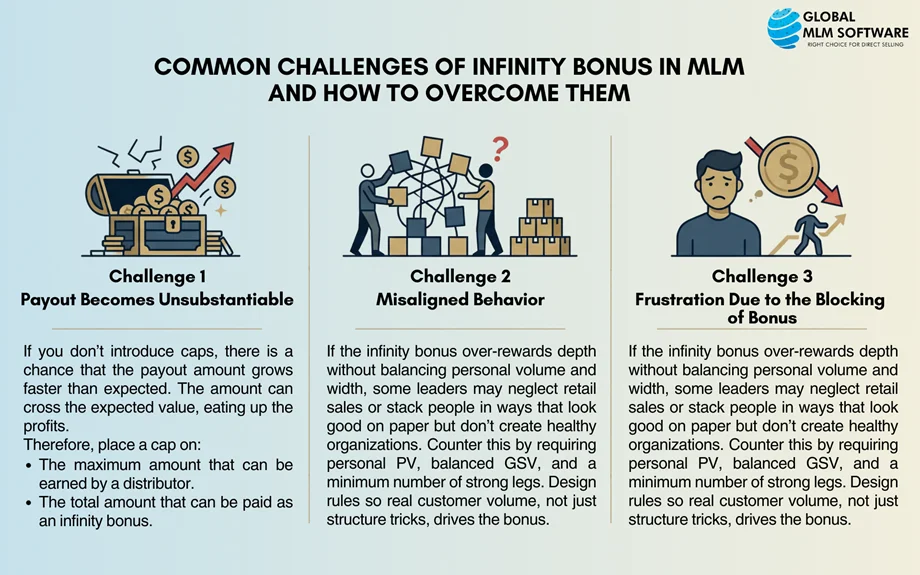
1. Payout Becomes Unsubstantiable
If you don’t introduce caps, there is a chance that the payout amount grows faster than expected. The amount can cross the expected value, eating up the profits. Therefore, place a cap on:
The maximum amount that can be earned by a distributor.
The total amount that can be paid as an infinity bonus.
2. Misaligned Behavior
If the infinity bonus over-rewards depth without balancing personal volume and width, some leaders may neglect retail sales or stack people in ways that look good on paper but don’t create healthy organizations. Counter this by requiring personal PV, balanced GSV, and a minimum number of strong legs. Design rules so real customer volume, not just structure tricks, drives the bonus.
3. Frustration Due to the Blocking of Bonus
When someone in the downline qualifies for the infinity bonus, the bonus amount for the upline decreases. When there’s a sudden decrease in earnings, it can cause frustration. Therefore, when you introduce a differential infinity bonus, the amount doesn’t reduce immediately with advancement in one rank. As the rank increases, the bonus amount from a specific member decreases in steps. Meanwhile, the person can focus on keeping the earnings stable by motivating the members at deeper levels to grow their earnings.
Key Takeaways
The MLM infinity bonus is a leadership-focused add-on to the compensation plan. Adding it helps you motivate leaders to build deeper teams. For higher-level ranks, the earning growth becomes stagnant. At that point, the infinity bonus brings new opportunities as it goes down to multiple levels.
When the qualification criteria are designed right with proper PV, GSV, and qualified leg requirements, it helps businesses keep their distributors motivated without putting pressure on them.
As a result, the infinity bonus creates meaningful residual income for top leaders and clearly differentiates your MLM plan while encouraging depth, mentoring, and long-term team development.
About Global MLM Solution
Global MLM Solution helps MLM businesses across all niches implement the infinity bonus as part of a well-structured compensation plan. Our MLM software solutions for all industries let you define rank-based percentages, set qualification criteria, and automate infinity bonus calculations within a single system.
Our team works with you to configure the infinity bonus in a way that fits your existing comp plan, so it drives depth and leadership development without disrupting your financials. Take a look at our client success stories, or visit our pricing page to find the right plan for your business.
FAQs
1. How does the infinity bonus differ from standard commissions in terms of depth?
In the case of an infinity bonus, the commission goes much deeper than other bonus types. Generational or level-based commission goes as deep as five to seven levels, whereas the infinity bonus can pay down multiple levels.
2. Who is eligible for the infinity bonus?
Normally, only higher-ranking leaders are qualified for infinity bonuses. There are specific criteria, such as rank requirement, PV requirement, GSV threshold, number of active downline members, and number of customers that people need to fulfill to qualify for the infinity bonus.
3. What is the "differential" rule in some infinity bonus plans?
Each qualified rank has a different infinity bonus percentage. In case a downline member also earns an infinity bonus, the sponsor’s infinity percentage changes to the difference between their percentage and the qualified member’s percentage. That’s called the differential rule.
4. What is the primary goal of the infinity bonus?
The primary goal of the infinity bonus is to motivate leaders and team builders to stay longer with the organization and to continuously make efforts. It encourages them to improve production, build depth, and increase the earnings of their downline beyond immediate levels.
5. Is the infinity bonus a standalone plan or an add-on to a main compensation plan?
The infinity bonus is considered an add-on to the main compensation plan. It is an additional reward layered on top of the primary commissions and bonuses.
6. What is the "blocking" mechanism in the MLM infinity bonus?
In many infinity structures, blocking happens when a downline leader also qualifies for the same type of infinity bonus. At that point, some or all of your infinity percentage in that leg stops or reduces, because their qualification partially blocks your earnings.
7. How does the MLM infinity bonus incentivize leadership?
The MLM infinity bonus strongly encourages leadership activities. To receive an infinity bonus, they need to help others grow, too, as the qualification criteria generally require team-building activities such as maintaining GSV and having a certain number of qualified legs.