Summary
This article explains what an MLM Pool Bonus is, how it works, and why it plays a critical role in driving distributor motivation and overall company growth. It explores different profit-sharing models, their advantages and drawbacks, and common challenges companies face when implementing pool bonuses. The blog also highlights real-world case studies and emerging trends shaping the future of MLM pool bonus structures, helping businesses design fair, sustainable, and high-performing reward systems.
The MLM pool bonus is more than just another reward added to your compensation plan. It’s a strategic feature that positively affects distributor behavior. It also helps improve retention rates and build a healthy network.
This article explains the core functionality of the pool bonus, how to design a pool bonus for your MLM business, and different distribution methods. We’ll also provide you with the details of setting it up in your MLM software.
Let’s begin.
What Is an MLM Pool Bonus?
An MLM pool bonus, also known as the global bonus pool, is a reward shared among specific distributors who qualify under certain criteria. The amount of the pool bonus is decided based on the set percentage of the company’s overall sales or profit, or commissionable volume.
The MLM pool bonus is a significant part of the compensation plan. It is implemented and executed using a dedicated pool engine that tracks qualified distributors, the amount collected, the amount per person, and the payout cycle of the pool bonus.
Let’s make it clearer with an example:
An MLM company keeps 2% of the global sales for the pool bonus.
The payout cycle is monthly, and the system computes 2% of the global sales for that specific month.
Consider that the global sales amount is 100 million dollars. Then, the pool bonus will be two percent, which is 2 million.
This pool bonus amount is equally divided among the “Presidential Diamond” rank holders.
So, if there are 20 people on that rank, each one gets 100,000 dollars for that month.
The calculations are done every month, and the amount depends on the global sales.
The MLM pool bonus can be seamlessly incorporated into scalable MLM Management Software and configured to match any company's qualifying ranks, payout criteria, and payout cycles. It is equally adaptable across MLM industries, from health and wellness and beauty to financial services, travel, and e-commerce.
The Strategic Importance of the Pool Bonus in MLM Success
Think of why the pool bonus is introduced. What impact does it have? Once a distributor receives it, they will make every effort to keep getting it. And the ones who haven’t received it yet will work towards it. It keeps distributors moving forward. That’s the direct visible impact. Other than that, its vibrations are felt across different aspects of business. And how does it happen? Let’s dig in to find out.
The Real Reason Top MLM Companies Rely on Pool Bonuses
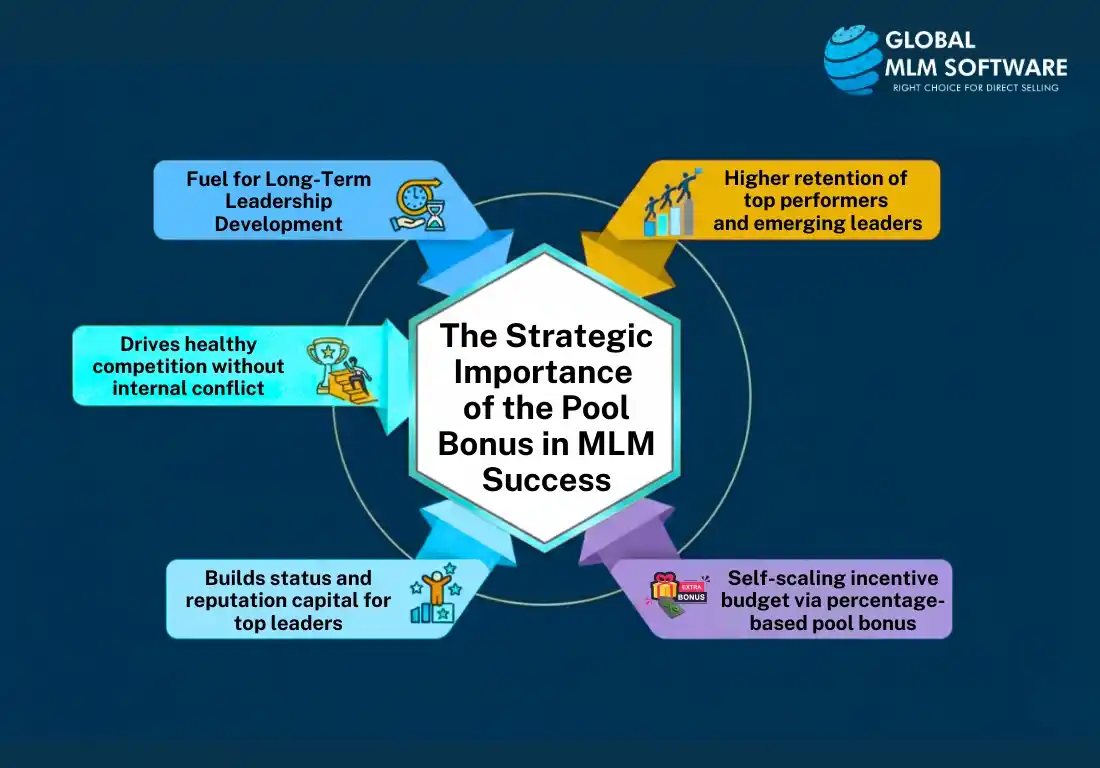
Fuel for Long-Term Leadership Development: Rewards coaching, mentoring, and team growth, not just personal sales.
Ensures Compliance by Reducing Dependency on Recruitment: Shifts focus from recruitment-heavy payouts to performance-driven rewards.
Company Growth and Distributor Goals Become One and the Same: Everyone works toward boosting total sales because the pool benefits all qualifiers.
Helps Top Leaders Build a Reputation: Pool qualification becomes a badge of honor that elevates leadership status.
Higher Retention of Top Performers and Emerging Leaders: Leaders stay motivated with consistent, achievement-based earnings.
Drives Healthy Competition Without Creating Internal Conflict: Distributors push for excellence while supporting each other to grow the pool.
1) Fuel for Long-Term Leadership Development
Most of the MLM companies include three main commission components in their compensation plans:
Personal volume commission: Applied to direct sales made by the distributor.
Team-based commission: Based on the overall team performance.
Leg-based commission: Provided team balance and depth-building in a limited number of legs.
Such a mechanism optimizes local metrics, i.e., the metrics related to distributors: own PV, own team, and own legs.
However, a pool bonus helps optimize macro KPIs, allowing distributors to think beyond their own growth.
The distributors make efforts to drive overall company growth and increase regional revenue.
Gives reason to collaborate with other top distributors and provide insights.
The structure increases the number of new rank achievers under top distributors.
Without a pool, a leader would only work on maximizing the downline volume in strong legs. However, when a pool bonus is added, part of their income depends on global revenue. It makes it rational for them to focus on weak legs to increase the global volume and invest in leadership development activities.
Effectively, the top rank holders will work as business partners, handling your company’s sales rather than just being a distributor whose work is limited to selling and earning.
2) Higher retention of top performers and emerging leaders
When distributors reach the top ranks, growth in their base commission becomes limited as:
They reach the earning caps.
The downline structure becomes saturated with no genealogy spots to add new distributors.
Also, when distributors become top leaders, the focus shifts to team building and mentorship rather than obtaining base commission.
However, a pool bonus is a type of MLM bonus that adds additional income that is not strictly tied to the top individual’s own incremental volume.
This causes several retention effects:
Increased earnings even after the caps: Leaders’ stake in the pool bonus assures them of an increase in earnings as the company grows.
Penalty for leaving: Pool bonus eligibility is restricted to specific ranks, and distributors need to pass qualification management criteria to maintain the rank. If they move to another company, they’ll still receive the base commission and team sales bonus. However, when they lose the rank, the pool bonus goes along with it. Rather than joining another company, it’s rational for them to grow their current MLM business and improve earnings.
Reward for stability: The pool bonus provides them assurance that they’ll receive sufficient earnings every payout cycle, even when other bonuses are low. No distributor would want to leave financial stability.
As a result, the pool bonus works as your MLM company’s retention lock for emerging and top-level distributors.
3) Self-scaling incentive budget via percentage-based pool bonus
From a financial point of view, the MLM pool bonus is attractive. The payout amount completely depends on the global and regional sales. When the global sales are low, the MLM company doesn’t have the burden of making a significant payout as a pool bonus. Similarly, when the sales are high, it doesn’t mean a significant portion is paid through a pool bonus.
The pool rate is usually fixed = 0.02-0.05 (2% to 5%) of the eligible volume.
Eligible volume is typically the global sales. However, when the pool bonus is calculated separately for different regions, regional volumes are counted. Also, there can be some exceptions to the eligibility volume. You can choose not to include low-profit-margin products or specific areas with high taxes.
The overall pool value becomes = Pool Rate X Eligibility Volume
Example, pool rate is 2%
Global sales amount is 10 million dollars. However, some of the products are not included in the eligibility volume. The total sales amount of those products is 1.4 million dollars.
The eligibility volume becomes = 10 million - 1.4 million = 8.6 million dollars
Pool value = 2% X 8.6 million = 170,000 dollars
This amount gets equally divided among individuals of specific ranks. You can alter the eligibility volume to keep the pool value sustainable and avoid financial burden.
Also, you can easily configure multiple pools as independent objects if you want to pay separately for different regions.
4) Builds status and reputation capital for top leaders
We already checked the benefits of the MLM pool bonus as a cash-flow event. Its primary benefits also include a signaling mechanism inside the field organization that powers:
Public recognition of the MLM pool bonus holders.
Leaderboards in the distributor dashboard to inspire others.
Motivation for other members in the downline to improve their earnings.
New distributors see pool qualifiers as idols.
Cross-line teams collaborate with MLM pool bonus holders to improve.
It helps MLM businesses identify field advisors and council members, as pool holders play significant roles in the company’s growth.
Because pool eligibility is tied to rank, structure, and MLM compliance, the recognition is anchored to measurable performance, which makes it defensible and harder to dispute.
5) Drives healthy competition without internal conflict
The best part of the MLM pool bonus is that it builds competitive pressure without triggering “winner-takes-all” contests. It saves the MLM business from internal conflicts and motivates all teams to work together.
Unlike the “one-person” award, which is only provided to the first-ranking individual, the pool bonus:
Allows multiple people to qualify without the need to perform better than other distributors. They aim to qualify the criteria and not to move ahead of their colleagues.
Let new qualifiers take the pool benefits without replacing other members.
Rewards absolute performance and not relative performance. So, they have to cross the finish line; it doesn’t matter who crossed first.
Because of the MLM pool bonus’s structure, leaders direct their efforts towards hitting the performance benchmarks, rather than lobbying and favoritism.
How Does an MLM Pool Bonus Work?
Implementing the MLM pool bonus looks straightforward. But it’s the result of a combined functioning of a structured approach, clearly defined objectives and rules, and a specific qualification engine. Let’s get into detail on how it works.
MLM Pool Bonus: Process and Mechanics Explained
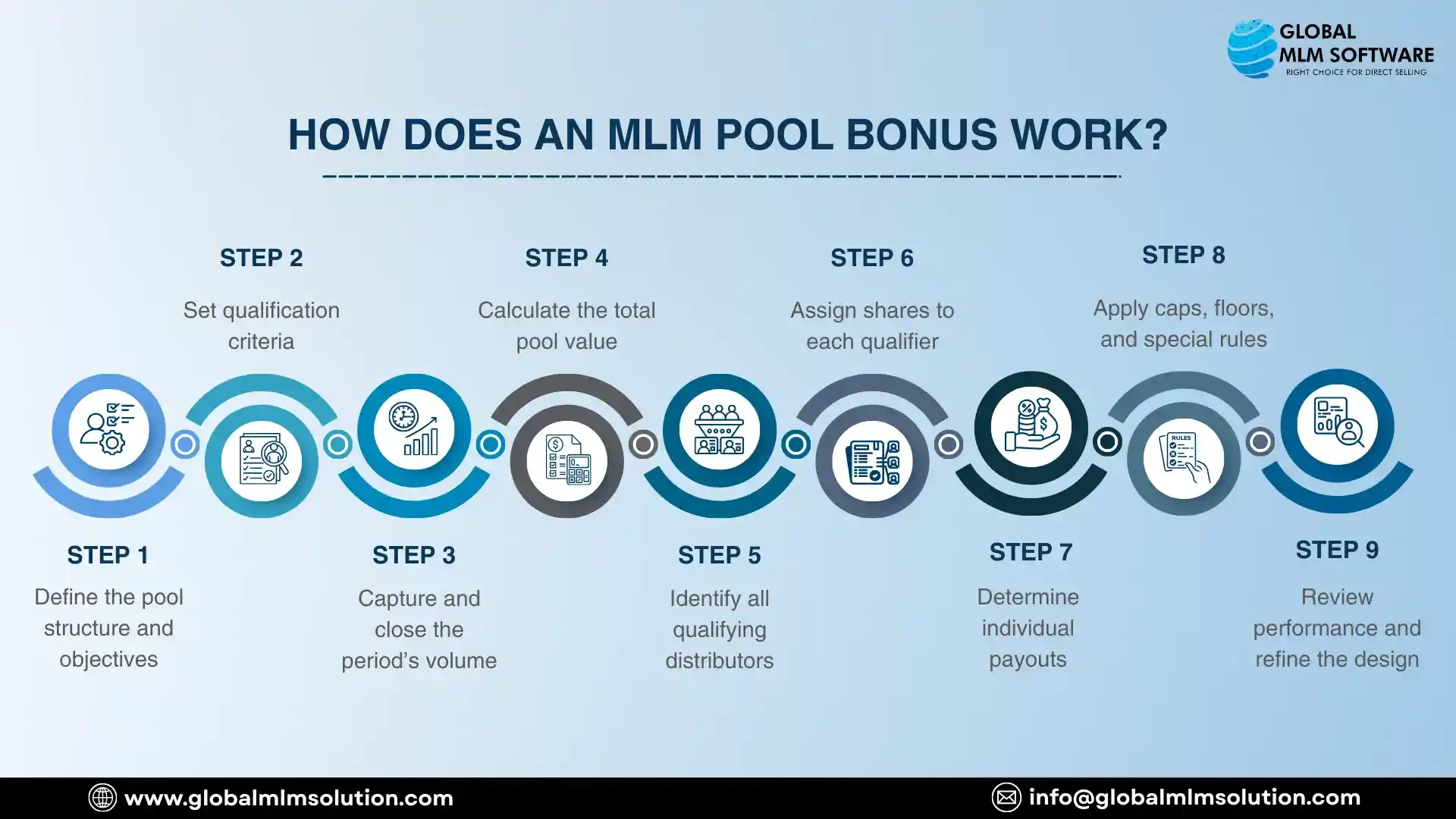
Define the pool structure and objectives
- Decide purpose: leadership reward, rank push, product/region focus.
- Choose funding base: global, regional, or product-line volume.
- Set pool rate (1–5%) based on margins and existing commissions.
Set qualification criteria
- Define required rank, PV, GV, and leg structure.
- Add activity/compliance rules (KYC, no red flags).
- Include any time rules (e.g., maintain rank for N months).
Capture and close the period's volume
- Record all orders, returns, and adjustments.
- Aggregate eligible volume by global, region, or product line.
- Exclude non-qualifying transactions.
Calculate the total pool value
- Apply the pool rate to the eligible volume.
Identify all qualifying distributors
- Run the qualification rules in MLM software.
- Produce a final list of pool participants.
Assign shares to each qualifier
- Choose a share model: equal-share, rank-tiered, or volume-weighted.
- Assign shares per distributor based on the chosen model.
Determine individual payouts
- Convert shares into payout amounts based on the total pool value.
- Generate a clear breakdown for each participant.
Apply caps, floors, and special rules
- Limit maximum payout per distributor if needed.
- Set a minimum payout threshold to avoid tiny checks.
- Ensure rules support fairness, compliance, and sustainability.
Review performance and refine the design
- Analyze impact on sales, rank advancement, and retention.
- Gather field feedback.
- Adjust pool rate, criteria, or share model as needed.
Step 1: Define the pool structure and objectives
As soon as you decide to introduce the MLM pool bonus to your business, the first thing to identify is “What’s the aim of the pool bonus, and who it’s for?”
Take a key decision on how the pool should be funded: Global commissionable volume, region-specific volume, or a specific product line’s volume.
This decision will directly affect the pool volume.
The Second aspect to decide on is the pool rate, which generally ranges from one to five percent. There are certain factors according to which you can decide your pool rate:
Profit margin: If your products have higher profit margins, you can go for a higher pool rate. If not, keep the pool rate low. If the profit margins differ for various products, calculate the average.
Base commissions and other bonuses: When base commission and bonus percentages are on the higher side, keep the pool rate low, as you are already contributing to distributors' earnings in the formats.
Business stage and growth strategy: Early-stage or high-growth MLM companies can choose a higher pool rate to build momentum and reward distributors aggressively. As the business matures, you can reduce the pool rate slowly, without affecting the earnings much.
The third aspect is to decide the participant group. The pool bonus in MLM is not for all distributors; otherwise, it would lose its value. So, keep it restricted to specific ranks.
| Number of Ranks | Pool Bonus Participant |
|---|---|
| Five or fewer than five ranks | Only the top rank |
| Five to ten ranks | Top three ranks |
| Ten to fifteen ranks | Top four ranks |
| More than fifteen ranks | More than four ranks |
Lastly, you need to decide the purpose:
Reward global leaders
Accelerate rank advancement
Increase product awareness
Based on the purpose, you can revisit all the aspects and ensure that they align with it.
When basic components of the structure are decided, it’s time to move forward to the next step.
Step 2: Set qualification criteria
Your next step is to decide the exact rules a distributor must meet to become an MLM pool participant for a specific payout cycle.
Rank requirements: The distributor must comply with rank advancement criteria and achieve the rank for which the MLM pool bonus is provided.
Volume thresholds: They must pass the minimum PV requirement to show personal activity and the GV to show leadership products.
Activity and compliance: There must not be any compliance red flags or pending tasks. KYC and payment info must be completed and updated.
Time-related rules: Before receiving the pool bonus, they must maintain the rank for certain months.
Overall, the qualification criteria must not be so easy that a large number of distributors become pool participants. On the other hand, it should not be so demanding that it becomes tough for any distributor to pass.
Step 3: Capture and Close the Period’s Volume
At the end of each payout cycle, the company needs to identify the eligible volume for calculating the MLM pool amount.
For that, they need to perform the following activities:
Record all the product orders, returns, and adjustments, and calculate the associated PV and GV.
Add the total PV and GV for the global pool. Add separately for different regions for regional pools. Calculate for specific products or line-ups for product-based pools.
Convert multiple currencies to a common base if needed.
Ensure non-qualifying transactions.
Once this is done, calculate the eligible volume for the MLM pool bonus.
Step 4: Calculate the total pool value
Now, the pool rate is applied to the eligible volume.
The base formula is pool value = pool rate X eligible volume
When it’s the global volume, the global eligible volume is considered. For regional volume and product-specific volumes, calculate the eligible volume for particular regions and products, respectively.
Also, you can implement a cap on the total pool value. For instance, consider the pool value is 30 million dollars. If a 20 million dollar cap is present, the pool value becomes 20 million, despite the pool rate.
After this step, you’ll have a fixed amount that needs to be distributed among the qualified participants. This takes us to our next step.
Step 5: Identify all qualifying distributors
In step 2, we already discussed setting up the qualification criteria. In this step, you only need to check distributors against set criteria.
As you won’t do it manually, you’ll need reliable MLM software by your side. You can implement the criteria in the software, and it will automatically identify the distributors.
Step 6: Assign shares to each qualifying distributor
Once the qualifiers are known, the next step is to decide how many shares each distributor gets.
Different models are followed for assigning shares.
Pros and Cons of Different Share Models for MLM Pool Bonuses
| Model | Pros | Cons |
|---|---|---|
| Equal-share model |
• Very simple to explain and administer. • Perceived as fair when qualifiers are similar in size. |
• Weak incentive to advance in rank. • Top leaders may feel under-rewarded. |
| Rank-tiered model |
• Strongly motivates rank advancement. • Rewards higher responsibility at upper ranks. |
• Can over-concentrate payout at the top. • Lower ranks may feel their share is too small. |
| Volume-weighted model |
• Closely links payout to real sales performance. • Can target specific behaviors (product lines, balanced legs). |
• More complex to design and track. • Lower-volume high ranks may feel unfairly treated. |
Equal-share model
In this model, all qualified distributors get an equal number of shares irrespective of rank and type of products sold. This works well when you want to keep things straightforward for your business. However, the major disadvantage is that distributors may lose motivation to move forward in the rank if this perk stays the same as they ascend the ladder.
Rank-tiered model
In this model, distributors with higher ranks get more shares. For instance, consider that there are three ranks: first, second, and third, with first being the highest, followed by second, and third being the lowest.
So, the first gets 4 shares, the second gets 2 shares, and the third gets 1 share. Similarly, you can have different share combinations and find the one that fits your compensation plan.
A rank-tiered model works best when you want to keep your distributors motivated. They keep moving upward in the rank advancement ladder.
Volume-weighted model
There are many ways in which the volume-weighted model works. You can make the shares proportional to GV, volume for specific product lines, and the number of qualified legs.
In this model, there are changes that higher-ranking distributors get lesser shares than lower-ranking members do. Also, it makes the system too complicated, requiring dedicated attention.
The only benefit you get here is that it creates a closer link between the actual sales and the reward.
Step 7: Determine share value and individual payouts
Once the share model is decided and shares are assigned to distributors, go ahead with calculating the share value.
One share value = Total pool value/number of shares
For calculating the number of shares, different formulas are applied as per the selected model.
1) For the equal-share model
Number of shares = number of distributors X number of shares assigned to each distributor.
So, one share value = Total pool value / [number of distributors X number of shares assigned]
Let’s consider,
- Pool value = 10 million dollars
- Number of distributors = 100
- Number of shares assigned to each distributor = 2
One share value = 10,000,000/(100 X 2) = 50,000 dollars
So, each distributor gets = one share value X number of shares assigned = 50,000 X 2 = 100 thousand dollars.
2) For a rank-tiered model
Calculations get a bit complicated here as distributors’ shares are different for every rank.
Therefore, one share value =
Total pool value / [no. of distributors on rank 1 X number of shares assigned to rank 1] + [no. of distributors on rank 2 X number of shares assigned to rank 2] + [no. of distributors on rank 2 X number of shares assigned to rank 2]
Let’s take the same data to understand it better:
Pool value = 10 million dollars.
Let’s apply the formula
= 10,000,000/ (15 x 4) + (35 X 2) + (50 X 1)
= 55,555 dollars
So, how much of the MLM pool bonus amount will be received by qualified distributors of different ranks:
Rank 1 distributors = 55,555 X 4 = 222,220
Rank 2 distributors = 55,555 X 2 = 111,110
Rank 3 distributors = 55,555 X 1 = 55,555
Step 8: Apply caps, floors, and special rules
Before finalizing the payout, it’s essential to apply caps and special rules to ensure transparency, distributor compliance, and financial sustainability.
You can set controls such as:
Maximum payout per distributor
You can set a limit on the percentage a distributor can hold. When there is a limited number of qualified distributors, each will receive a high percentage of the total pool value.
For instance,
The pool value is 10 million dollars.
The number of qualified distributors is eight
So, each will receive 100/8 = 12.5% of the pool value.
10 million dollars X 12.5% = 1.25 million dollars.
Let’s say, if you introduce a percentage cap of 10%, then the distributor will receive 1 million. The remaining amount stays in the MLM business’s account.
Such a measure prevents extreme concentration of payout in a few people.
Similarly, rather than a percentage, you can also go for the maximum payout amount that a distributor can have. However, you’ll need to change that for every payout cycle to align it with the pool value.
Minimum payout threshold
The minimum payout threshold decides the minimum share value required to make the payout. If the share value is less than a certain amount, either no payout is made, or the pool is carried forward to the next payout cycle.
So, let’s say,
Minimum payout threshold = 5,000 dollars
Number of qualified distributors = 500
Pool value = 1 million dollars
Considering the equal share model, the share value is 1,000,000/500 = 2,000 dollars
So, the share value is less than the minimum payout threshold. In such cases, the payout becomes zero, or you can choose to add the current pool value to the pool value of the next payout.
After the caps and special rules are applied, you can initiate the payout and let your distributors receive the MLM pool bonus.
Step 9: Review performance and refine the pool design
After several pool bonus payout cycles, you’ll have enough data to understand the impact, review performance, and refine the design.
You must generate reports that answer the following:
How did it increase the overall sales?
What was the impact on rank advancement?
Are distributors satisfied with the pool amount?
Are the qualification criteria too easy or too tough to pass?
Compare the metrics (sales, retention, rank advancement) before and after introducing the pool bonus. If the pool bonus was there from the beginning, you can conduct a survey and request distributors to provide feedback.
Common Challenges of MLM Pool Bonuses and How to Overcome Them
While introducing a new compensation element, you can expect some friction. There will be challenges, but if you stay prepared for them, it becomes easier to overcome and move forward. Let’s check them out and stay one step ahead:
Key Challenges of MLM Pool Bonuses and Practical Fixes
| Challenge | Solution |
|---|---|
| Highly volatile payout | Use longer payout cycles (half-yearly/yearly) so results average out, and bonuses are more stable. |
| Over-concentration at the top | Soften share multipliers and add caps on max % per distributor. |
| Complexity & low transparency | Simplify rules, document them clearly, and include examples and training in your compensation rollout. |
| Misalignment with payout budget | Set pool rate from margins and target payout; use caps and review actual vs planned regularly. |
| Regulatory & compliance risks | Fund pools from product sales, enforce minimum PV, and focus on sales to true end customers. |
Highly Volatile Payout
The pool value amount is based on a fixed percentage of the sales. Any spike or dip in the sales can change the MLM pool bonus amount. This makes the income unpredictable for the distributors.
Usually, go for a half-yearly or yearly payout cycle for the MLM pool bonus. Over a longer period, it averages out the sales and makes the earnings predictable.
Over-concentration of payout to a few distributors
A small group of top leaders owns a large share of payouts, leaving mid-tier leaders with small amounts.
It is necessary to provide more shares to higher-ranking individuals, as that’s what motivates lower-ranking members to grow. However, it makes the share multipliers too aggressive. Rather than incrementing the number of shares as 2X, 4X, and 8X with each rank, increment it as 1.2X, 1.5X, and 2X, where X is the value of one share. You can also introduce caps to avoid this issue.
Complexity and Lack of Transparency
With qualification criteria, incremental shares, caps, and many other elements, the MLM pool bonus becomes highly complex. Distributors who can’t understand it can’t work towards it. They may distrust the system or ignore it.
You must clearly define the core rules, qualification criteria, share logic, and funding rate in the compensation plan. Also, add example calculations to make it easier for distributors to understand. You can also make it a part of your MLM training program.
Misalignment with Payout Budget
If the pool rate is set without proper modeling, the total payout goes above the budget. You can’t undo the commitment or change the pool rate once declared. This can cause financial instability.
Create the pool rate based on profit margins, existing commission percentage, and desired total payout. Put caps to avoid paying above the budget, even when the pool rate is higher than it should be. Regularly review the actual payout vs. the planned payout. Adjust the pool rate or caps accordingly to keep it sustainable.
Regulatory and compliance risks
If the pool is driven by recruitment volume rather than genuine product sales, it can cause regulatory issues.
Base your pool funding primarily on the product sales volume. There must be a minimum personal volume that distributors need to achieve to qualify for the MLM pool bonus. Besides that, ensure that most of the sales come from selling it to the end customers who are not related to your MLM business in any way. This is a major requirement to fulfill the MLM compliance checklist.
Case Studies of MLM Pool Bonus
Most of the existing MLM businesses provide a pool bonus, and we have examined all of them. Some of them were too complicated, while a few were vague. Out of all existing ones, we are going to go through 4Life’s pool bonus design. It’s straightforward, easy to understand and implement, and works for businesses getting started.
Let’s begin by outlining a few fundamental aspects of the 4Life’s pool bonus design:
The MLM pool bonus is paid monthly.
There are fifteen ranks in 4Life’s compensation plan, starting from Associate and having Platinum Elite at the top. Out of fifteen ranks, 4Life offers a pool bonus to the top eight ranks. So, they reward mid-ranking to top-ranking distributors.
They follow a rank-tiered bonus, which is split into two parts.
2% of the LP (life points), which is nothing but point volume, is assigned to ranks 8th to 3rd.
1% of the LP is assigned to the top two ranks separately.
So, the calculations for the 8th to 3rd rank and the top two ranks are done separately.
In the first part, the Bronze rank (8th) receives one share, and it goes up to Gold Elite (3rd), receiving 32 shares.
In the second part, the Platinum rank (2nd) gets one share, and Platinum Elite (1st) gets two shares.
Look at the table for a better understanding:
| Rank | Shares |
|---|---|
| Part 1 (Separate Pool Bonus of 2% of total PV) | |
| Bronze | 1 |
| Bronze Elite | 2 |
| Silver | 4 |
| Silver Elite | 8 |
| Gold | 16 |
| Gold Elite | 32 |
| Part 2 (Separate Pool Bonus of 1% of total PV) | |
| Platinum | 1 |
| Platinum Elite | 2 |
Now, let’s take an example amount to know how the MLM pool functions
Total PV = 1,000,000
Pool rate = 2% (for the first part) and 1% (for the second part)
Total qualified distributors in the first part: 146
Value of each share in the first part:
= 2% X 1,000,000/(40 X1) + (34 X 2) + (25 X 4) + (22 X 8) + (13 X 16) + (12 X 32)
= 2% X 1,000,000/976
= 20.49
Total qualified distributors in the second part: 11
Value of each share in the second part:
= 1% X 1,000,000/(7 X 1) + (4 X 2)
= 1% X 1,000,000/15
= 666.67
Total qualified distributors on each rank
| Rank | Number of Qualified Distributors | Pool amount (in PV) received by each distributor(share value X number of assigned shares) |
|---|---|---|
| Bronze | 40 | 20.49 X 1 = 20.49 |
| Bronze Elite | 34 | 20.49 X 2 = 40.98 |
| Silver | 25 | 20.49 X 4 = 81.96 |
| Silver Elite | 22 | 20.49 X 8 = 163.92 |
| Gold | 13 | 20.49 X 16 = 327.84 |
| Gold Elite | 12 | 20.49 X 32 = 655.68 |
| Platinum | 7 | 666.67 X 1 = 666.67 |
| Platinum Elite | 4 | 666.67 X 2 = 1333.34 |
The best part about this MLM plan design is that the payout doesn’t get concentrated at the top. Also, separating pool calculations for Platinum and Platinum Elite motivates distributors to advance ranks for better earnings.
Future Trends of MLM Pool Bonuses
As data-based decision-making, customer-focused activities, and compliance-oriented plan design become critical to MLM businesses, new trends emerge. Here, we are going to discuss those trends and how you can keep your MLM pool bonus targeted, transparent, and strategically controlled.
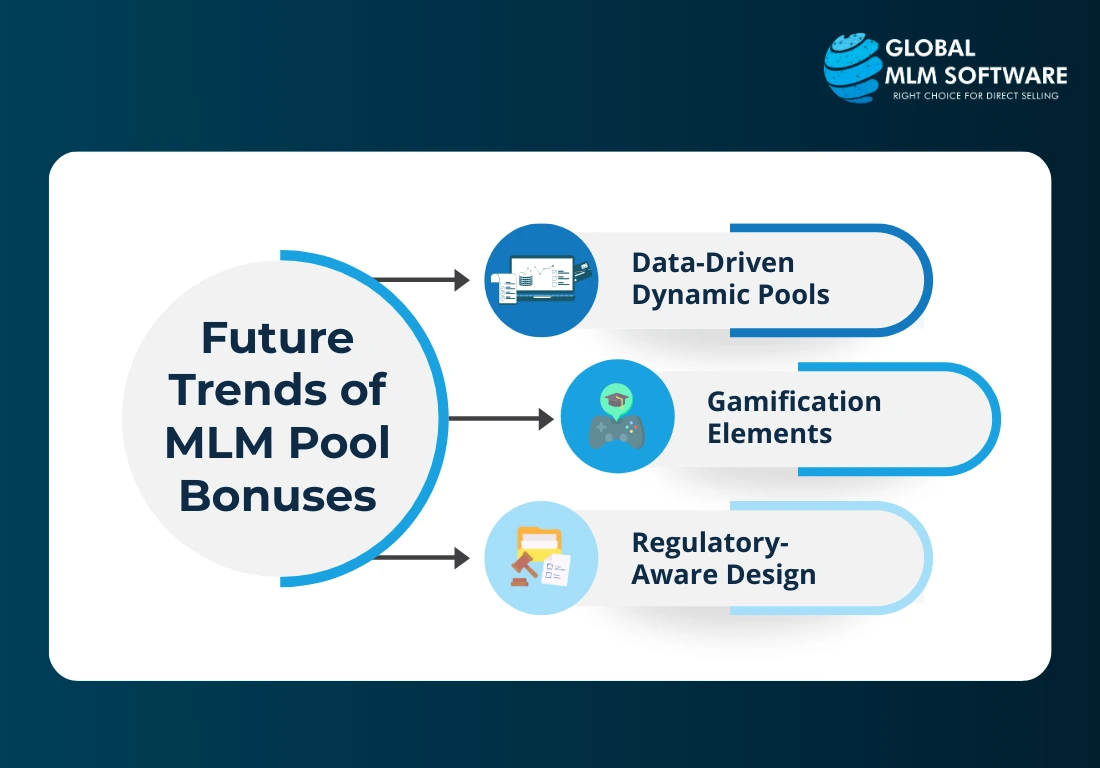
Data-driven dynamic pools: Real-time dashboards showing estimated pool amount and number of qualified distributors based on predictive analytics.
Gamification elements: Provide progress bars and countdown timers on distributors’ dashboards to develop excitement. Provide badges to qualifiers and place their names on the leaderboard. They earn a reputation, and you earn distributor motivation.
Regulatory-aware design: While businesses are ensuring compliance currently, activities are expected to become robust with advanced encryption tech, role-based data sharing, and red-flag alert systems.
Key Takeaways
There’s no doubt MLM pool bonus is a powerful leadership tool when it’s designed correctly. To get started, you need to analyze the historical sales data and payout amounts. Based on that, calculate the profit margin and amount you can allocate as an MLM pool bonus without assuming future sales growth. If you are starting a new MLM company, take industry standards as a reference point.
Accordingly, decide on the pool rate, caps, eligibility criteria, and share model. Keep in consideration that the primary aim is distributor growth while ensuring financial sustainability.
About Global MLM Solution
Global MLM Solution is a leading MLM software provider that supports all major compensation plans with a fully customizable pool bonus module built for businesses across industries. Explore our client case studies to see how we have helped companies design and implement high-performing compensation plans.
Ready to get started? Visit our MLM software pricing page to find a plan that fits your business needs and build a pool bonus structure that drives distributor growth while keeping your financials sustainable.
FAQs
1. How is the pool value determined in an MLM pool bonus?
Pool value is determined by multiplying the pool rate by the total eligible volume. For instance, the global sales are 10 million dollars, which is considered the eligible volume. Now, if the pool rate is 2%, the pool value becomes 200,000 (2% of 10 million dollars).
2. How is the payout distributed among distributors in an MLM pool bonus?
Payout is distributed among distributors as per their share count in an MLM pool bonus. Depending on the share model, higher-ranking distributors usually receive more shares, while middle-ranking members receive fewer shares. You need to ensure that distributors stay motivated for rank advancement and practice stays fair without the bonus amount being concentrated on top ranks.
3. What are some key features and considerations of MLM pool bonuses?
Key features include a fixed percentage of volume as pool rate, clear qualification rules, and a defined share model. When designing the model, you have to consider that the payout amount doesn’t exceed the expectation, not over-concentrating income on the top, and a compliant design.
4. What types of targeted incentives can the MLM pool bonuses fund?
MLM pool bonuses can target a wide range of incentives, such as:
Leadership activities
Rank advancement
Product-line promotions
Market expansion
Customer-centric behavior
5. How is the pool for the MLM bonus created?
To create a pool for the MLM bonus, you need to follow these steps:
Choose a funding base: global sales, regional sales, or product-line sales.
Set a pool rate based on profit margin and existing payouts.
Find the pool value by multiplying the eligible volume by the pool rate.
6. What are the types of distribution for an MLM pool bonus?
There are mainly three types of distribution models:
Equal-share model: All qualified distributors receive the equal MLM pool bonus amount.
Rank-tiered model: Higher ranks receive more shares than lower ranks, linking pool payout to rank.
Volume-weighted model: Shares are allocated based on the performance metrics, such as GV and specific product-line volume.