
Summary
This blog explains MLM performance bonuses, including their types, benefits, and how to design effective bonus structures. It also highlights common challenges and practical solutions to help direct selling leaders motivate teams, increase sales, and drive sustainable business growth.
In direct selling, commissions often get most of the attention. However, distributors experience significant pay jumps from performance bonuses. These bonuses are designed to reward leaders who consistently hit targets such as team volume, rank advancement, retention, or leadership development.
For dedicated MLM businesses, understanding and implementing performance bonuses isn’t optional. It helps you boost distributor retention, allows them to train their downline with clarity, and avoids their frustration of “almost qualifying” but missing by a small margin.
This guide breaks down what MLM performance bonuses are, how they work, how to set qualifications, common problems businesses face, and where performance bonus programs are headed next.
What is a performance Bonus in MLM?
A performance bonus in a network marketing plan is a conditional, time-bound incentive payout earned when a distributor or leader reaches specific, measurable targets within a set period, most commonly on a weekly, monthly, quarterly, or annual basis.
Unlike standard commissions, which are usually calculated directly from product sales volume, the performance bonus is structured to reward behaviors and outcomes that signal healthy growth and leadership, such as:
Moving to a new rank and meeting any required hold period
Achieving defined team or group sales volume milestones
Keeping a required number of personally sponsored members active
Developing qualified leaders, holding certain ranks, across multiple legs
Improving retention, reorder rates, or overall consistency
Meeting customer acquisition or active-customer targets
Commissions keep the business moving, while performance bonuses are designed to accelerate momentum by rewarding leaders who build stable, repeatable results over time.
Tracking and automating these calculations accurately across a growing network is something MLM software handles natively. It calculates that every performance bonus is processed correctly based on the defined criteria within the compensation plan.
Types of MLM Performance Bonuses
The MLM performance bonus typically follows a few repeatable structures, having specific business objectives, such as faster rank progression, deeper leadership creation, steadier volume, or improved retention. That’s why understanding the category helps leaders interpret what the company is actually incentivizing.
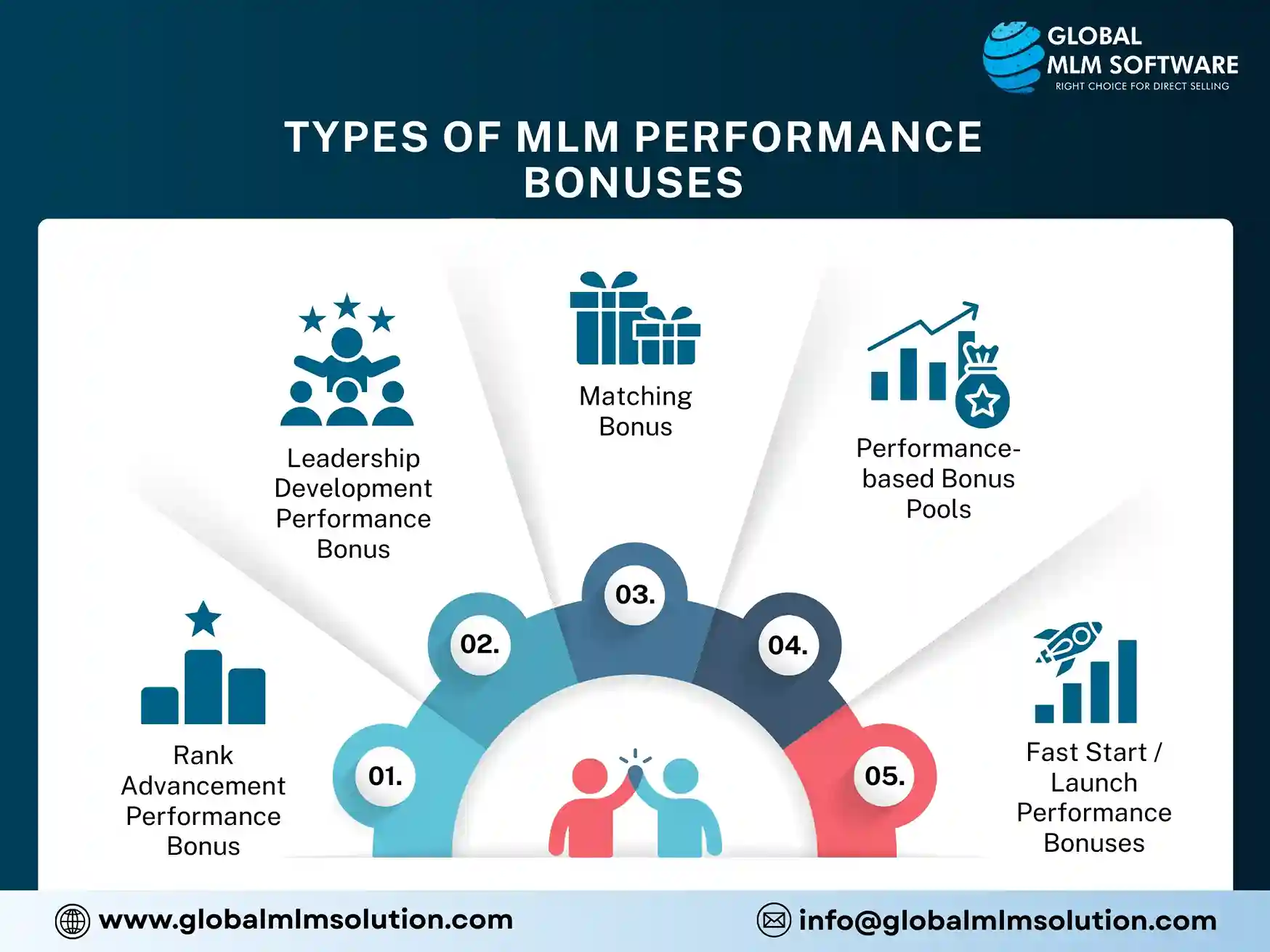
Rank Advancement Performance Bonus
A rank advancement performance bonus is a milestone payout triggered when a leader achieves a new title under the compensation plan within a defined qualification period. It is usually tied to rank rules such as minimum personal volume or group sales volume.
Because rank movement can be temporary, many companies require “hold” conditions. In such cases, the distributor needs to maintain the achieved rank for one or more consecutive payout cycles.
Leadership Development Performance Bonus
A leadership development performance bonus rewards your distributors for upscaling new distributors and turning them into new qualified leaders within the organization. Rather than paying purely on sales output, this bonus focuses on rewarding depth-building and duplication by requiring downline members to reach defined leader ranks and meet minimum activity thresholds.
Matching Bonus
A matching bonus is a type of performance bonus that pays a qualified sponsor a percentage of the eligible earnings generated by downline leaders.
It helps you compensate your sponsors for training, support, and duplication rather than only sales-based activities.
Performance-based Bonus Pools
There are several bonuses that you can introduce to your compensation plan: leadership-based bonus pool, an infinity bonus pool, etc. Bonus pools allocate a defined portion of company revenue or commissionable volume into a shared fund, then distribute it among qualifiers based on rank, points, or “shares.”
MLM businesses introduce pool mechanics because they provide budget control and allow strategic tuning to prioritize targets, such as retention, customer growth, or leadership depth.
Fast Start / Launch Performance Bonuses
Fast start and launch bonuses measure time-bound performance and incentives for early sales and team-building activities. Leader-focused versions reward sponsors for helping new recruits complete key behaviors:
- First customer orders
- Initial PV
- First presentations
- Early rank advancement
MLM companies frequently add guardrails such as minimum customer volume, net volume after returns, and limits on counting self-purchases toward qualification to ensure MLM compliance.
How to Design MLM Performance Bonuses?
Designing performance bonuses in an MLM plan is not just about adding extra payouts. It’s about motivating the right behaviors, rewarding genuine effort, and encouraging sustainable growth across the network. A well-structured bonus system aligns distributor actions with business goals while remaining fair, simple, and transparent. Below is a practical step-by-step approach to creating performance bonuses that actually work.
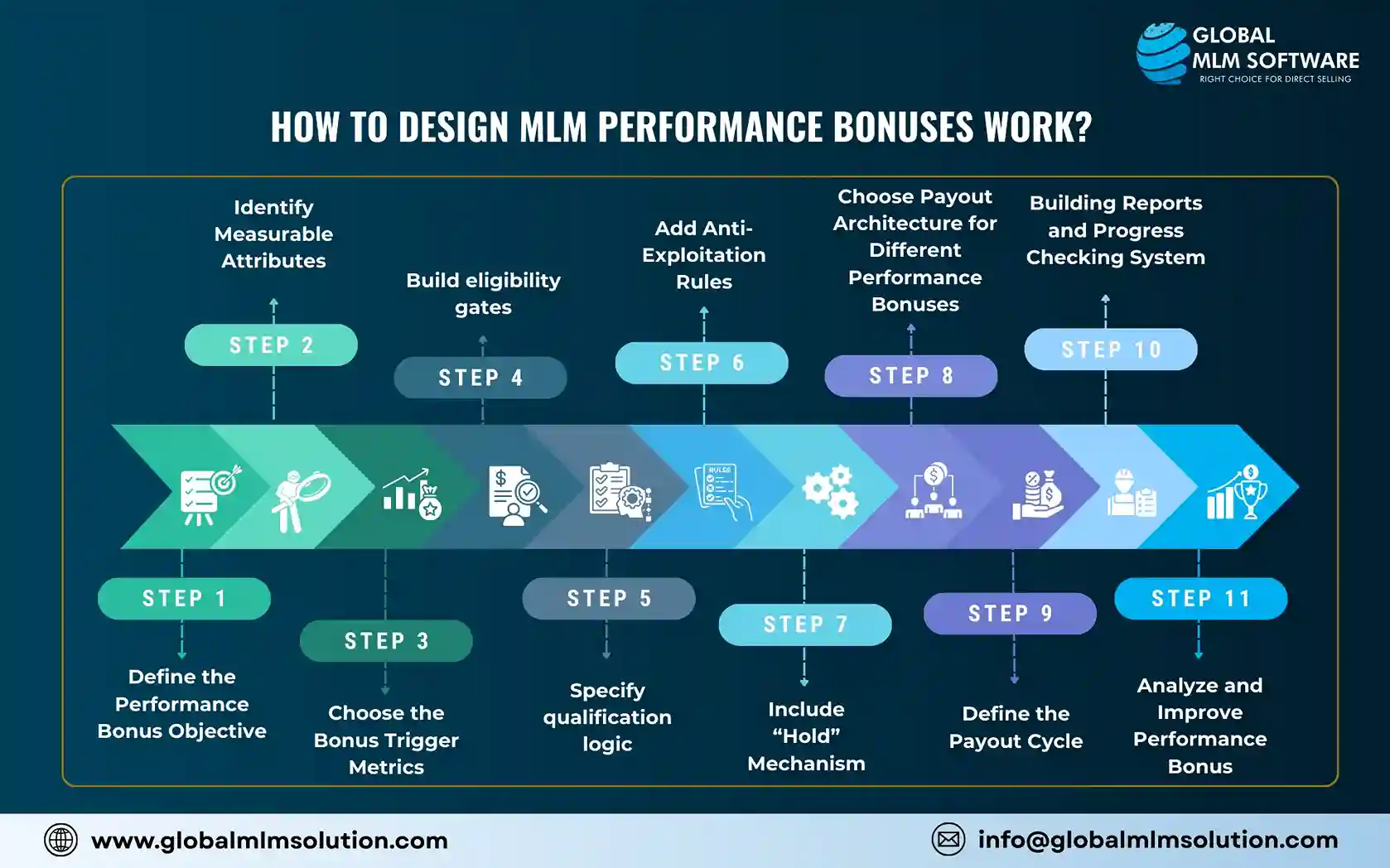
Step 1: Define the Performance Bonus Objective
Start by being clear about why the bonus exists. Every performance bonus should serve a purpose. Are you trying to increase sales volume, promote leadership development, improve customer retention, or accelerate recruitment?
If the objective isn’t defined first, the bonus can quickly become expensive without driving meaningful results. A focused goal ensures the bonus supports business growth instead of becoming just another payout.
Step 2: Identify Measurable Attributes
Once the objective is clear, determine what behaviors or outcomes can be measured. Performance must be tied to numbers that are trackable and verifiable.
These might include personal sales, team volume, new enrollments, customer orders, or rank advancements. Avoid vague indicators. If you can’t measure it accurately, you can’t reward it fairly.
Step 3: Choose the Bonus Trigger Metrics
Trigger metrics are the specific thresholds that activate the bonus. Think of them as milestones participants must hit before a reward is unlocked.
For example, a distributor may need to reach a certain monthly volume or maintain a team growth rate. The triggers should be challenging enough to inspire effort but realistic enough to feel attainable.
Step 4: Build Eligibility Gates
Eligibility gates help maintain quality and prevent inactive members from receiving rewards. These gates define who is qualified to participate in the bonus program.
Common requirements include minimum personal purchases, active status, or compliance with company policies. Gates ensure bonuses are paid only to engaged and contributing distributors.
Step 5: Specify Qualification Logic
Qualification logic explains how performance is calculated. This includes rules such as whether volume rolls up or compresses, if carry-forward volume is allowed, or how ties are handled.
Clear logic removes confusion and disputes. When distributors understand exactly how they qualify, trust in the compensation plan increases.
Step 6: Add Anti-Exploitation Rules
Without safeguards, even well-designed bonuses can be gamed. Distributors may attempt artificial activity, bulk ordering, or temporary spikes just to trigger payouts.
Introduce policies that discourage manipulation, such as order caps, customer validation, or cooling-off periods. The goal is to reward genuine performance, not loopholes.
Step 7: Include a “Hold” Mechanism
A hold mechanism temporarily withholds part of the bonus until certain conditions are confirmed. This protects the company from returns, cancellations, or fraudulent activity.
For example, a percentage of the payout might be released after 30–60 days once sales are verified. This adds stability and reduces financial risk.
Step 8: Choose the Payout Architecture for Different Performance Bonuses
Decide how the money will be distributed. Will it be a flat amount, percentage, tiered payout, pool sharing, or rank-based reward?
Different structures serve different purposes. Tiered bonuses encourage progression, while pools promote teamwork and choose the format that best supports the behavior you want to reinforce.
Step 9: Define the Payout Cycle
Timing matters. Bonuses can be paid weekly, monthly, quarterly, or annually.
Short cycles provide quick motivation and immediate gratification, while longer cycles often support strategic or leadership goals. Select a frequency that matches the type of performance you’re rewarding.
Step 10: Build Reports and Progress Checking System
Distributors need visibility into their progress. Without clear tracking tools, motivation drops.
Provide dashboards, reports, and notifications that show real-time performance, qualification status, and projected bonuses. When people can see how close they are to earning a reward, they are more likely to stay engaged.
Step 11: Analyze and Improve Performance Bonus
No bonus plan is perfect from day one. Monitor results regularly and evaluate whether the bonus is producing the intended outcomes.
Look at participation rates, payout costs, and behavioral impact. Gather feedback from the field and make adjustments when necessary. Continuous improvement keeps the program relevant and effective over time.
Benefits of MLM Performance Bonus in MLM
The performance bonus is more than “extra payouts.” It can be considered as a control layer inside the compensation plan that directs leader behavior toward the outcomes MLM businesses need.
When structured with clear eligibility rules and measurable triggers, they can improve growth quality, retention, and forecasting stability.
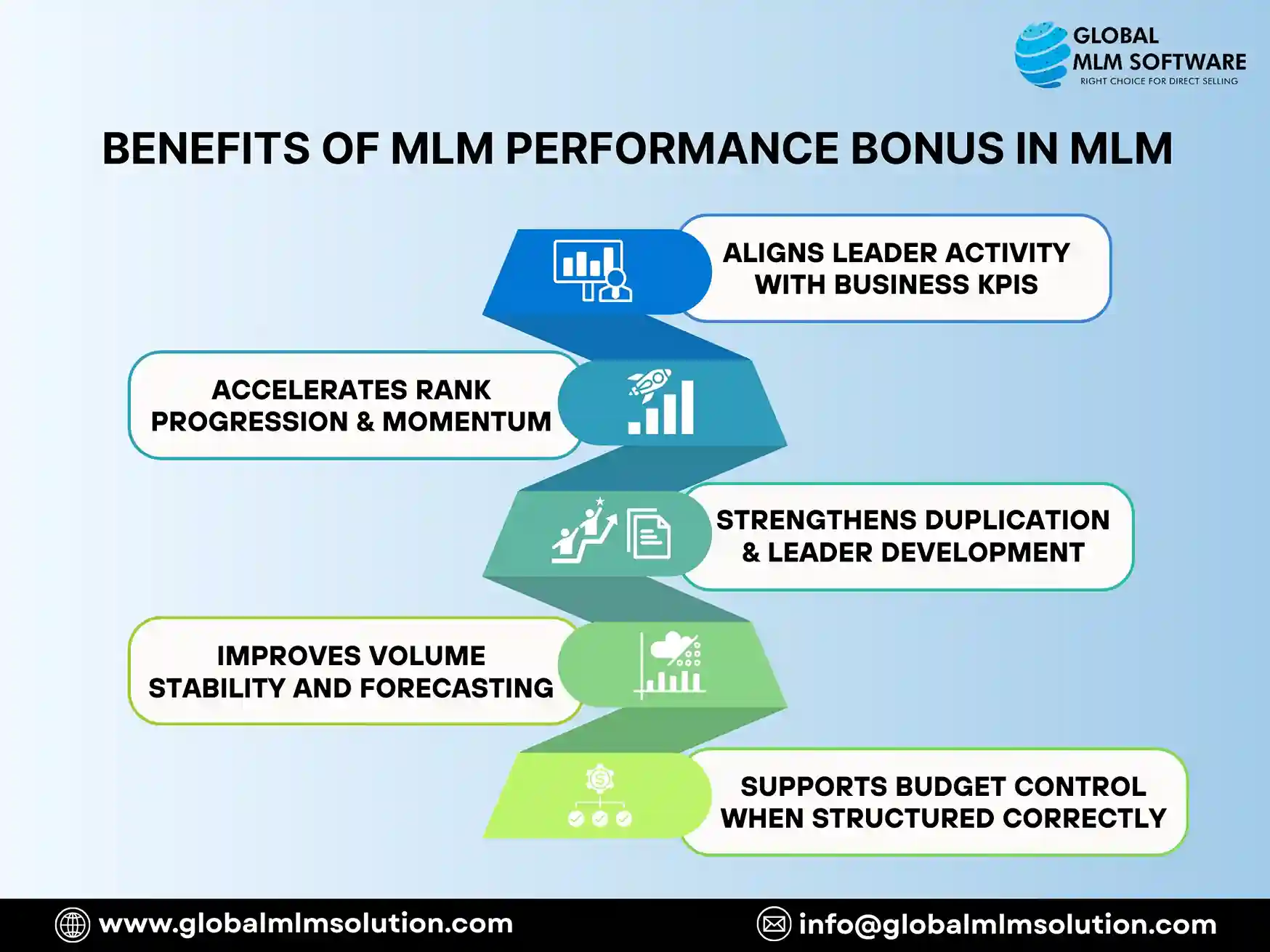
Aligns Leader Activity With Business KPIs
A well-designed performance bonus allows an MLM business to reward the metrics that matter most to the long-term health of the company. It promotes:
Qualified leader development
Net volume growth
Customer continuity
Balanced leg production
Instead of relying on informal coaching to shape behavior, the plan itself reinforces priorities through objective, trackable requirements.
This alignment reduces strategic drift in the field and makes it easier for leadership to standardize training around specific targets. To further support consistent activity tracking and motivation across your network, integrating an effective MLM distributor engagement system ensures your leaders and distributors stay connected and focused on performance goals.
Accelerates Rank Progression and Momentum
Milestone-based performance bonuses, such as rank advancement, tier thresholds, and achievement triggers, create a structured progression path that leaders can follow.
This improves field motivation by providing the team members with concrete checkpoints, increasing activity when rank advancement is near and distributors make efforts to achieve it.
Strengthens Duplication and Leader Development
Leadership-focused performance bonuses reward the creation of additional earners, not just additional sellers.
So, an MLM business incentivizes coaching, systems adoption, and MLM training through performance bonuses:
By tying payout to the emergence of qualified leaders in separate legs
Minimum activity standards
Repeatable onboarding behavior
Over time, this improves leader density, which is one of the strongest predictors of scalable, resilient network growth.
Improves Volume Stability and Forecasting
Consistency or maintenance bonuses can shift the field away from end-of-period surges and toward steadier ordering patterns, especially when requirements include active-customer activity or reorder continuity.
How does it benefit MLM businesses?
Increases predictability in monthly revenue
Reduces operational strain around cutoffs
Helps the company forecast production with greater confidence.
Stability is also beneficial for inventory planning, supply chain management, and customer support staffing.
Supports Budget Control When Structured Correctly
From an MLM business’s perspective, performance bonuses can be engineered for cost predictability.
Pool-based bonuses cap total expense by design, while tiered bonuses can be modeled to keep payout within a target percentage of revenue.
When it is combined with return-adjusted calculations and eligibility gates, the company can reward performance without paying for activity that later reverses or fails to meet compliance and quality standards.
Common Challenges of Performance Bonus in MLM and How to Overcome Them
Performance bonuses can drive powerful results, but there are some challenges and failure points that you need to counter. These challenges are mostly around improper implementation, poor communication, and short-term volume behavior.
Below are the most common challenges and the practical fixes that reduce disputes while improving bonus quality.
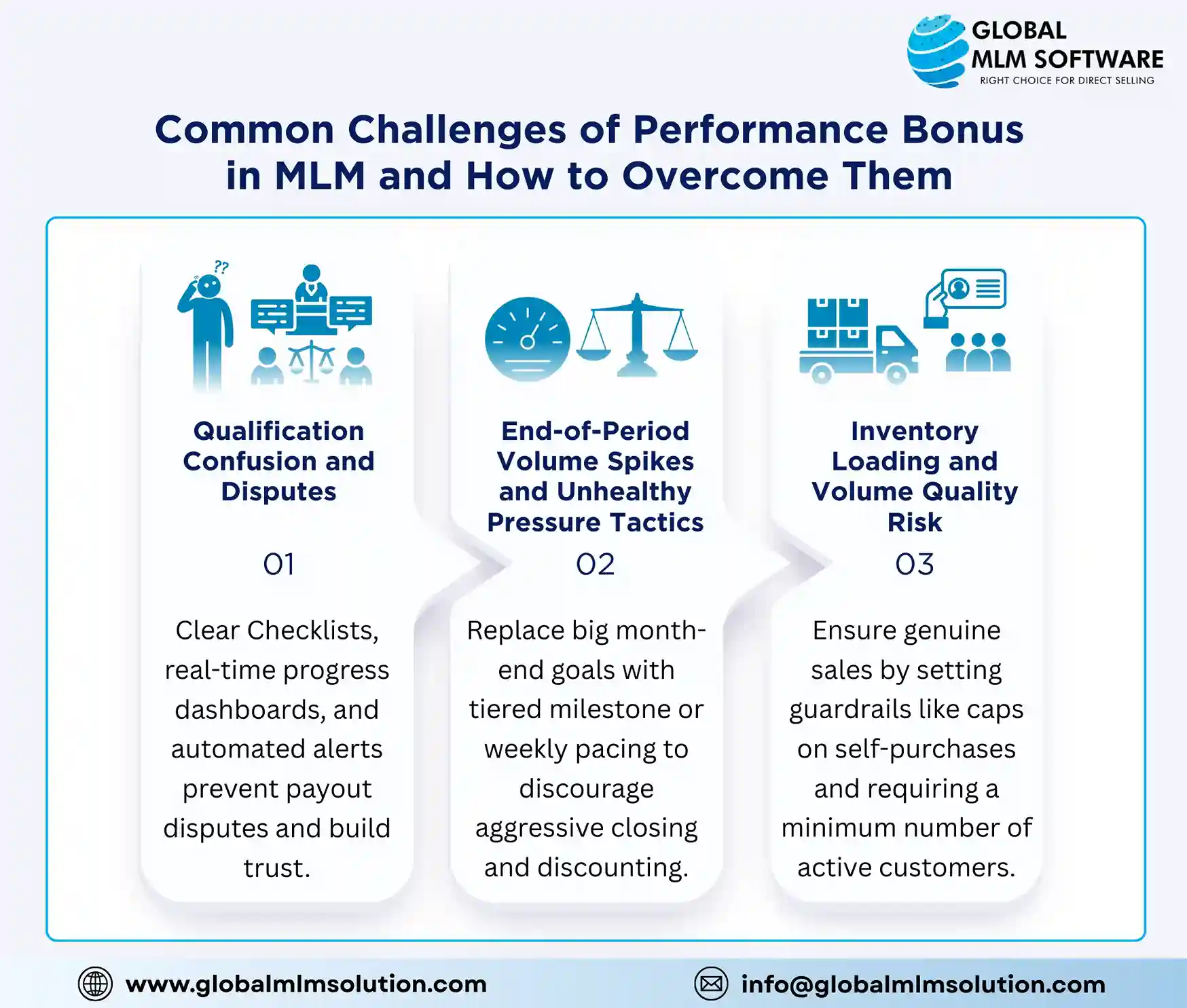
Qualification Confusion and Disputes
End-of-Period Volume Spikes and Unhealthy Pressure Tactics
Inventory Loading and Volume Quality Risk
- Return-adjusted volume
- Caps on how much self-purchase counts toward specific bonuses
- Minimum active customer requirements.
Key Takeaways
MLM Performance bonuses work best when they reward the outcomes your business can verify: customer-driven volume, repeat ordering, and leader development across healthy legs.
Keep qualification rules simple, visible, and not too easy or too hard to achieve, define PV/GV/CV precisely, pay on net volume, and use hold periods for rank rewards.
Model payout cost under multiple growth scenarios, then choose a payout architecture that stays within the margin.
Finally, invest in dashboards and audit trails so leaders can self-track progress and support can explain every payout quickly. Review results quarterly, listen to field feedback, and adjust thresholds carefully, without surprising changes that erode trust unnecessarily.
About Global MLM Solution
Getting performance bonus structures right is one thing, but having the technology to execute them accurately is another. Global MLM Solution works with MLM businesses to build platforms that automate complex bonus calculations, maintain clear audit trails, and give distributors real-time visibility into their progress and payouts.
The result is a compensation system that is transparent, scalable, and built to retain the people who matter most to your network. See how we have put this into practice through our customer success stories, and explore our pricing options when you are ready to build
FAQs
1. What is the purpose of MLM performance bonuses?
MLM performance bonuses are introduced to reward measurable results that strengthen the organization. MLM businesses use them to encourage behaviors like rank stability, leadership development, consistent team volume, and customer retention. When designed well, they create clear targets, improve focus, and support predictable growth.
2. Are MLM performance bonuses considered taxable income?
In most countries, performance bonuses paid to distributors are treated as taxable earnings, similar to commissions. The exact tax treatment depends on local laws and whether the recipient is classified as an independent contractor or another category.
3. Where can potential distributors find more information about MLM performance bonuses?
The most reliable sources are the company’s official compensation plan, policies and procedures, back-office training materials, and compliance documentation, from which potential distributors find more information about MLM performance bonuses.
4. How is a performance bonus calculated?
MLM performance bonus calculation depends on the plan design. Some bonuses pay a fixed amount for hitting a rank or milestone, others use tiers based on group volume, and some pay a percentage of eligible net volume.
5. Is the performance bonus paid monthly or annually?
It varies by company and bonus type. Many leadership and volume bonuses are paid monthly or even annually, while fast-start bonuses may be weekly and pool or recognition programs can be quarterly or annually. Payment timing also depends on validation rules, such as return adjustment windows. The compensation plan specifies the exact payout cycle.