
⚡ Quick Answer: Rank advancement in MLM is the process by which a distributor moves through a compensation plan's defined title tiers by meeting specific volume, leg, and activity thresholds. Each rank unlocks higher commission rates, leadership bonuses, and expanded earning potential. Companies typically structure between five and twelve ranks, with qualification based on personal volume, group volume, and active leg count.
Do your distributors disengage after a few months? Are you struggling with high distributor churn rates? Most of the time, it is not a lack of effort; your compensation plan may not provide a structured growth path to unlock higher earnings. Rank advancement in MLM solves that.
This article breaks down how network marketing rank advancement works, how to set qualification rules, and gives you a step-by-step roadmap to build sustainable growth in MLM across your entire network.
Key Takeaways
-
MLM rank advancement systems combine personal sales, team performance, customer counts, and compliance metrics to ensure sustainable, performance-driven distributor growth.
-
Balanced KPIs like PV, GV, and customer activity prevent manipulation while encouraging real sales, mentorship, and consistent business-building across teams.
-
Structured rank progression improves distributor motivation by providing clear milestones, recognition, and access to higher commissions and business perks.
-
Customer-centric rules and limits on chargebacks or support issues help maintain product integrity and reduce fake sales or inventory loading risks.
-
Effective rank advancement systems require gradual difficulty increases, simple rules, and real-time tracking tools to avoid confusion and distributor drop-off.
What is Rank Advancement in MLM?
Rank advancement in MLM is a system where distributors move up the title ladder and unlock higher earnings at every level. Every rank has a defined set of requirements that a distributor must meet within a qualification window.
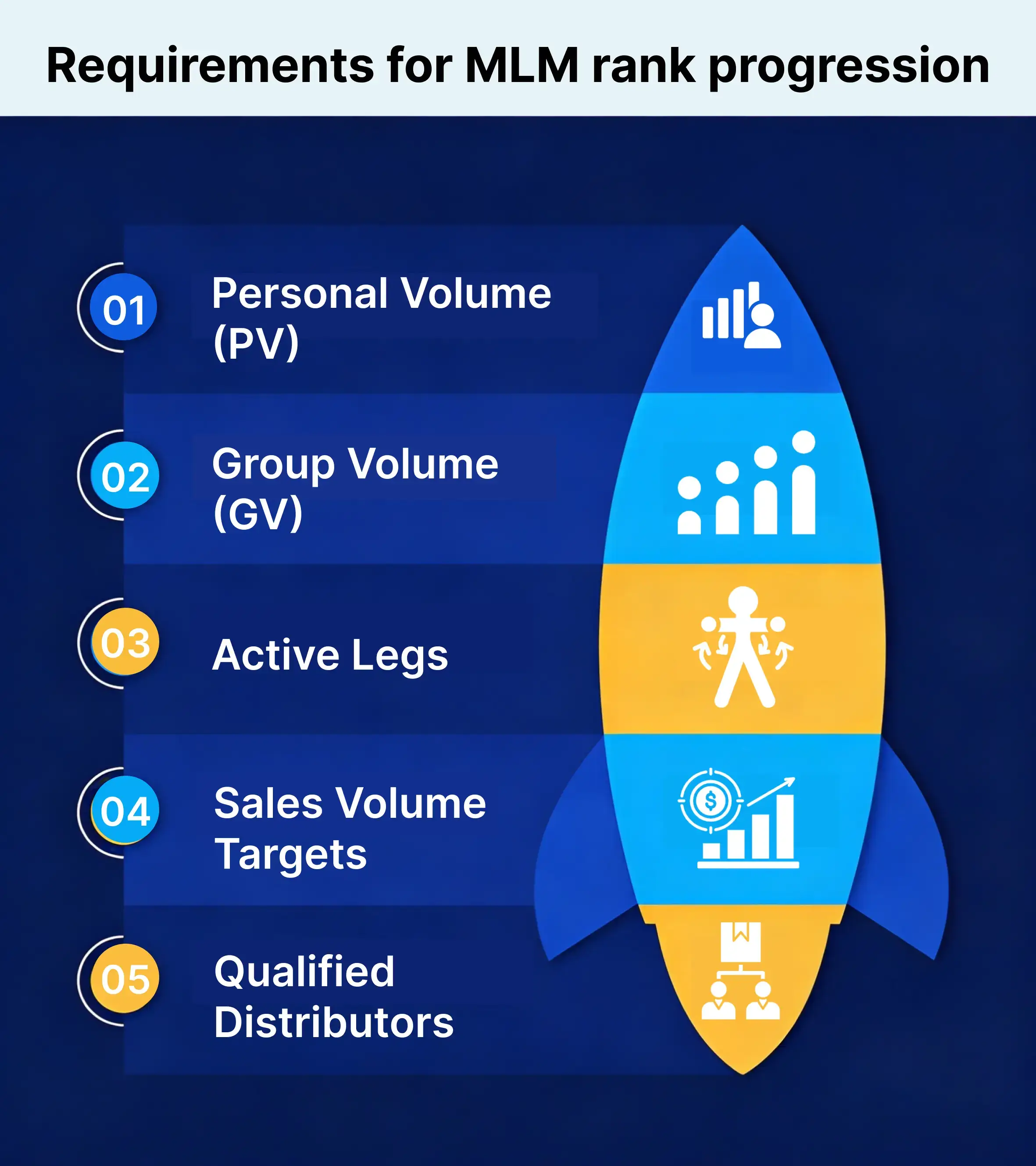
Requirements for MLM rank progression typically include:
Personal Volume (PV): Minimum individual sales volume generated within the qualification window.
Group Volume (GV): Combined sales volume across the distributor's downline.
Active Legs: A minimum number of directly sponsored distributors who are themselves generating qualifying volume
Sales Volume Targets: Total network production required at each tier — increases with every rank
Qualified Distributors: Senior ranks require a defined number of rank-qualified leaders at specific depth levels.
Common Ranks in MLM:
Rank names vary across companies, but the qualification logic behind them is usually similar.
| Rank Level | Common Titles | Primary Requirement |
|---|---|---|
| Entry | Distributor, Associate, Member | Personal volume only |
| Mid-Tier | Silver, Gold, Director | Group volume + active legs |
| Senior | Executive, Ambassador, Diamond | Qualified leaders in downline |
| Top | Presidential, Crown, Double Diamond | Multiple breakaway legs + sustained GV |
How Rank Progression Works in Practice?
In a typical MLM rank structure, each title requires more volume, more active legs, and more developed leaders than the rank before it, as the following example shows:
Distributor Alice joins an MLM Nutrition company, VitaCore Nutrition.
The company’s compensation plan has 8 ranks, starting from Associate to Diamond Director.
To move up to Senior Associate, she needs to hit 100 PV personally and bring in two active distributors
Every rank above that comes with more personal volume targets, more active leg requirements, and a group volume target that her whole downline must meet.
By rank of Gold Director, only her group volume (GV) is not enough. She should mentor two of her downline associates to reach Senior Associate ranks or above.
To reach the top rank of Diamond Director, TeraBytes requires her to reach 500 in PV, 10,000 in GV, and three qualified legs each with a Gold Director or higher.
How do MLM Rank Qualification Rules Work?
MLM rank qualification rules define the exact conditions a distributor must meet within a set time period to achieve or maintain a rank. Missing even one qualification metric can prevent a distributor from achieving the next rank, even if every other target is met.
Qualification Windows Determine When Rules Apply
Most compensation plans give distributors a set period of time to meet the requirements needed to achieve or maintain a rank.
| Window Type | How It Works | Common Use |
|---|---|---|
| Monthly | Resets every calendar month | Entry and mid-tier ranks |
| Quarterly | Measured across a 3-month block | Senior and leadership ranks |
| Rolling | Tracks a moving 30/60/90-day period | Flexible plan structures |
Some compensation plans give distributors one missed cycle before they lose their rank. Others do not degrade ranks at all. The title remains unchanged to prevent distributor demotivation, even if the commission earnings decrease. Some MLM companies also allow distributors to maintain two ranks.
Pin Rank vs. Paid As Rank: Two Separate Records in MLM
Most MLM compensation plans track two rank records for every distributor:
Pin Rank (Title Rank): The highest rank a distributor has ever achieved. This is permanent recognition. It does not roll back.
Paid As Rank: The rank a distributor qualifies for in the current period, based on active volume and leg conditions. This determines actual commission eligibility.
A distributor who reaches Gold Director but has a slow month does not lose the title. Instead, they are simply paid at a lower rank until they requalify. Nu Skin's Sales Compensation Plan explicitly separates these two records in its qualification table.
How Rank Advancement Works in Different MLM Compensation Plans
MLM career advancement mechanics vary significantly across MLM plan types:
Unilevel MLM Plan: Here, distributors build an unlimited width on a single level. Rank advancement is based on how many of those frontline distributors stay active and how much volume the entire group generates. Keeping distributors active matters more than adding new ones.
Binary MLM Plan: Distributors build two legs. Rank qualification is determined by the weaker leg, not total volume. A distributor with 8,000 GV on one leg and 500 GV on the other leg, qualifies on the weaker leg’s GV, i.e.,500. Balanced leg development is a qualification condition.
Matrix MLM Plan: A matrix plan limits how many distributors can sit at each level. Every position in the matrix must be active to qualify for rank advancement. Spillover from uplines can accelerate early ranks, but it can also create dependency on upline activity.
Stairstep Breakaway MLM Plan: Distributors accumulate volume until they hit a breakaway threshold. At this point, they separate into an independent group. To advance in rank, they must develop other distributors within their team who also hit that threshold and break away on their own.
For example, Amway requires distributors to qualify as Silver Producer for six months in a performance year to reach Platinum rank. Only three of those months need to be consecutive. Platinum is the first leadership milestone in Amway's compensation structure.
Rank Advancement Bonuses and Commissions in MLM
Rank advancement in MLM triggers a separate layer of MLM commissions and bonuses at every tier. Each reward is tied to specific rank thresholds in the compensation plan
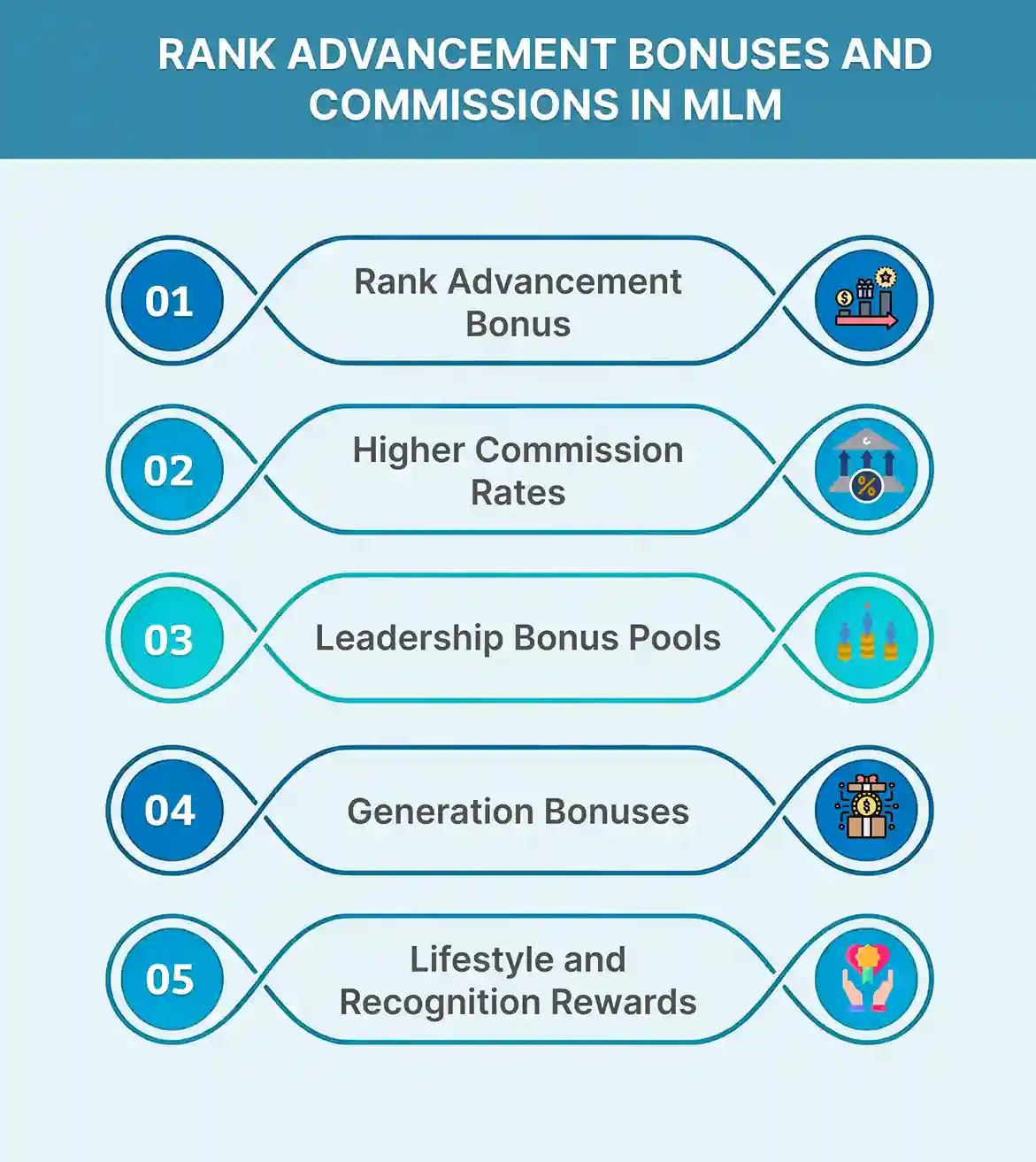
Rank Advancement Bonus: It is a one-time reward paid when a distributor reaches a new rank for the first time.
Higher Commission Rates: Each rank tier unlocks a higher base commission percentage on personal and group sales volume.
Leadership Bonus Pools: Senior ranks gain access to company-wide bonus pools. It is a percentage of total company volume distributed among qualified leaders at defined rank thresholds.
Generation Bonuses: It is available at senior ranks in stair-step breakaway and unilevel plans. It is generally paid on the volume of breakaway legs or defined generations within the downline
Lifestyle and Recognition Rewards: It included car allowances, travel incentives, and event access, which are tied to specific rank thresholds in many MLM compensation plans.
Rank Advancement Design Mistakes to Avoid
Poor MLM level advancement can drive distributor disengagement, inflate churn, and create compliance exposure. Here are some mistakes to avoid:
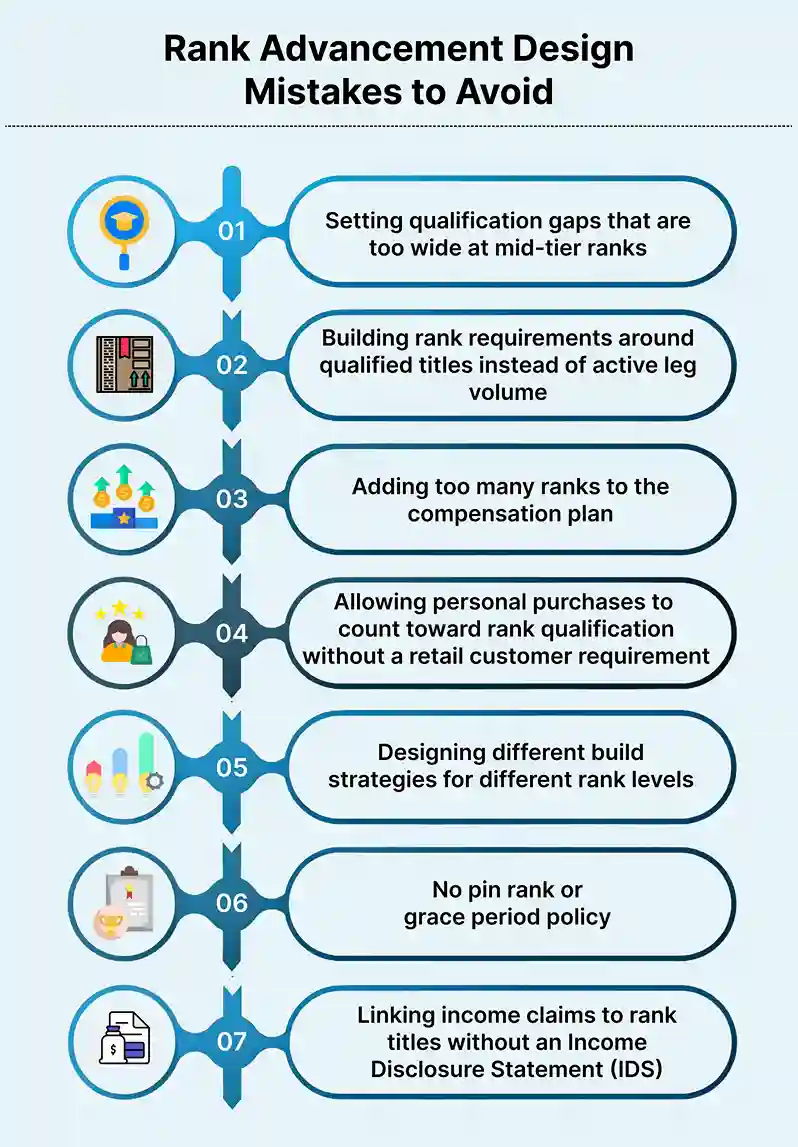
Setting qualification gaps that are too wide at mid-tier ranks: A huge jump in personal volume or group volume between ranks causes distributors to quit. Keep targets achievable to reduce distributor drop-outs at mid-level ranks.
Building rank requirements around qualified titles instead of active leg volume: One mid-level dropout can pull down multiple distributors above them, all losing their rank at the same time. Design rank requirements so they are tied to active leg volume, instead of distributor titles in that leg.
Adding too many ranks to the compensation plan: Every additional rank adds qualification complexity, increases distributor confusion, and creates more failure points in the structure. Limit to 5-8 ranks, with genuine progression milestones between them.
Allowing personal purchases to count toward rank qualification without a retail customer requirement: This creates inventory loading risk and exposes the business to FTC scrutiny. Set a minimum retail customer count as a qualification metric at every rank tier.
Designing different build strategies for different rank levels: If your plan rewards one behavior at lower ranks and a completely different behavior at higher ranks, it confuses distributors and kills their momentum. Ensure the same core activity qualifications at every rank level.
No pin rank or grace period policy: Without rank protection mechanisms, one performance month permanently demotivates distributors who have worked hard to advance. Separate pin rank from paid-as rank and allow at least one missed cycle before rank rollback is applied.
Linking income claims to rank titles without an Income Disclosure Statement (IDS): An IDS is a published document disclosing actual distributor earnings across all rank levels. Any income claim tied to rank advancement without an IDS may create FTC compliance issues. Publish an updated IDS annually and reference it in all rank-related income communications.
Eg: Amway’s 2024 IDS statement shows that the average annual income for all U.S. registered IBOs at Founders Platinum level and below was $723 before expenses.
How MLM Owners Should Structure Rank Advancement Payouts to Stay Profitable
Rank advancements require MLM operators to pay higher commissions and bonuses at every tier. Without proper financial modelling, your payout commitments can exceed what the network generates. Here is what you can do to avoid this:
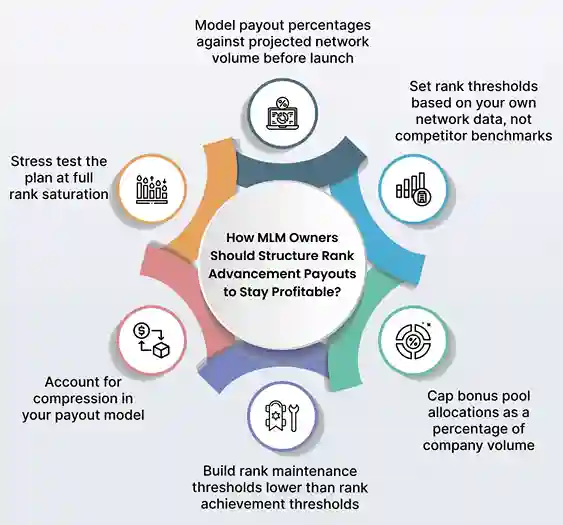
Model payout percentages against projected network volume before launch: Before launch, calculate how much you will pay out at every rank across different growth scenarios, including slow, steady, and rapid network expansion. If the numbers do not work in any scenario, adjust your rank thresholds before distributors join.
Set rank thresholds based on your own network data, not competitor benchmarks: Do not copy rank thresholds from competitors. A structure that works for a 500,000-distributor network will bankrupt a 5,000-distributor network if it's not configured properly. Base your thresholds on your own projected volume and nothing else.
Cap bonus pool allocations as a percentage of company volume: Define leadership pools and generation bonuses as a percentage of total company volume, not a fixed dollar amount. Fixed dollar pools run out as your network grows. Percentage-based pools scale automatically with the business.
Build rank maintenance thresholds lower than rank achievement thresholds: The volume required to hold a rank should always be lower than the volume required to achieve it. Distributors should not need to perform at their peak every single month just to keep their title. Lower maintenance thresholds reduce rank rollback, retain more distributors, and keep payouts predictable.
Account for compression in your payout model: When inactive distributors are skipped in commission calculations, their volume shifts upward to the next qualified distributor. This is called compression. If you do not account for it in your payout model, you can end up paying out significantly more than your plan was designed to pay.
Stress test the plan at full rank saturation: Model what happens if 20% of your network reaches senior ranks simultaneously. If the payout is unsustainable in that scenario, the rank thresholds are too low. Adjust them before going live.
How Distributors Can Advance Ranks in MLM: A Six-Step Roadmap?
Rank advancement in MLM follows a six-step process tied directly to compensation plan qualification mechanics. Here is what distributors can do, in the perfect order.
`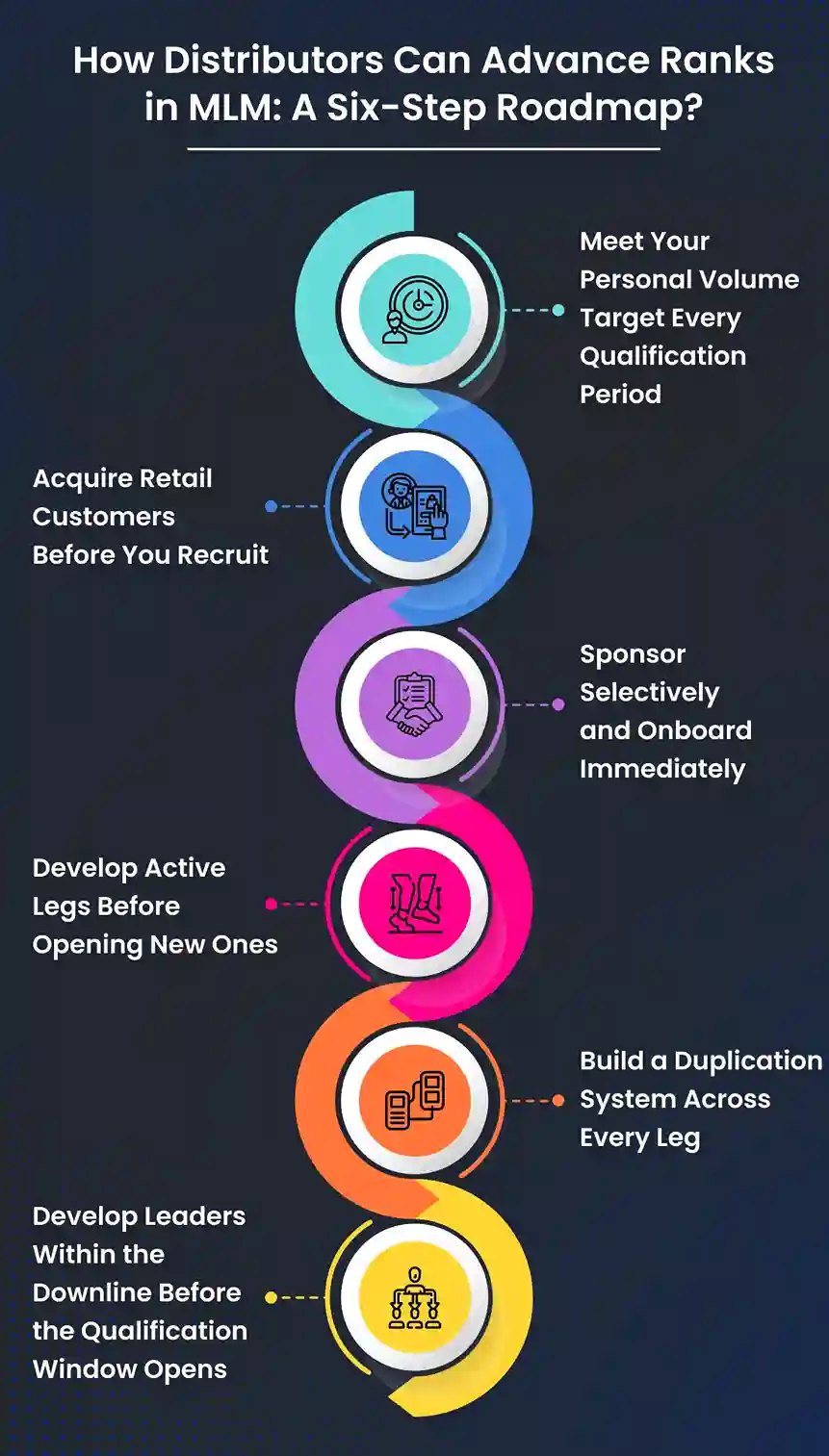
Step 1: Meet Your Personal Volume Target Every Qualification Period
Personal volume is the entry condition at every rank. No other activity counts toward qualification without it. Understand your PV threshold, hit it first, and treat it as the foundation to achieve everything else.
Step 2: Acquire Retail Customers Before You Recruit
Rank qualification requires real product movement to end customers, not internal consumption alone. Build a retail customer base first. It satisfies the customer count metric, creates a stable volume base for you, and keeps your business FTC-compliant.
Step 3: Sponsor Selectively and Onboard Immediately
Every directly sponsored distributor is a potential active leg if you help them become active from day one. Recruit enthusiastic distributors who are willing to sell and build. Onboard them within 72 hours and equip them with product knowledge, PV target, and first customer, if possible, to get the momentum going.
Step 4: Develop Active Legs Before Opening New Ones
Active legs are counted for mid-tier and senior ranks, not just enrolled distributors. An active leg is a directly sponsored distributor who is meeting their own volume threshold within the same qualification window. Focus on getting each leg active before sponsoring new ones.
Step 5: Build a Duplication System Across Every Leg
Past the first two ranks, your personal effort alone will not get you to the next tier. Each leg must follow the same member onboarding, customer acquisition, and PV process on its own. Build a system your team can run without you.
Step 6: Develop Leaders Within the Downline Before the Qualification Window Opens
Senior ranks require qualified leaders at specific levels in your downline; volume alone is not enough. Identify distributors who are consistently hitting their PV targets and selling to real customers. Start developing them toward their next rank before your own qualification window opens. A downline that builds leaders advances faster than one that only builds volume.
The Operational Side of Rank Advancement
The most common breakdown in rank advancement happens when manual tracking fails as the network grows.
Global MLM Solution has worked with more than 400+ MLM businesses to design rank advancement systems that actually hold up under real network pressure. The MLM software automates qualification tracking, volume calculation, leg activity monitoring, and rank assignment in real time. Rank triggers fire automatically, distributors see qualification progress live, and admins get full visibility of rank distribution at every level.
It supports unilevel, binary, matrix, and stair-step breakaway plans, with custom settings like configurable rank rules, grace period settings, pin rank, and paid as rank separation. Book an MLM software free demo to explore the full feature set live.

Shabana is a dynamic writer and strategist with profound expertise in network marketing. Her sharp analysis of industry trends and exceptional ability to distill complex concepts into clear, actionable insights make her content invaluable for professionals at every level. Through her writing, she empowers readers to navigate the evolving landscape of relationship-driven sales with confidence and integrity. Blending data-driven strategies with human-centric principles, Shabana provides a unique perspective that helps businesses thrive while maintaining authentic connections.
FAQs
1. What is rank advancement in MLM?
Rank advancement in MLM is the process by which distributors move through a compensation plan's title tiers by meeting specific volume, leg, and activity thresholds. Each rank unlocks higher commissions and bonuses.
2. What are the most common rank qualification requirements in MLM?
Most MLM compensation plans require a combination of personal volume, group volume, active legs, and, in senior ranks, qualified leaders within the downline. All these criteria should be met within the same qualification window.
3. What is the difference between a pin rank and a paid as rank?
A pin rank is the highest rank a distributor has ever achieved, and it does not roll back. A paid-as rank is the rank they qualify for in the current period, which determines actual commission eligibility.
4. What are the conditions for maintaining rank titles and receiving bonuses in network marketing companies?
Maintaining rank titles and bonus eligibility in MLM typically requires hitting minimum personal and team sales volume each qualification period, maintaining a minimum number of active downline legs, and staying current on any subscription or autoship requirements. Requirements reset each cycle, so consistent activity matters more than a single strong month. Exact thresholds vary by company and plan type — check your specific compensation plan document for current requirements.
5. How does rank advancement differ across MLM compensation plans?
In a unilevel plan, rank is driven by retention and group volume depth. In a binary plan, the weaker leg determines qualification. In a stairstep breakaway, distributors must develop legs that independently break away.