MLM Bonus: An event- or milestone-based incentive paid on top of regular commissions — triggered by specific achievements such as recruiting, rank advancement, or hitting team volume targets. Bonuses are one-time or conditional.
MLM Commission: Ongoing earnings calculated directly from product sales volume, paid according to the compensation plan structure. Commissions are recurring.
Imagine a distributor who joins your network and does nothing. No sales or recruitment. Then, another joins and starts selling and recruiting immediately. Often, the difference between the two is how well you structure your MLM bonuses.
As an MLM operator, the bonuses you include in your compensation plan directly shape what distributors do next. Unlike MLM commissions, which are recurring, MLM bonuses are event-driven incentives. This guide covers different types of MLM bonuses, which ones to include, and how to build a structure that drives results without breaking your payout budget.
MLM bonuses are separate from regular commissions and are triggered by specific qualifications such as sales targets, rank achievements, recruitment milestones, or team performance.
Bonus structures can be fixed-value or percentage-based and may be awarded as one-time, periodic, or ongoing incentives depending on the compensation plan.
Common bonus types include Fast Start, Sponsor, Matching, Rank Advancement, Leadership Pool, Generation, Direct Referral, Overriding, and Differential bonuses, each designed to reward different distributor behaviors.
Certain bonuses are plan-specific, such as Pairing Bonuses in binary plans, Matrix Completion and Position Bonuses in matrix plans, and Infinity Bonuses in unilevel plans.
Effective MLM bonus systems balance short-term incentives (e.g., Fast Start bonuses) with long-term leadership rewards (e.g., Generation and Leadership Pool bonuses) to drive both recruitment and retention.
MLM Commissions Vs. MLM Bonuses: Key Differences
MLM Commissions and MLM bonuses are both forms of distributor compensation, but they are calculated differently, triggered differently, and serve different business objectives:
| Factor | MLM Commission | MLM Bonus |
|---|---|---|
| Trigger | Product sale recorded | Milestone or event achieved |
| Frequency | Recurring — every sales cycle | Conditional — only when triggered |
| Calculation Basis | Percentage of personal or group sales volume | Fixed amount, percentage of recruit's earnings, or volume differential |
| Plan Dependency | Tied directly to compensation plan structure | Layered on top of the plan — varies by plan type |
| Distributor Action Required | Sell products | Recruit, rank up, hit volume targets, or activate downline |
| Payout Predictability | High — consistent with sales volume | Variable — depends on qualifying events |
| Business Owner Control | Set via commission rate and level depth | Set via bonus rules, caps, and qualifying conditions |
| FTC Scrutiny | Low — directly tied to sales | Higher — must be linked to sales, not recruiting alone |
| Example | 10% on personal sales volume each month | $200 one-time payment on reaching Silver rank |
What is an MLM Bonus?
An MLM bonus is a performance-based payment earned by distributors in a multi-level marketing company. It is typically based on personal sales, team sales volume, or any other criteria, as outlined by the MLM compensation plan.
Quick-Reference: MLM Bonus Types at a Glance
| Bonus Type | Trigger | Best-Fit Compensation Plan |
|---|---|---|
| Sponsor / Introducer Bonus | New recruit makes a qualifying purchase | All plans |
| Fast Start Bonus | New distributor hits volume target within first 30–90 days | All plans |
| Matching Bonus | Direct recruit earns a commission | Unilevel, Stair-Step |
| Pairing Bonus (Binary Bonus) | Both binary legs hit a minimum volume threshold | Binary |
| Level Commission | Downline sale recorded at a defined level | Unilevel, Matrix |
| Override Commission | Downline group hits a volume target | Stair-Step / Breakaway |
| Rank Advancement Bonus | Distributor qualifies for a new rank | All plans |
| Leadership Pool Bonus | Distributor qualifies for top-rank pool | All plans |
| Generation Bonus | Sales volume recorded across defined downline generations | Generation / Hybrid |
| Infinity Bonus | Sales volume beyond depth limit until next qualifier | Binary, Unilevel |
| Position Bonus / Matrix Completion Bonus | Predefined matrix slots filled | Matrix |
| Cycle / Board Split Commission | Board or cycle structure completes | Board / Matrix |
| Re-entry Bonus | Distributor re-enters a matrix after completing a cycle | Board / Matrix |
| Car / Lifestyle Bonus | Distributor reaches a qualifying rank or volume milestone | All plans |
| Differential Bonus | Difference between a distributor's commission rate and their recruit's rate | Stair-Step / Breakaway |
| Compression / Roll-up Bonus | Inactive distributor is skipped; volume rolls to next qualified upline | Unilevel, Binary |
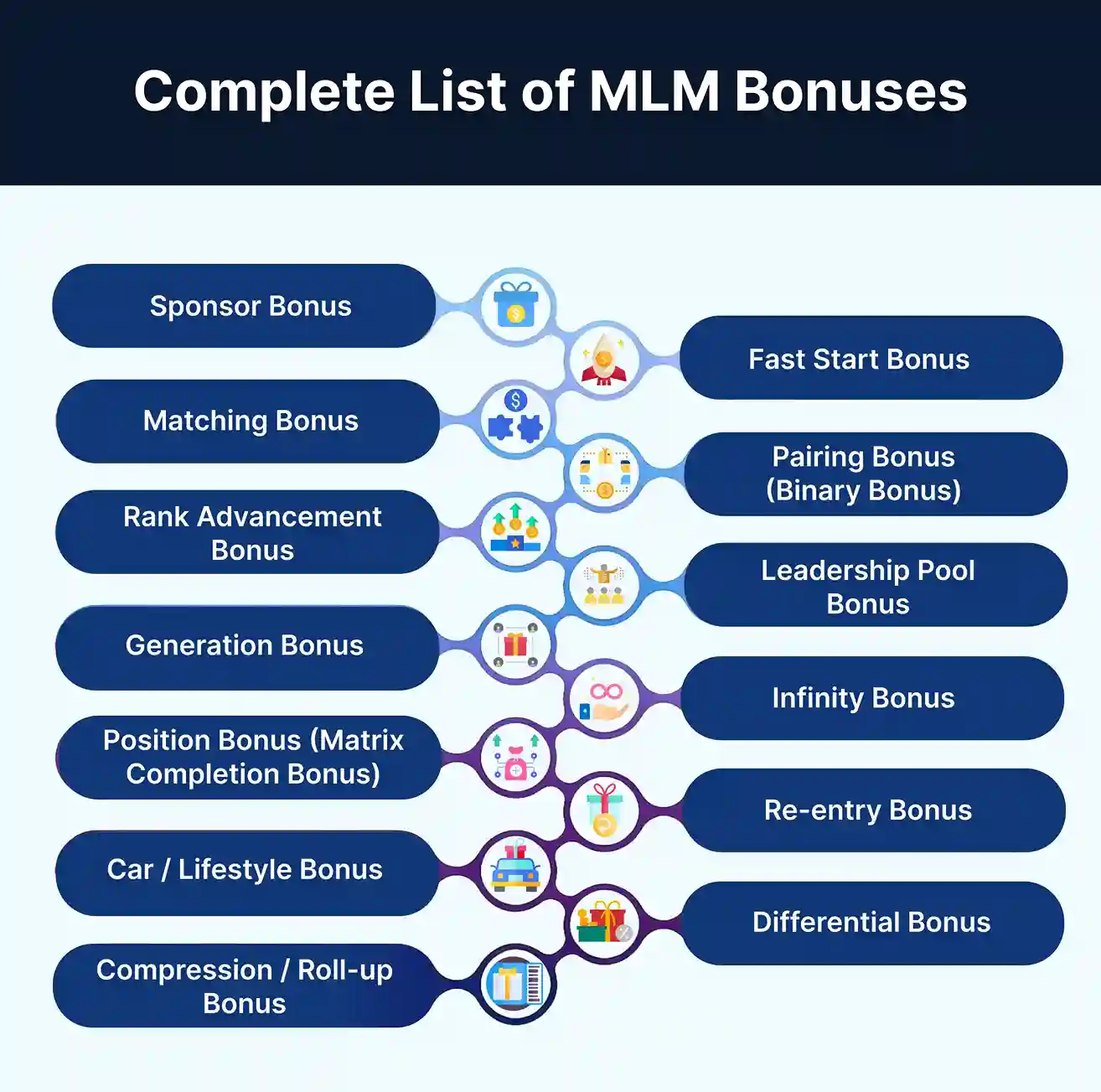
Complete List of MLM Bonuses
MLM bonus structures vary across compensation plans. Here is a complete breakdown of every bonus type used in direct selling today:
Sponsor bonus
A sponsor bonus, also called an introducer bonus, is a one-time incentive paid to a distributor for personally enrolling a new member. This bonus directly rewards frontline recruitment and helps companies accelerate network growth.
A new recruit joins a network and makes a first purchase. If the purchase meets the minimum personal volume (PV) threshold, the upline sponsor receives a sponsor bonus.
5% to 20% of the new recruit’s first order value.
All compensation plans.
Sarah enrolls a new distributor who places a $300 order. The plan pays a 10% sponsor bonus on first orders above $250. Therefore, Sarah receives a sponsor bonus of $30.
Fast Start Bonus
A fast start bonus is a higher-rate, time-limited incentive paid to new distributors who hit a defined sales or recruitment target within their first 30–90 days of joining. This bonus helps solve early drop-off, as most new recruits go inactive within this period.
When a new distributor joins, the MLM company gives them a 30, 60, or 90-day window to hit a minimum sales target. They receive a higher commission percentage for sales generated within that window. Once the window expires, normal commission rates will apply.
10%-30% of sales volume generated during the qualifying window.
All compensation plans.
Sarah personally sponsors a new distributor, John, who purchases a starter package worth $300. She qualifies for a 10% fast start bonus, which is $30.
Matching Bonus
A matching bonus is a commission paid to distributors based on the earnings of their personally sponsored distributors. It rewards leaders for helping their frontline recruits succeed.
The company pays a percentage of the commissions earned by personally sponsored distributors. Some plans extend matching bonuses across multiple generations, while others limit payouts to the frontline.
5%–25% of the qualifying commissions earned by sponsored distributors.
Unilevel MLM plan, Generation, and Hybrid compensation plans.
Sarah’s new recruit, John, earns $500 in commissions during a month. If the matching bonus rate is 10%, Sarah earns $50 on John’s commissions.
Pairing Bonus (Binary Bonus)
A pairing bonus, also known as a binary bonus, is a commission paid when a distributor generates the required sales volume across both legs of a binary organization.
The company tracks sales volume in the distributor's left and right teams. A bonus is paid when the required pairing ratio is achieved. Common pairing ratios include 1:1, 1:2, and 2:1, depending on the compensation plan. Any excess volume may carry forward to the next commission cycle.
5%–20% of paired volume or a fixed amount per completed pair.
Sarah accumulates 500 PV on her left leg and 500 PV on her right leg. Her company uses a 1:1 pairing ratio and pays 10% on paired volume. Therefore, she earns $100 as a pairing bonus on top of her regular commissions.
Rank Advancement Bonus
A rank advancement bonus is a one-time reward paid to distributors when they achieve a new rank within the MLM compensation plan. It recognizes leadership growth and encourages long-term team development.
The company sets rank qualification criteria based on factors such as personal sales volume, team volume, active distributors, or organizational structure. When a distributor reaches a new rank, they receive a bonus payment.
$50–$10,000+ per rank advancement, depending on the company's compensation plan and rank structure.
Unilevel, Binary, Generation, Matrix MLM plan, and Hybrid compensation plans.
Sarah qualifies for the rank of Gold Leader by achieving 5,000 GV in team sales and maintaining five active frontline distributors. She receives a one-time rank advancement bonus of $500 upon reaching the rank.
Leadership Pool Bonus
A leadership pool bonus is a commission paid from a shared pool of company sales revenue to distributors who qualify for designated leadership ranks. It rewards sustained leadership performance and organizational growth.
The company allocates a percentage of total company sales volume or commissionable revenue to a bonus pool. Qualified leaders receive shares of the pool based on their rank, performance, or the number of shares they have earned.
1%–5% of company sales volume allocated to the pool, with individual payouts varying based on the number of qualified leaders and shares earned.
Unilevel, Generation, Binary, and Hybrid compensation plans.
Sarah qualifies for the company's Leadership Pool by maintaining the rank of Gold Leader. The monthly pool contains $100,000, and Sarah earns 2 shares out of 200 total shares.
Generation Bonus
A generation bonus is a commission paid on the sales volume or earnings generated by leadership groups within a distributor's downline. It rewards distributors for building and developing multiple layers of leaders.
Once a distributor reaches a qualifying rank, they earn a percentage of the sales volume or commissions generated by specific generations in their organization. A new generation typically begins when another qualified leader appears in the downline.
1%–10% per generation, with payouts extending across multiple generations depending on rank.
Generation MLM plan, Unilevel, and Hybrid compensation plans.
Sarah qualifies to earn generation bonuses on her first three generations.
- Generation 1 Sales Volume: $10,000
- Generation 2 Sales Volume: $8,000
- Generation 3 Sales Volume: $5,000
- Generation Bonus Rate: 5%
Sarah earns a $1,150 generation bonus from the combined sales volume of these generations.
Infinity Bonus
An infinity bonus is a commission paid on the sales volume or earnings generated beyond a distributor's standard commission depth. It rewards top leaders for building deep, high-performing organizations.
After a distributor reaches a qualifying leadership rank, they earn a percentage of sales volume or commissions generated by leadership groups below their normal payout levels. Unlike standard level-based commissions, the bonus can extend across multiple leadership groups, subject to rank qualifications.
0.5%–5% of qualifying volume or commissions generated beyond the standard payout depth.
Unilevel, Generation, and Hybrid compensation plans.
Sarah qualifies for an infinity bonus that pays 2% on the volume generated by leadership groups beyond her regular commission levels. She earns an additional $1,000 from volume generated beyond her standard commission structure.
Position Bonus (Matrix Completion Bonus)
A position bonus, also known as a matrix completion bonus, is a commission paid when a distributor fills all or a predefined number of positions within a matrix level. It rewards distributors for building width and completing matrix structures.
The company defines a matrix structure, such as 3×7 or 5×5. When enough distributors are placed into the required positions, the distributor earns a bonus for completing a level or section of the matrix.
$25–$5,000+ per completed level, depending on the matrix size and compensation plan.
Matrix and Hybrid compensation plans.
Sarah participates in a 3×5 matrix plan. To complete Level 2, she needs 9 positions filled beneath her. Once all 9 positions are occupied, she qualifies for a $200 matrix completion bonus.
Re-entry Bonus
A re-entry bonus is a reward that allows a distributor to earn an additional position in the compensation plan after meeting specific performance requirements. It allows qualified to earn commissions through an additional position within the compensation plan after meeting specific performance requirements.
When a distributor reaches a predefined sales volume, commission threshold, or matrix completion milestone, the company grants a new position, often called a re-entry position. This new position can earn commissions independently while remaining linked to the distributor's original account.
Varies by plan. Rewards typically include an additional earning position, bonus commissions, or access to a new matrix cycle.
Matrix, Cycler, Board, and Hybrid compensation plans.
Sarah completes her matrix and earns a re-entry position bonus. She also now earns commissions from both positions.
Car / Lifestyle Bonus
A car or lifestyle bonus is a fixed incentive paid to distributors who achieve and maintain specific leadership ranks. It rewards sustained performance and supports lifestyle-related expenses such as vehicle payments, travel, housing, or personal development.
The company sets rank and volume requirements for qualification. Distributors who meet and maintain these requirements receive a monthly or periodic bonus payment, either as a car allowance or a general lifestyle incentive.
$100–$2,000+ per month, depending on rank and company policy.
Unilevel, Binary, Generation, and Hybrid compensation plans.
Sarah achieves the rank of Diamond Leader and qualifies for a monthly lifestyle bonus of $500. She receives $500 per month as long as she continues to meet the qualification criteria.
Differential Bonus
A differential bonus is a commission paid to distributors based on the difference between their commission rate and the rate earned by leaders in their downline. It rewards distributors for advancing to higher ranks and developing future leaders.
The company assigns commission percentages to different ranks. When a distributor's rank qualifies them for a higher percentage than a downline leader, they earn the difference between the two rates on the qualifying sales volume.
1%–10% differential, depending on rank progression and compensation structure.
Generation, Breakaway, and Hybrid compensation plans.
Sarah is at a 10% commission rate. A leader in her downline qualifies at 6%.
Sarah's Commission Rate: 10%
Downline Leader's Rate: 6%
Differential: 4%
Qualifying Sales Volume: $20,000
Sarah earns a $800 differential bonus (4% × $20,000).
Compression / Roll-up Bonus
A compression bonus is a commission mechanism that moves commissionable volume from inactive or unqualified distributors up to the next qualified distributor. It ensures that commissions are paid on active contributors rather than lost to inactive positions.
When a distributor becomes inactive or fails to meet qualification requirements, their position is compressed for commission purposes. The volume and payout opportunity then roll up to the next qualified upline distributor.
Not a separate payout percentage. Instead, it increases the commissionable volume available to qualified distributors.
Unilevel, Generation, and Hybrid compensation plans.
Sarah earns commissions on five levels. One distributor on Level 2 generates $500 in volume but goes inactive and no longer qualifies. Without compression, Sarah loses the $500 in commissionable volume. With compression, Sarah earns $40 (8% × $500) on the rolled-up volume.
How to Design an Effective MLM Bonus Plan?
Designing an effective MLM bonus plan includes 6 important steps:
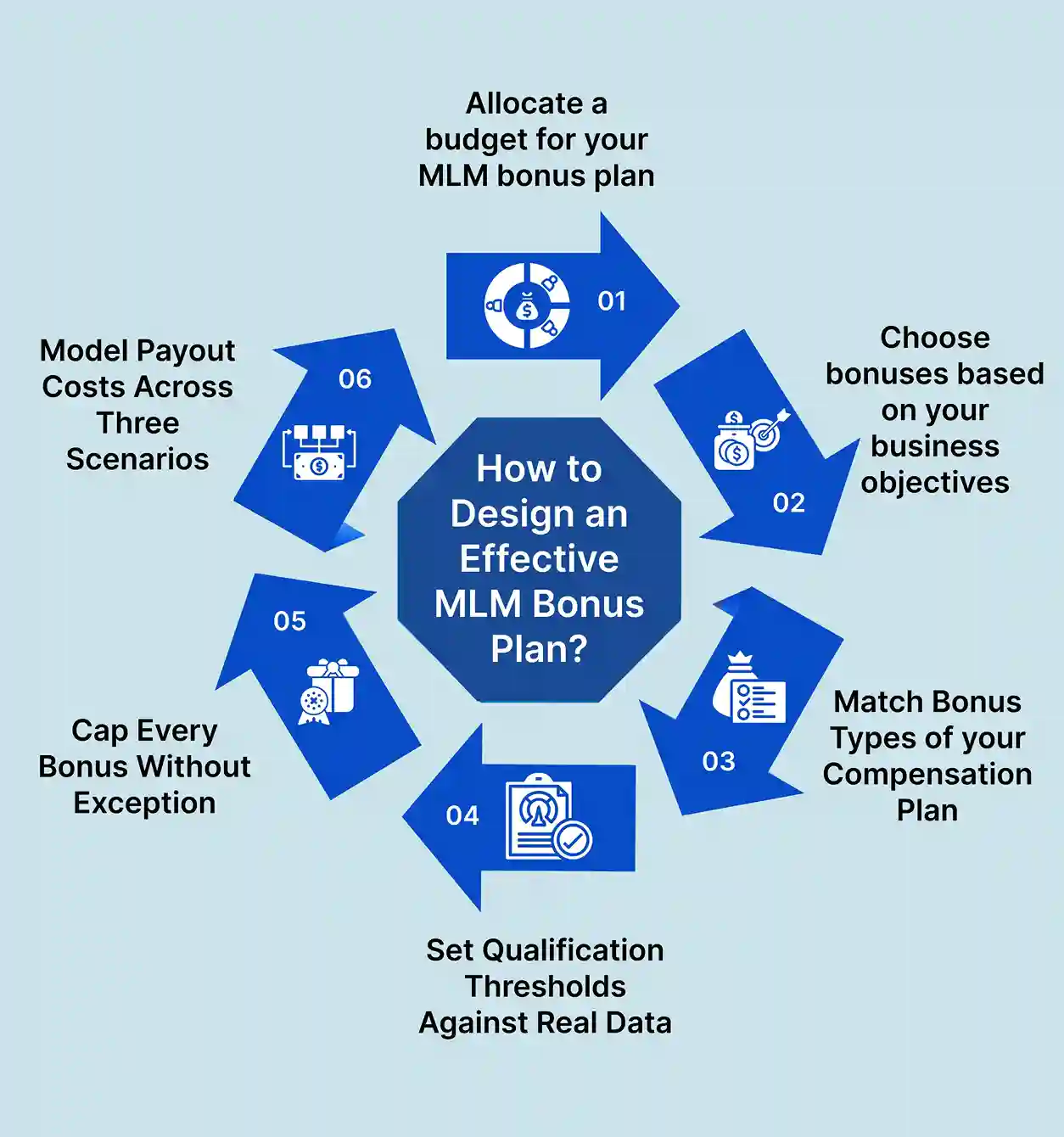
1. Allocate a budget for your MLM bonus plan
Before configuring any bonus, set a hard payout ceiling. Generally, the rule of thumb is that the total payouts should not exceed 35%-40% of the revenue. Then:
Split the budget between commissions (20%–25%) and bonuses (10%–15%).
Once a bonus budget is set, allocate it further across the bonus types you choose.
Later, adjust these values as your network matures and real payout data becomes available.
2. Choose bonuses based on your business objectives
Once a budget is defined, list down the business problems you are looking to solve through these bonuses. Make sure every bonus you include in your plan has a business objective attached to it.
3. Match Bonus Types of your Compensation Plan
Once you have listed down the objectives, match the bonus types corresponding to that objective with your compensation plan. For example, if you run a binary plan with a recruitment objective, you can choose a sponsor bonus to encourage enrollment and a pairing bonus to balance leg volume.
Make sure to keep a minimum of 2-3 core bonus types, to keep the compensation plan manageable. Then divide your bonus budget across these: recruitment bonuses (4%–5%), retention and depth bonuses (3%–4%), rank and leadership bonuses (2%–3%).
4. Set Qualification Thresholds Against Real Data
Next, you need to set the qualifying threshold for your selected bonuses. For this, start with benchmark thresholds against industry averages.
The Direct Selling Association (DSA) publishes annual industry reports you can use for this. Set qualifications closer to the medium activity level to keep it achievable. Once your network is up and running, replace industry standards with your own median data.
5. Cap Every Bonus Without Exception
Set a maximum payout limit for each distributor during every commission period, with no exceptions. Without a cap, a single high-recruitment period can push payouts beyond your allocated budget.
For example, if your fast start bonus pays 20%, set a maximum cap of $150 per new enrollment, regardless of how large the first order value is.
6. Model Payout Costs Across Three Scenarios
Before running any bonus plan, it's important to run simulations at low, medium, and high activity levels. Make sure all your bonuses are payable and do not exceed the bonus budget, even at high activity levels. This means that even if every distributor in your network qualifies simultaneously, your total bonus payout should stay within the allocated budget.
Which MLM Bonuses should you choose?
The bonuses you choose should map directly to the business outcomes you need. Use this table as a starting point. Match your objective to the recommended bonus type, then validate against your compensation plan structure and budget.
| Business Objective | Recommended Bonus Types |
|---|---|
| Drive new recruitment | Sponsor Bonus, Fast Start Bonus |
| Increase early activation | Fast Start Bonus |
| Improve retention | Matching Bonus, Generation Bonus |
| Reduce mid-tier stagnation | Rank Advancement Bonus, Leadership Pool Bonus |
| Build deep network volume | Generation Bonus, Infinity Bonus, Level Commission |
| Balance binary legs | Pairing Bonus |
| Reward top performers | Car/Lifestyle Bonus, Leadership Pool Bonus |
| Reduce inactive distributor impact | Compression/Roll-up Bonus |
Expert Tip: For a new plan, activate a minimum of there bonus types at launch: One recruitment bonus, one retention bonus, and one rank progression bonus. These three cover the core distributor lifecycle without overcomplicating your payout structure.
MLM Bonuses vs. Pyramid Schemes: The Legal Line
In an MLM, every bonus should be tied to product sales. Keep these three pointers in mind while configuring your MLM bonus structure to stay on the right side of the law:
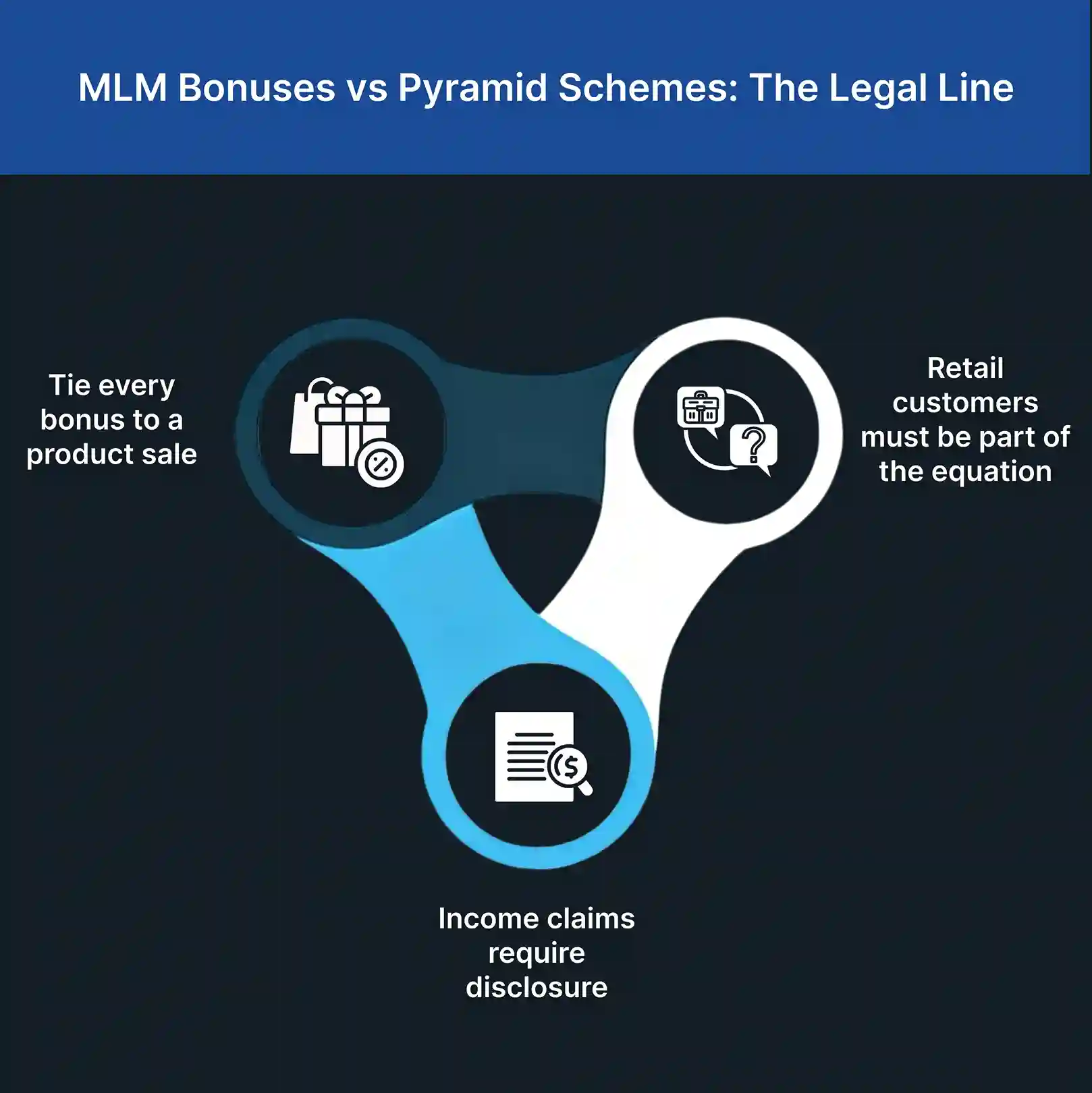
1) Tie every bonus to a product sale
Any bonus that pays on enrollment alone, with no purchase requirement, is a recruitment fee. Set a minimum PV threshold on every bonus trigger without exception. Regulatory agencies such as the Federal Trade Commission emphasize that compensation should be primarily based on product sales rather than recruitment.
Similarly, the Direct Selling Association promotes compensation structures that reward retail sales and customer acquisition.
2) Retail customers must be part of the equation
The FTC requires that products be sold to genuine end consumers, not just to distributors. Your bonus structure must distinguish between retail sales and internal consumption.
3) Income claims require disclosure
Any bonus-related income example used in distributor-facing materials must be accompanied by an Income Disclosure Statement (IDS). The Direct Selling Association (DSA) sets the standard format for compliant income disclosure across the industry.
How MLM Software Automates Bonus Calculation?
As distributor networks grow, commission calculations become increasingly complex. MLM commission software automates four core functions:
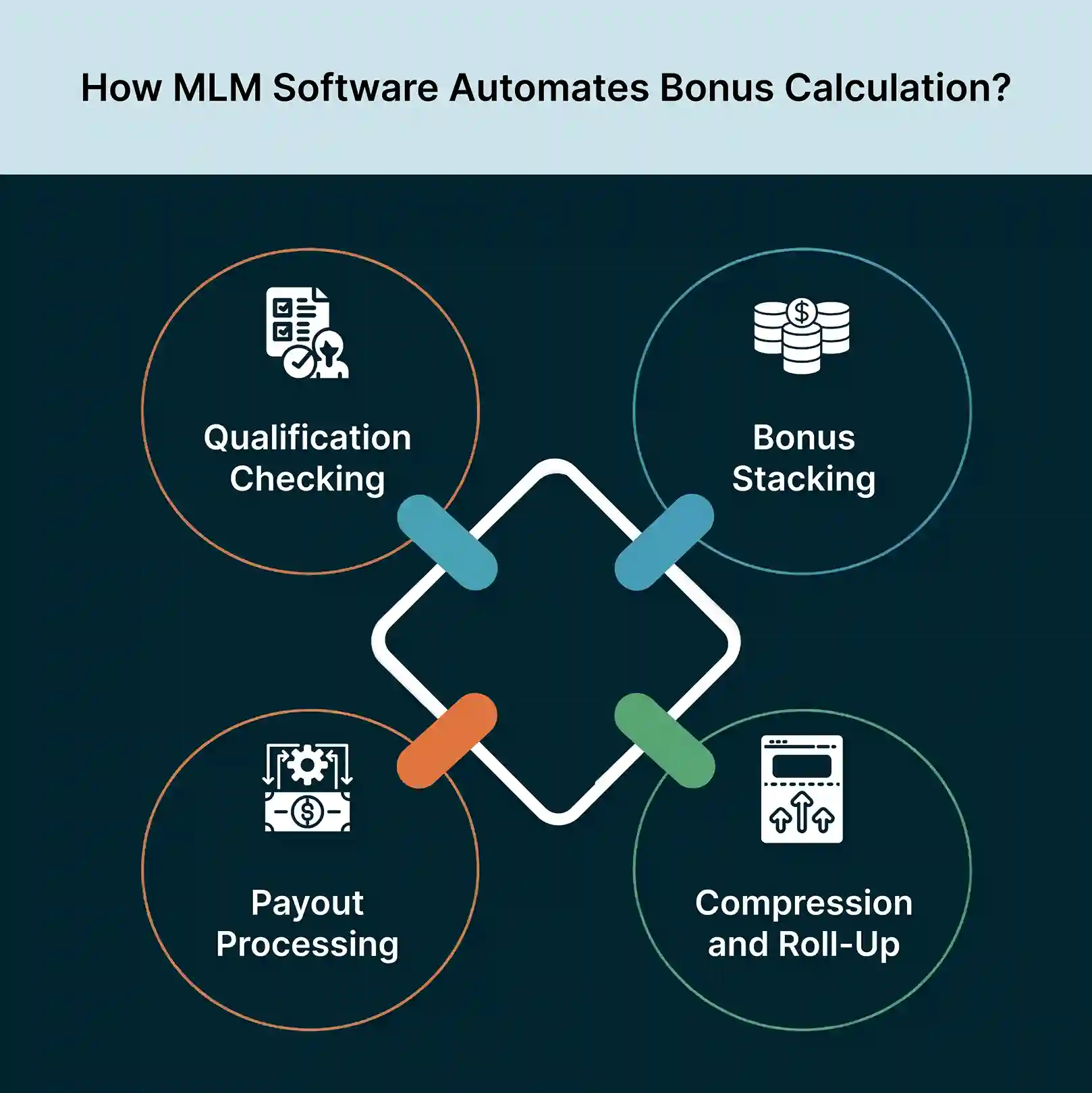
Qualification Checking
The engine monitors every distributor's personal volume (PV), group volume (GV), rank, and activity status in real time. When a distributor meets a qualifying condition like a rank advancement, a volume threshold, or a recruitment milestone, the system automatically calculates the applicable bonus.
Bonus Stacking
A single distributor can qualify for multiple bonuses in one cycle. The system calculates each bonus independently, applies any caps or limits set in the plan rules, and combines the total payout accurately.
Compression and Roll-Up
When an inactive distributor breaks a volume chain, the engine skips them and rolls their volume up to the next qualified upline. This preserves the integrity of generation and level bonuses without manual adjustment.
Payout Processing
Calculated bonuses feed directly into the MLM e-wallet for same-cycle disbursement. Admins can view a full breakdown of every bonus paid to every distributor, with the qualifying condition that triggered it. This is visible through the MLM genealogy tree.
Final Thoughts on MLM Bonuses
The bonuses you include in your compensation plan will determine distributor behaviour, retention, and sales performance. When structured correctly, they drive sales, retention, and sustainable network growth. However, it is important to configure them correctly, with accurate qualification logic and real-time calculation. And for that, you need advanced MLM software solutions.
Global MLM Solution provides MLM software that supports bonus configuration, commission calculations, genealogy management and payout processing for various compensation plans.
Book Your MLM Software Demo to see how Global MLM Solution handles your specific bonus structure, or contact our team to discuss your compensation plan requirements directly.

Shabana is a dynamic writer and strategist with profound expertise in network marketing. Her sharp analysis of industry trends and exceptional ability to distill complex concepts into clear, actionable insights make her content invaluable for professionals at every level. Through her writing, she empowers readers to navigate the evolving landscape of relationship-driven sales with confidence and integrity. Blending data-driven strategies with human-centric principles, Shabana provides a unique perspective that helps businesses thrive while maintaining authentic connections.
FAQs
1. What is an MLM bonus?
An MLM bonus is an event- or milestone-based incentive paid to a distributor on top of their regular commissions. It triggers when a specific condition is met — a new enrollment, a rank advancement, or a volume target. Unlike commissions, which recur every sales cycle, bonuses are conditional and are paid only when the qualifying event occurs.
2. What is the difference between an MLM bonus and an MLM commission?
The key difference between an MLM bonus and an MLM commission is how and when they pay. Commissions are recurring earnings tied directly to product sales volume. They are paid during each commission cycle in which qualifying sales are recorded. Bonuses are conditional payments tied to specific events like recruiting, hitting a volume threshold, or advancing in rank.
3. What is a fast start bonus in MLM?
A fast start bonus pays at a higher rate on the sales volume a new distributor generates within their first 30–90 days. Once the window closes, the standard plan rate applies.
4. What is a matching bonus in MLM?
A matching bonus is a percentage of the commissions earned by a distributor's direct recruits, paid to their upline sponsor.
5. How do I structure MLM bonuses without exceeding my payout budget?
Set a hard payout ceiling. Bonuses should sit within 10%–15% of revenue. Cap every bonus per cycle, run payout simulations at low, medium, and high activity levels, and activate only bonuses mapped to a defined business objective. Every bonus should be mapped to a defined business objective.