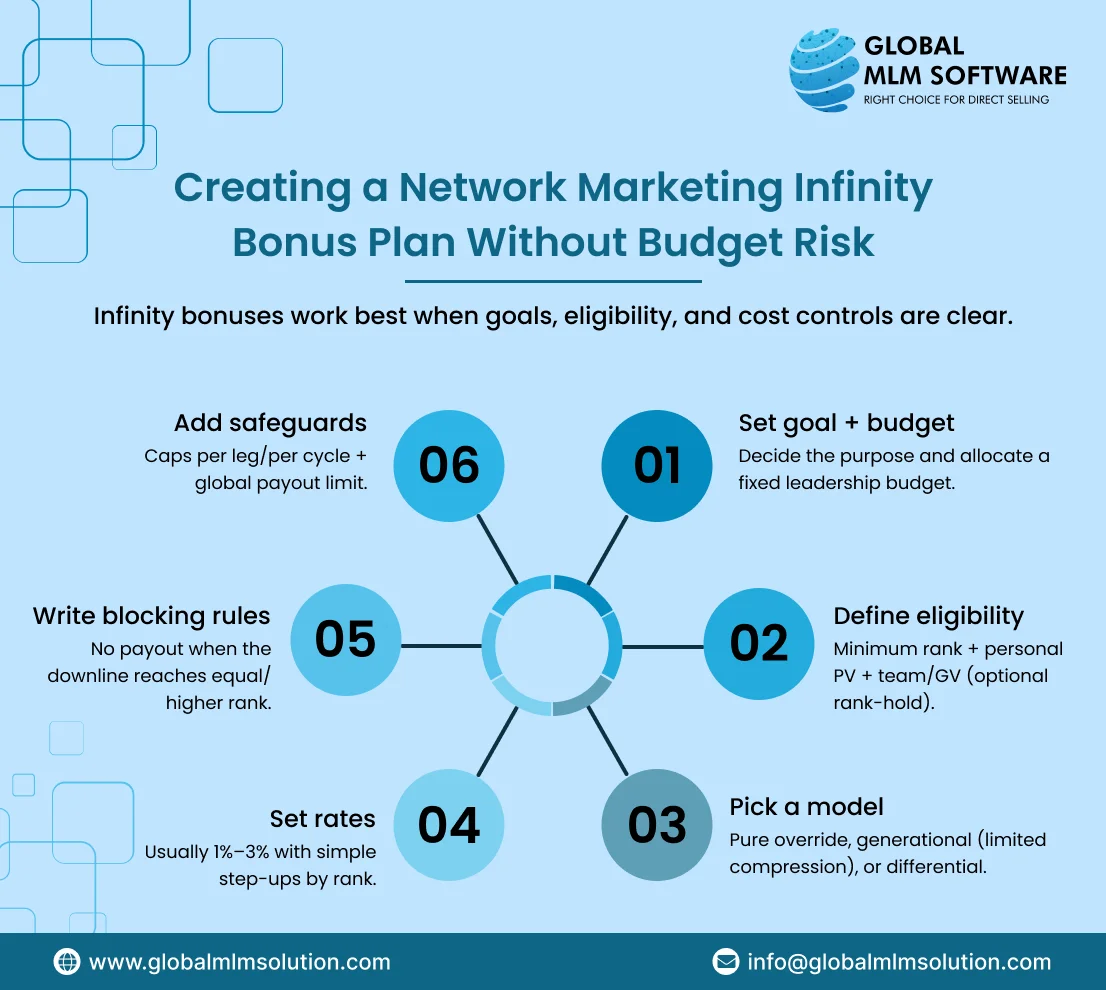
An infinity bonus can boost leadership motivation and long-term team growth—but only if it’s built with clear goals, tight qualification rules, and cost controls. Use this 6-step framework to design a structure that’s profitable, scalable, and easy to explain.
Step 1: Set the objective and payout boundaries
Before you add an infinity bonus, be clear about what you want it to achieve—deeper team development, stronger mentoring, or better retention at the top. If your current commission budget is already tight, forcing another payout layer can create pressure on margins.
A practical approach is to decide on a fixed leadership budget first (from your overall commission allocation) and then carve out the infinity bonus from that amount. Once the budget is defined, you can select percentages and introduce caps early so the bonus stays attractive without becoming expensive during high-growth periods.
Step 2: Define qualification rules
Infinity bonus eligibility should feel like a leadership privilege, not something everyone gets automatically. Start with a minimum rank requirement, often the top few ranks in the plan, so the bonus supports advancement. Add a personal PV requirement to keep leaders active in real selling instead of relying only on team volume.
Many companies also include a minimum group sales or GV threshold, so sponsors don’t earn from deep volume while their own frontline is inactive. If needed, add rank maintenance rules so the rank must be held for a set time before the infinity bonus begins.
Step 3: Choose the infinity bonus model
Your payout model will largely determine cost, simplicity, and how distributors experience the bonus. A pure override model keeps the percentage consistent for all qualified ranks and typically stops when the leg is blocked, which makes it easier to control.
A generational model can continue through inactive positions using compression, but it needs limits so the payout doesn’t inflate; many plans restrict the number of inactive skips. A differential model assigns different percentages by rank and pays the “gap” between an upline and a qualified downline, which can strongly encourage rank progression while controlling double-paying at higher levels.
Step 4: Set infinity percentages by rank
Once the model is selected, set percentages that are easy to explain and meaningful at the top. A common practice is to offer the infinity bonus to roughly the top one-third of ranks.
Percentages often fall in the 1% to 3% range, with the lowest qualified rank starting around 1% and higher ranks moving upward in visible steps. Keep increments simple—usually 0.5% or 1%—so distributors can clearly feel the benefit of ranking up, rather than seeing tiny changes that don’t affect behavior.
Step 5: Define blocking and generation rules clearly
Blocking rules are the backbone of an infinity bonus, so they must be stated without ambiguity. In many plans, the sponsor does not earn an infinity bonus on any leg where a downline member reaches the same rank or a higher rank.
If you use a generational approach with compression, specify exactly how many inactive positions can be skipped and what counts as “inactive.” If the percentage changes after certain events—like skipping or passing a qualified leader—spell out the step-down logic in plain language so distributors don’t feel surprised when a leg grows and their rate changes.
Step 6: Add caps, safeguards, and global controls
To keep the infinity bonus sustainable, add guardrails that prevent extreme payouts. You can cap how much infinity income can come from a single leg, which reduces over-dependence on one team. You can also set a maximum infinity amount per payout cycle so the bonus remains predictable for the business.
For overall cost control, some companies set a global limit by restricting what portion of total commissionable volume (or global GV) can be paid out through the infinity component. These safeguards protect margins while still preserving the “long-term depth reward” message that makes the bonus appealing.
Conclusion
A strong infinity bonus rewards leaders for building depth, not chasing short-term spikes. Keep the rules simple and visible. Make qualification feel earned. Control costs with caps and clear blocking. Test the math before launch, then monitor it often. When built this way, the bonus stays motivating, fair, and profitable as the network scales.