
While setting up your network marketing business, one of the most important decisions you will have to make is choosing the right MLM compensation plan.
Your MLM compensation plan will determine your distributor behaviour, recruitment velocity, retention rates, and long-term profitability, before even selling a single product. It basically dictates how money moves through your network and how much of it circles back to you as profit.
To put that in perspective, the global direct selling industry recorded $163.9 billion in retail sales in 2024. A large part of how that revenue was distributed across networks came down to how each company's compensation plan was designed.
But such an important decision cannot be taken without a proper understanding. If you have heard of terms like unilevel, binary, matrix plans, etc., but couldn't make sense of them, this comprehensive guide will tell you everything regarding network marketing compensation plans, their structure, calculations, and real company examples. It also includes a scored quiz that tells you exactly which plan fits your business, to help you decide.
Key Takeaways
-
Choosing the right MLM compensation plan directly influences recruitment speed, distributor retention, payout control, regulatory compliance, and long-term business profitability.
-
Unilevel MLM plans support unlimited frontline recruitment, making them ideal for product-focused companies seeking scalable growth, simpler training, and lower compliance risks.
-
Matrix structures provide predictable payout forecasting through fixed width and depth limits, making them effective for subscription-based businesses and recurring revenue models.
-
Binary MLM plans encourage rapid expansion through spillover and team-building incentives, but require balanced network growth and stronger retail sales compliance management.
-
Leadership-focused models such as Generation and Stairstep Breakaway reward rank advancement, helping companies improve distributor retention, leadership development, and long-term network stability.
What is an MLM Compensation Plan?
An MLM compensation plan is the structural framework that determines how a direct selling company pays its independent distributors. It defines the rules for every commission, bonus, and incentive in the network. The plans also lay out rules for who qualifies, based on what activity, at what threshold, and on what schedule.
Every decision a distributor makes is a direct response to the compensation plan they are operating under. In that sense, the compensation plan is not just a payment document. It is the behavioural architecture of your entire network.
Types of MLM Compensation Plans
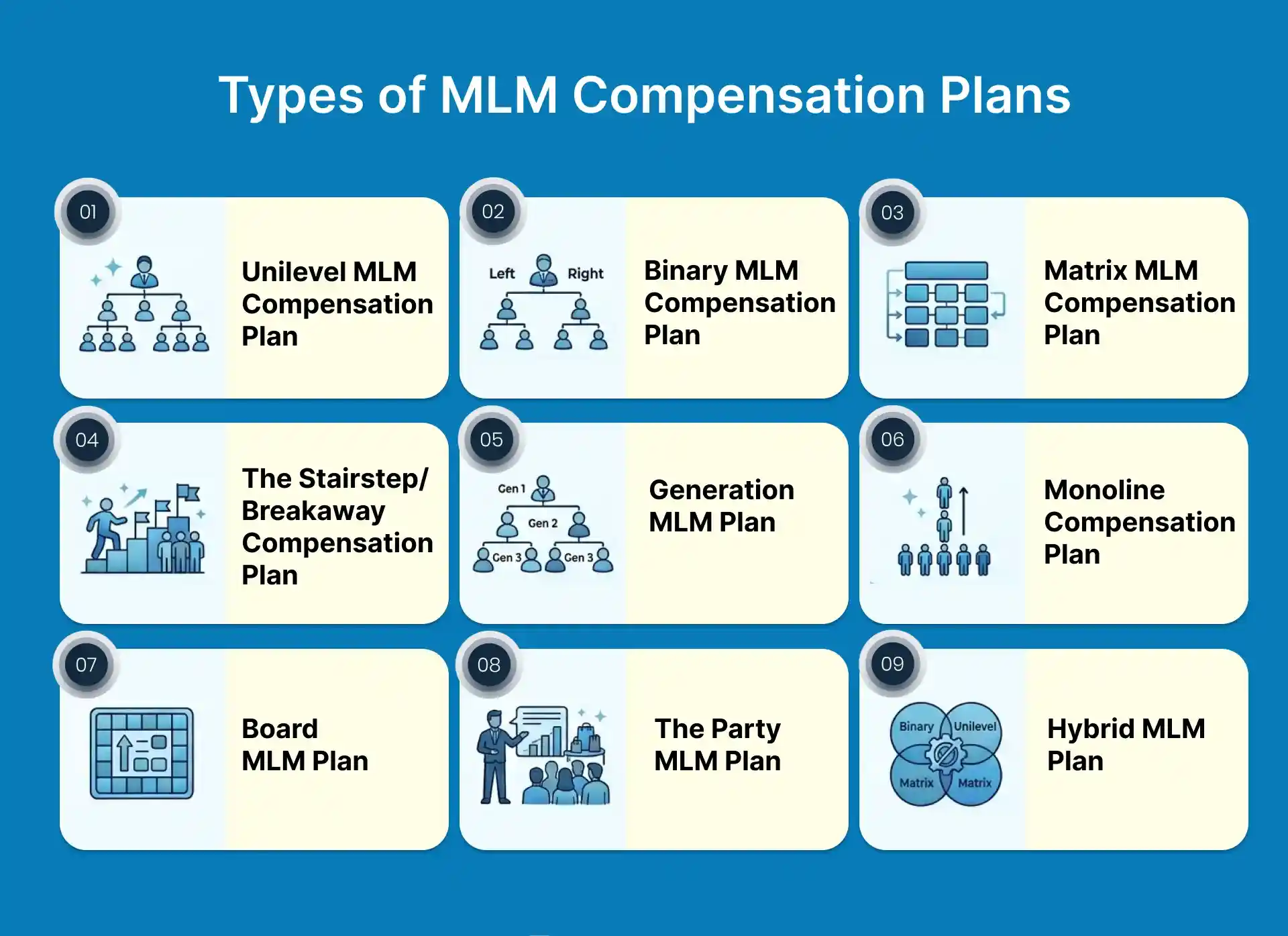
Before diving into understanding the various MLM compensation plan calculations, you need to understand their distinctions. Not all MLM plans work the same way. Some define how your entire network is structured. Others sit on top of that structure and add a layer of rank advancement, leadership rewards, or event-based selling.
There are nine plans mentioned here. The primary plans define your network structure and commission flow, and supporting plans that enhance it. Then there is the hybrid plan, which combines two or more primary structures into one. Hybrids are covered separately at the end of this section.
1) Unilevel MLM Compensation Plan
The unilevel MLM plan allows all recruits of a distributor to be placed in a single level in their downline. This line extends horizontally as new members are added to the network. When these downline members sponsor recruits, they are placed in a level below them. In this way, the network expands vertically as well.
By definition, the unilevel compensation plan in MLM is one of the simplest structures in direct selling, and that simplicity is one of the plan's defining features. Distributors are incentivised to build the widest possible frontline, to increase their direct commissions, and open up more pathways to rank advancement. It is also the easiest plan to get regulatory approval for, as it aligns naturally with FTC and DSA requirements.
In real life, doTERRA runs one of the most recognized unilevel structures in direct selling. The plan pays distributors up to 7 levels deep. The plan scales precisely because width has no ceiling; distributors build an extensive downline network for higher income. If your growth strategy depends on rapid network expansion driven by high-volume recruiters, Unilevel gives you a perfect foundation.
Features of the Unilevel MLM Plan
| Best for | Product-led companies, consumables, mid-range price points, and repeat purchases-driven, like in Health and wellness, beauty, etc. |
| Commission calculation criteria | Distributors must meet the minimum Personal Volume (PV) threshold to qualify each cycle. GV and PV are used to determine ranks |
| Pay Cycle | Monthly |
| Compression | Yes. Inactive distributors skipped, commissions pass to the next qualified upline |
| Spillover | No, since there is no limit to how many members a sponsor can place in their downline. |
| Rank-gated commissions | Yes. Distributors typically qualify for lower-level commissions once they reach levels 4-5 and beyond. |
| Supporting Software | Unilevel MLM Software |
2) Binary MLM Compensation Plan
The binary MLM plan builds every distributor's network around two legs, a left and a right. Each distributor sponsors exactly two members, one on each side, and the network grows downward as a binary tree.
In a binary plan, commissions are usually calculated based on the weaker leg's volume. And this is binary's most underrated leadership engine. Top performers cannot just recruit; they are structurally required to mentor and develop their weaker side. This built-in accountability leads to more resilient teams, with new recruits receiving full support from their leaders.
A living example of this is Usana Health Sciences. Its binary plan offers leadership and elite bonuses based on the associate's team performance. This works perfectly well in the health and wellness sector, where new recruits need product knowledge and confidence before selling independently. If you are looking for a plan with a retention and reputation strategy built into it, look no further than the binary MLM plan.
Features of the Binary MLM Plan
| Best for | Health and wellness, beauty, and lifestyle companies with high-ticket or high-margin products. |
| Pay Cycle | Weekly |
| Commission calculation criteria | Distributors must meet the minimum PV threshold each cycle. Commissions calculated on the weaker leg's volume — the lesser of left or right leg business volume (BV). GV of both legs determines rank advancement |
| Compression | Yes. Inactive distributors are skipped, commissions pass to the next qualified upline |
| Spillover | Yes. Recruits exceeding the two-leg limit are placed under existing downline members, benefiting lower-level distributors |
| Rank-gated commissions | Yes. Distributors must build sufficient depth in both legs before higher commission percentages and bonus pools unlock |
| Supporting Software | Binary MLM Software |
3) Matrix MLM Compensation Plan
The matrix MLM plan works on a template with a fixed width and depth. Every distributor can only sponsor a fixed number of members on their frontline. Additional recruits are placed based on the plan's spillover mechanism. A company can choose from any of the matrix structures. Some common configurations include 2x15, 3x9, 4x7, and 5x7, etc.
For example, if an MLM company chooses a 2x15 matrix, each distributor has 2 frontline positions, and the network extends 15 levels deep. The structure grows in a controlled, predictable pattern. It is one of the compensation plans where you can accurately forecast total payout volume at any given network size.
LiveGood is the cleanest proof of how this model works at scale. The company recorded a revenue growth of 3,000% in its first year, by using a 2X15 matrix as the core of its compensation plan. If you are selling subscription or membership-based products, the matrix is the strongest structural fit. It provides predictable recurring income at every level, with payout volume that you can forecast from day one.
Features of the Matrix MLM Plan
| Best for | Subscription and membership-based businesses, digital products, and recurring revenue models that need controlled, predictable network growth. |
| Commission calculation criteria | Distributors must meet the minimum PV threshold each cycle. Commissions paid as a flat percentage of CV per level. GV and PV determine rank advancement and the depth of levels accessible |
| Pay Cycle | Monthly |
| Compression | Yes. Inactive distributors are skipped, commissions pass to the next qualified upline |
| Spillover | Yes. Once frontline positions are filled, additional recruits are automatically placed in the next available position deeper in the network |
| Rank-gated commissions | Yes — distributors must build sufficient depth before deeper levels unlock. Full 15-level access requires rank advancement |
| Supporting Software | Matrix MLM Software |
4) The Stairstep/Breakaway Compensation Plan
The stairstep/breakaway plan is not a standalone structure like the unilevel, binary, or matrix plan. It is a rank advancement and breakaway mechanism layered on top of these plans. This means you can include this structure in your existing unilevel/binary/matrix plan to reward your distributors for both the sales volume and the teams they build.
The stairstep/breakway plan basically operates through two mechanisms. The stairstep element maps out a series of ranks for distributors to climb through. Each requires specific PV or GV thresholds. Once a distributor reaches the topmost rank, the breakaway mechanism is triggered. They separate from their upline and form a new team, with new earning opportunities.
Nu Skin's official Sales Compensation Plan is a perfect example of this MLM compensation plan. Executives break away from their Sponsor's Circle Group, and their volume stops counting toward their upline's totals. If you are building a performance-driven network where top earners need room to grow, and sponsors need long-term income from the leaders they developed, the stairstep breakaway is built for exactly that.
Features of the Stairstep/Breakaway MLM Plan
| Best for | Companies running Unilevel, Binary, or Matrix plans that want to add a performance and leadership layer — rewarding distributors for rank advancement, not just volume. |
| Pay Cycle | Monthly |
| Commission calculation criteria | Distributors must meet the minimum PV threshold each cycle. GV and PV determine rank advancement up the staircase. Commission percentages increase at each rank. Once breakaway is triggered, upline earns a Breakaway Bonus on the separated group's volume instead of the full differential. |
| Compression | Yes. Inactive distributors skipped, commissions pass to next qualified upline |
| Spillover | Depends on the base plan — yes if layered on Binary or Matrix, no if layered on Unilevel |
| Rank-gated commissions | Yes — higher commission percentages, bonus pools, and generation-level overrides unlock only as rank advances up the staircase |
| Supporting Software | Stairstep Breakaway MLM Software |
5) Generation MLM Plan
The generation MLM plan is a unique structure that rewards distributors for developing leaders in their downline. It is a leadership bonus mechanism layered on top of a primary MLM plan, most commonly unilevel. It defines the network into generations, rather than levels. A new generation begins each time a distributor in the downline reaches a qualifying rank.
The structure is also called the Gap Commission plan. When a downline distributor reaches a qualifying rank, they earn their own commission percentage on their group's volume. The upline earns the difference between their commission percentage and the downline's, which is referred to as the gap. As downline leaders advance and close that gap, the upline's income from that generation decreases. This way, distributors are incentivized to develop new leaders elsewhere in the network.
Oriflame's compensation plan perfectly encompasses this idea. Directors earn generation bonuses starting at 1% on their personal generation. Additional percentages are unlocked on deeper generations. If you are building a consumables and beauty company, where repeat purchase cycles and leadership depth matter, you must consider the generation plan.
Features of the Generation MLM Plan
| Best for | Consumables, beauty, and wellness companies with repeat purchase cycles, where long-term distributor retention and leadership depth are the primary growth drivers. |
| Pay Cycle | Monthly |
| Commission calculation criteria | Distributors must meet the minimum PV threshold each cycle. GV and PV determine rank advancement. Commissions paid as per the gap between their commission percentage and the qualifying downline's percentage. |
| Compression | Yes — inactive distributors skipped, commissions pass to the next qualified upline |
| Spillover | Mostly no, since it is layered on a unilevel MLM plan. |
| Rank-gated commissions | Yes — generation bonuses only unlock when downline distributors reach qualifying ranks. Deeper generation layers activate only as the leadership network matures |
| Supporting Software | Generation MLM Software |
6) Monoline Compensation Plan
The Monoline plan goes by many names, like the single leg, single line, or linear plan. It is one of the simplest compensation plans in MLM. Every new member is placed directly beneath the last in a single, unbroken chain. There are no legs to balance, no matrix to fill, no width restrictions. The entire network is one line.
In this structure, the position of a distributor determines his earnings. The earlier they join, the higher they sit in the line, and the more members they accumulate beneath them. Commissions are paid on the sales volume of the entire downline, regardless of who personally recruited each member. This means every new recruit added anywhere in the chain benefits every member above them.
Unlike other plans covered here, the monoline plan requires no structural decision-making, placement strategy, or leg management. If your MLM business is at an early stage, you need a compensation structure that is fast to explain and ever faster to onboard. The monoline MLM plan is your best bet.
Features of the Monoline MLM Plan
| Best for | Early-stage companies and digital product businesses that need a fast, simple structure with zero onboarding complexity. |
| Pay Cycle | Weekly/Monthly |
| Commission calculation criteria | Commissions paid as a percentage of total downline sales volume. No PV threshold complexity — position in the line and overall network volume determine earnings. Some companies require a minimum number of personal recruits before commission eligibility activates |
| Compression | No — position in the line is fixed. Inactive members cannot be skipped without disrupting the sequential structure |
| Spillover | Yes — every new recruit placed anywhere in the chain automatically benefits all members above them |
| Rank-gated commissions | No — earnings are determined by position and downline volume, not rank advancement |
| Supporting Software | Monoline MLM Software |
7) Board MLM Plan
The board MLM plan, also called the revolving matrix plan, is a matrix variant with a tighter depth and is built around a cycling mechanism. Distributors are placed into a fixed-width board, typically 2x3 or 3x3, and work collectively to fill every position. Once full, the board splits, and the distributor advances to a higher-value board.
Companies choose the Board plan over a standard Matrix because it creates urgency. Every distributor can see exactly how many positions are left to fill, which drives collective recruitment faster than an open-ended matrix. Advancing to a higher board gives distributors a sense of progression that keeps them engaged beyond commissions. And since bonuses only pay out on board completion, the company controls payout timing precisely.
The Board plan is most common among digital product companies, membership platforms, and crypto-based MLM ventures. Most established direct selling brands fold board cycling into hybrid structures rather than running it as a standalone plan.
Features of the Board MLM Plan
| Best for | Digital product companies, membership platforms, and early-stage MLM businesses needing high recruitment energy and fast network momentum |
| Pay Cycle | Weekly or per board completion |
| Commission calculation criteria | Ongoing commissions paid as a percentage of sales volume generated within the board. A separate completion bonus is triggered when the board fills — typically a fixed amount or multiple of the joining fee. Some plans also pay referral bonuses for personally sponsored members. |
| Compression | No — board positions are fixed and sequential. Compression mechanics do not apply to board cycling structures |
| Spillover | Yes — once a member's direct positions are filled, additional recruits flow into the next available board position, benefiting members already in the structure |
| Rank-gated commissions | Partial — higher board levels carry larger completion bonuses. Advancement to higher boards is triggered by completing the current board, not by rank qualification |
| Supporting Software | Board MLM Software |
8) The Party MLM Plan
The party plan is unlike every other plan in this guide. Instead of building downlines through direct recruitment, distributors sell through home parties, cooking demos, online events, and social gatherings where guests can see, touch, and try the product before buying.
Like the Stairstep Breakaway and Generation plans, the Party Plan layers this host-reward mechanism on top of a primary plan, typically Unilevel or Matrix. This way, distributors earn both event commissions and ongoing downline income simultaneously.
Pampered Chef, owned by Berkshire Hathaway, has run this model for over four decades. Consultants host cooking demonstrations, sell kitchenware in person, and build their networks through the guests who enroll themselves. If you are selling a product that can benefit from live demos, the party MLM plan is the right choice.
Features of the Party MLM Plan
| Best for | Beauty, skincare, kitchenware, and home product companies where in-person product experience drives conversion |
| Pay Cycle | Monthly |
| Commission calculation criteria | Distributors earn retail commission on total event sales volume. Host rewards are calculated as a percentage of total party sales. Downline commissions follow the primary plan structure — Unilevel or Matrix — with GV and PV determining rank advancement |
| Compression | Depends on the primary plan — yes if layered on Unilevel or Matrix |
| Spillover | Depends on the primary plan — yes if layered on Matrix, no if layered on Unilevel |
| Rank-gated commissions | Yes — deeper downline commissions unlock as rank advances through the primary plan structure |
| Supporting Software | Party Plan MLM Software |
9) Hybrid MLM Plan
As the name suggests, a hybrid MLM compensation plan combines two or more primary plan structures into one. Companies build hybrids to capture the strengths of multiple plans while neutralising their individual weaknesses.
The most common MLM hybrid compensation plans are:
Binary Breakaway: It is a binary plan with a stairstep breakaway layer. Distributors build two legs and earn on weaker leg volume, but top performers can break away and form independent groups, and unlock leadership overrides bonuses.
Unilevel Breakaway: This is the most widely used hybrid in direct selling. It has a unilevel base with a stairstep breakaway layer. Distributors earn level-by-level commissions but advance through defined ranks, with top earners breaking away to earn generation-level overrides. Herbalife and Amway both run versions of this structure.
Matrix Board: This structure means a matrix plan with a board cycling mechanic layered on top. Distributors earn level commissions within their fixed matrix while board completions trigger additional bonuses and advancement events. This structure is common in digital products and membership-based MLMs.
Binary Board: It is a binary plan with a board cycling mechanic. It combines binary's team-building urgency with the gamified milestone rewards of a Board structure.
MLM Compensation Plan Comparison
Any kind of information is not complete without a proper comparison. If the previous sections helped you understand each plan type in detail, this section will focus on comparing MLM compensation plans so you can choose the best option. Here is a head-on comparison of the three most popular MLM plans, pitted against each other.
1) Unilevel vs Matrix MLM Plan
| Unilevel | Matrix |
|---|---|
| Unlimited frontline distributors | Fixed frontline positions — typically 2, 3, or 4 |
| No spillover | Spillover fills open matrix positions automatically |
| Distributors control their own recruitment pace | Spillover can help fill open positions within the matrix structure. |
| Commissions are paid as a percentage of CV per level | Commissions are paid as flat percentage per level within fixed grid |
| Easier to explain and implement | More complex — fixed width and depth can confuse new distributors |
| Lower payout per level | Higher overall payout potential within matrix structure |
| Best for wide recruitment and individual effort | Best for controlled growth and predictable payout management |
2) Unilevel vs Binary MLM Plan
| Unilevel | Binary |
|---|---|
| Unlimited frontline distributors | Only two frontline distributors allowed |
| No spillover — every recruit placed by the distributor directly | Spillover places excess recruits into existing downline legs |
| Commissions are paid level by level up to fixed depth | Commissions are paid on weaker leg volume regardless of depth |
| Individual effort drives growth | Teamwork and leg balance drives growth |
| Monthly pay cycle | Weekly pay cycle |
| Upline has no influence over downline placement | Upline can influence downline placement through spillover |
| Lower regulatory risk | Higher regulatory risk if retail sales are weak |
| Best for product-led companies | Best for opportunity-led, fast-expansion companies |
3) Binary vs Matrix
| Binary | Matrix |
|---|---|
| Two frontline positions only | Fixed width — typically 2, 3, or 4 frontline positions |
| Unlimited depth | Fixed depth |
| Commissions are paid on weaker leg volume | Commissions are paid as flat percentage per level within the grid |
| Spillover into existing legs | Forced placement fills the next available matrix position |
| Leg balance is critical — imbalance reduces earnings | No leg balancing required |
| Weekly pay cycle | Monthly pay cycle |
| Fast, aggressive network growth | Controlled, steady network growth |
| Best for team-building, opportunity-led companies | Best for subscription and membership-based companies |
How to Choose the Best MLM Compensation Plan for Your MLM Business?
There is no universally best MLM compensation plan to choose. However, the one you choose should perfectly fit your product, market, distributor profile, and financial position. If you are confused, this questionnaire will help you identify the best option. Answer each question and note your score. Add up your total at the end to find your recommended plan combination.
1. What drives the majority of your revenue?
Repeat product purchases from retail customers → 1
A mix of product sales and distributor recruitment → 2
Distributor recruitment and network growth → 3
2. What is your product's price point?
Under $50 → 1
$50–$200 → 2
Above $200 → 3
3. Who is your target distributor?
Part-time, new to network marketing → 1
A mix of part-time and full-time → 2
Full-time, experienced network marketers → 3
4. How would you describe your growth target in year one?
Steady and controlled — I want predictable, manageable growth → 1
Moderate — balanced growth with controlled payout cycles → 2
As fast as possible — network expansion is the priority → 3
5. What is your capital position in the first 12 months?
Tight — cash flow needs careful management → 1
Moderate — can handle monthly payout cycles comfortably → 2
Strong — can support weekly payouts from day one → 3
6. How important is team collaboration to your distributor model?
Not critical — distributors work independently → 1
Somewhat important — a mix of individual and team activity → 2
Critical — distributors need structural incentives to work together → 3
7. How do you want to control your payout volume as the network scales?
Flexibly — I will manage it through rank qualification and level limits → 1
Tightly — I want hard caps built into the plan structure → 2
I prioritise fast payouts over tight payout control → 3
8. What type of product are you selling?
Consumables, wellness, beauty, or lifestyle products → 1
Subscriptions, memberships, or digital products → 2
High-ticket, high-margin products → 3
9. How many markets do you plan to operate in at launch?
One market → 1
Two to three markets → 2
Multiple international markets from the start → 3
10. How would you describe your distributor onboarding strategy?
Mass recruitment — I need volume quickly → 3
Selective — I am building a smaller, high-quality network → 1
Mixed — broad recruitment with a quality filter → 2
Your Score: If your total ranges between-
10–16 → Your ideal MLM plan is Unilevel: Product-led, compliance-friendly, built for sustainable growth. Unilevel keeps the structure simple, regulatory risk low, and payout cycles predictable. If you want to build strong leadership teams, layer a Stairstep Breakaway mechanism on top. It will create a leadership pathway for top performers and unlock generation-level override income as the network matures.
17–23 → Your ideal MLM plan is Matrix: Predictability, controlled growth. Matrix caps payout volume, protects margins, and grows at a pace the company can manage. You can take it further by layering a Stairstep Breakaway structure that keeps ambitious distributors in the matrix longer.
24–30 → Your ideal MLM plan is Binary: Opportunity-led, growth-hungry, built for fast expansion. Binary drives network momentum through spillover and team accountability from day one. A Generation plan layer is perfect to further complement this structure. It rewards the leaders who build the deepest parts of your network, thereby turning short-term recruitment energy into long-term compounding income.
If your score lies somewhere in between these ranges, then you should opt for the hybrid plan. You can refer to the hybrid plans section of this guide before deciding. If you require expert guidance, MLM consulting services will help you design a plan that fits your business from the ground up.
A Few Things to Keep in Mind Before Locking in Your Compensation Plan
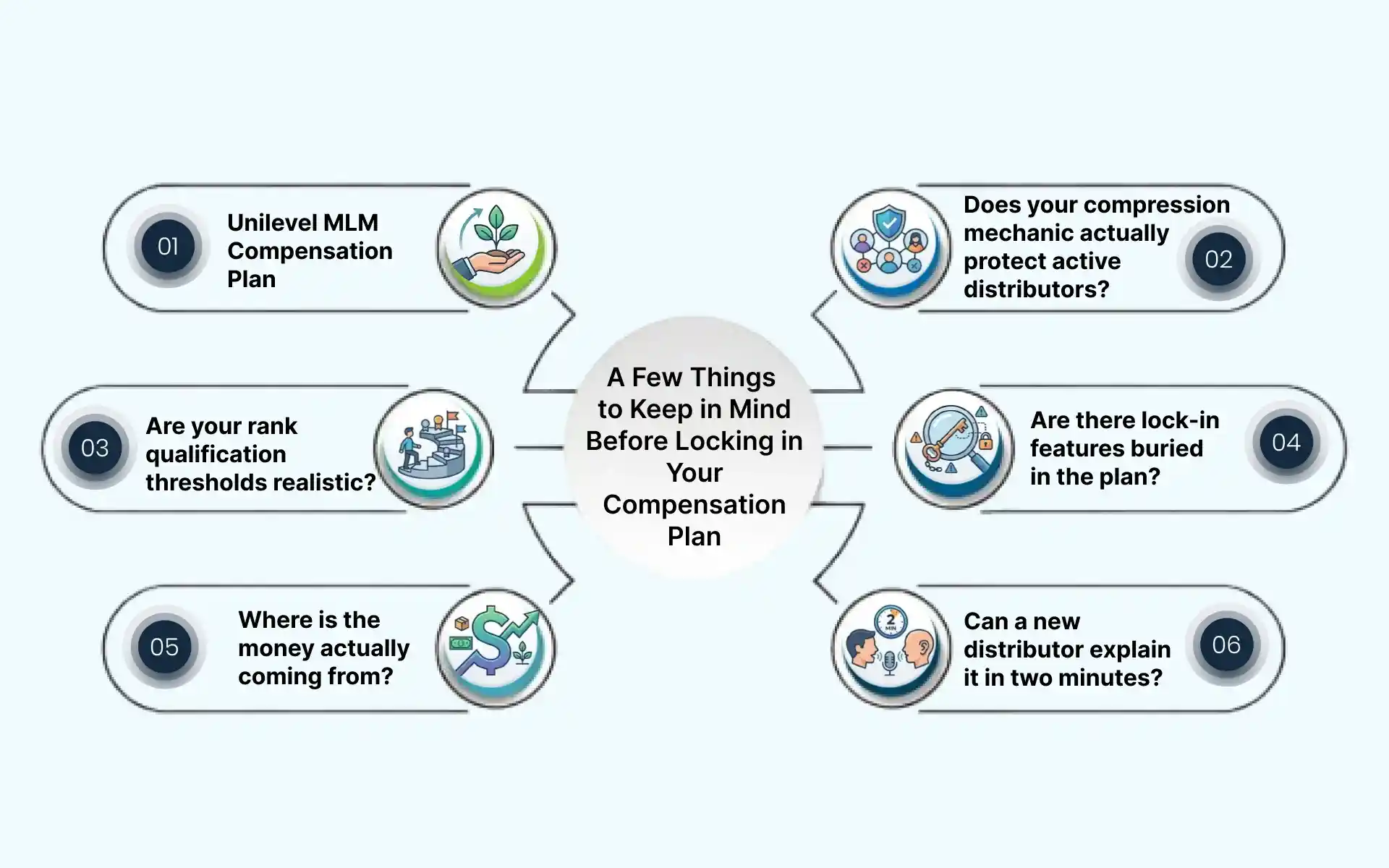
Once you have evaluated all your options, there are a few checks you need to run before finalizing the best MLM compensation plan for your business:
1) Is your total payout sustainable?
Commissions, bonuses, and incentives across all levels should sit between 35% and 50% of commissionable volume. If it is below 35%, you will struggle to attract and retain distributors. If you keep it above 50%, your margins are at risk as the network scales.
2) Does your compression mechanic actually protect active distributors?
Compression should automatically skip inactive members and pass commissions to the next qualified upline, consistently, across all levels. If it only applies to the first few levels, your active distributors are still losing income to dead zones deeper in the network. Make sure the rules are consistent across the entire network.
3) Are your rank qualification thresholds realistic?
If the PV or GV required to maintain rank is set too high, distributors will either buy inventory to qualify (a huge red flag for regulators) or churn out when they cannot keep up. Rank should be achievable through genuine sales activity, not personal purchases.
4) Are there lock-in features buried in the plan?
Autoship requirements, minimum purchase thresholds, and clawback provisions can quietly push distributors into inventory loading just to stay commission-eligible. These features increase regulatory risk and distributor resentment in equal measure. It's important to identify these features and change them before the regulatory authorities do.
5) Where is the money actually coming from?
A compliant plan pays meaningfully on retail customer sales, not just on distributor recruitment. If the majority of commission income flows from recruitment activity rather than retail sales, your plan may be at risk of being labeled a pyramid scheme, regardless of how it looks on paper.
6) Can a new distributor explain it in two minutes?
Most importantly, the plan needs to be easily understood and explained. If your distributors are themselves struggling with the issue, they will struggle to recruit as well. Complexity kills field momentum faster than almost anything else. The best plans are sophisticated enough to reward the right behaviours and simple enough for a new distributor to understand or explain, from day one.
A compensation plan that looks sustainable on paper can behave very differently at scale. Before you lock anything in, run your numbers through an MLM calculator to model how commissions, bonuses, and payout volumes will flow at different network sizes. You can use tools like the unilevel MLM calculator or the matrix MLM calculator to simulate real payout conditions, so you can base your decisions on actual numbers.
Choosing Your MLM Compensation Plan: What Comes Next
The right MLM compensation plan is the foundation on which every other part of your business is built. It can become your strongest recruitment, retention, and revenue tool if you plan it right from the start.
This guide has covered every major plan type, how each one calculates commissions, what it costs to run, and what kind of business it is genuinely built for. The comparison tables, the checklist, and the quiz will help you make sure the plan you choose is the right one for your business.
If you are ready to take the next step, Global MLM Solution has helped hundreds of direct selling companies design, build, and launch compensation plans that scale. Browse our customer success stories to see how companies across industries have structured their plans for sustainable growth. You can also try a free demo of the MLM software here.

Shabana is a dynamic writer and strategist with profound expertise in network marketing. Her sharp analysis of industry trends and exceptional ability to distill complex concepts into clear, actionable insights make her content invaluable for professionals at every level. Through her writing, she empowers readers to navigate the evolving landscape of relationship-driven sales with confidence and integrity. Blending data-driven strategies with human-centric principles, Shabana provides a unique perspective that helps businesses thrive while maintaining authentic connections.
FAQs
1. What is the best MLM compensation plan?
An unilevel MLM plan is best for product-led companies, while the Binary is best for fast network expansion. On the other hand, Matrix is best for controlled, predictable growth. In the end, the best MLM compensation plan depends on your business model.
2. Which MLM company has the best compensation plan?
USANA is widely respected for its binary plan that ties leadership bonuses to team performance. Also, doTERRA's unilevel structure is consistently cited for retail-first design and regulatory alignment. Atomy's Binary plan also stands out for its zero joining fee and volume-based commissions.
3. What MLM companies use the stairstep breakaway compensation plan?
The stair-step MLM plan is widely adopted by companies like Nu Skin, Amway, and Herbalife. In fact, Amway is known to have pioneered this concept in the 1950s.
4. Which are some trusted mlm businesses with fair compensation plans?
doTERRA, USANA, Atomy, and Nu Skin are consistently cited for fair compensation structures. All four publish annual income disclosure statements and maintain documented retail customer bases, which are the two clearest indicators of a legitimate, retail-first compensation plan.
5. What are the different types of MLM compensation plans?
There are nine major types used in direct selling today:
1) Unilevel MLM plan: unlimited frontline width, fixed depth, pays level by level.
2) Binary MLM plan: two-leg structure, pays on weaker leg volume, drives team-based recruitment.
3) Matrix MLM plan: fixed width and depth, spillover fills positions automatically.
4) Stairstep Breakaway MLM plan: rank advancement mechanism layered on a primary plan, top earners break away into independent groups.
5) Generation MLM plan: pays on the gap between upline and downline commission percentages across rank-defined generations.
6) Monoline MLM plan: single-line structure, every new recruit benefits all members above them.
7) Board MLM plan: Matrix variant with a cycling mechanism, board completion triggers bonuses and advancement.
8) Party MLM plan: Host-driven event model layered on a primary plan, drives retail sales through group demonstrations.
9) Hybrid MLM plan: A combination of any two MLM plans, designed to capture the strengths of each while neutralising their individual weaknesses.