Every founder shopping for MLM software hears the same pitch: lowest price, longest feature list, highest star rating. So they pick based on those numbers — and then launch day arrives. Suddenly their compensation plan needs a developer and six weeks to configure. Or 180 of the 200 "features" they paid for turn out to be irrelevant to their model. Or the "top-rated" platform has zero tools for the one thing their category actually needs, because it was built for a completely different kind of brand. The comparison criteria everyone uses to shop for MLM software are, almost without exception, the wrong ones.
There's a better way to evaluate — and it doesn't involve spreadsheets full of star ratings. It involves one question: can this vendor configure your exact compensation plan, live, in front of you, during the demo? If they can, you keep talking. If they can't — or if they ask for a "follow-up call" — you already have your answer. This guide breaks down the 8 criteria that actually predict whether a platform will hold up once you're past the sales pitch and into real operations, the red flags that should end a demo early, and a 4-week evaluation timeline built to get you to DSU Fall 2026 with a signed agreement instead of a stack of unanswered questions.
Demo performance beats price and feature count: Don't rank vendors by monthly cost or feature lists — test whether they can configure your exact compensation plan live and run a test transaction.
Use an 8-criterion framework: Comp plan setup, social selling tools, AI features, FTC compliance, category fit, multi-market support, implementation quality, and migration support — each with its own demo question.
Watch for 7 red flags: Vague AI claims, compliance tools sold as add-ons, no live reference clients in your category, and quotes withheld until after signing all signal a mismatch.
There's a hard deadline: Oct 6 (DSU Fall 2026): The article pushes a 4-week evaluation sprint so founders arrive at the conference with a signed platform deal, not still shopping.
Migration and build-vs-buy are high-risk decisions: Genealogy errors during migration break commissions instantly; custom-built software costs $200K–$800K and takes 12–24 months — buying beats building for most companies.
The best way to compare MLM software isn't price or feature count — it's whether a vendor can configure your specific compensation plan live, in front of you, during a demo. If they can't do that in real time, no other feature on their list matters. Use the 8-criterion framework below, verify each one live, and get a written quote before you sign anything.
Why Most MLM Software Comparisons Lead Founders To The Wrong Decision
Most comparisons rank platforms by monthly price, feature count, or review-site star rating. None of these predict whether a platform can actually run your compensation plan, your compliance obligations, or your category's specific needs once you're live.
The majority of MLM software comparisons are built around the wrong criteria. Price per month. Feature count. Star rating on a review aggregator. Number of years the vendor has been in business. None of these predict whether a platform will actually serve your company once you are past the demo and into live operations.
Here is what actually happens when founders use these criteria: they select a platform with a lower monthly fee and discover on launch day that configuring their specific compensation plan requires a developer and six weeks. They choose a platform with the highest feature count and find that 180 of the 200 listed features do not apply to their model. They select the highest-rated vendor on a review aggregator built primarily for supplement brands and discover the platform has no tutorial video sharing, no multi-SKU daily auto-ship, and no cosmetic claim compliance library — because it was built for wellness brands, not beauty brands.
The right primary evaluation criterion: Can this vendor configure my specific compensation plan — my ranks, my commission rates, my override structure, my market — live during a 30-minute demo? If yes, evaluate everything else. If no, end the demo early and move to the next vendor. A platform that cannot demonstrate your plan in a demo will not run your plan correctly after you sign.
The 8-criterion framework below is designed to replace price-and-feature-count comparisons with a live demonstration standard. Every criterion has a demo verification question and a red flag that reveals when a vendor's claim is not matched by their capability.
The 8 Criteria That Actually Matter When Comparing MLM Software Platforms
These 8 criteria predict whether a direct selling platform will serve your company on the dimensions that matter most: compensation accuracy, distributor experience, regulatory compliance, and operational scalability.
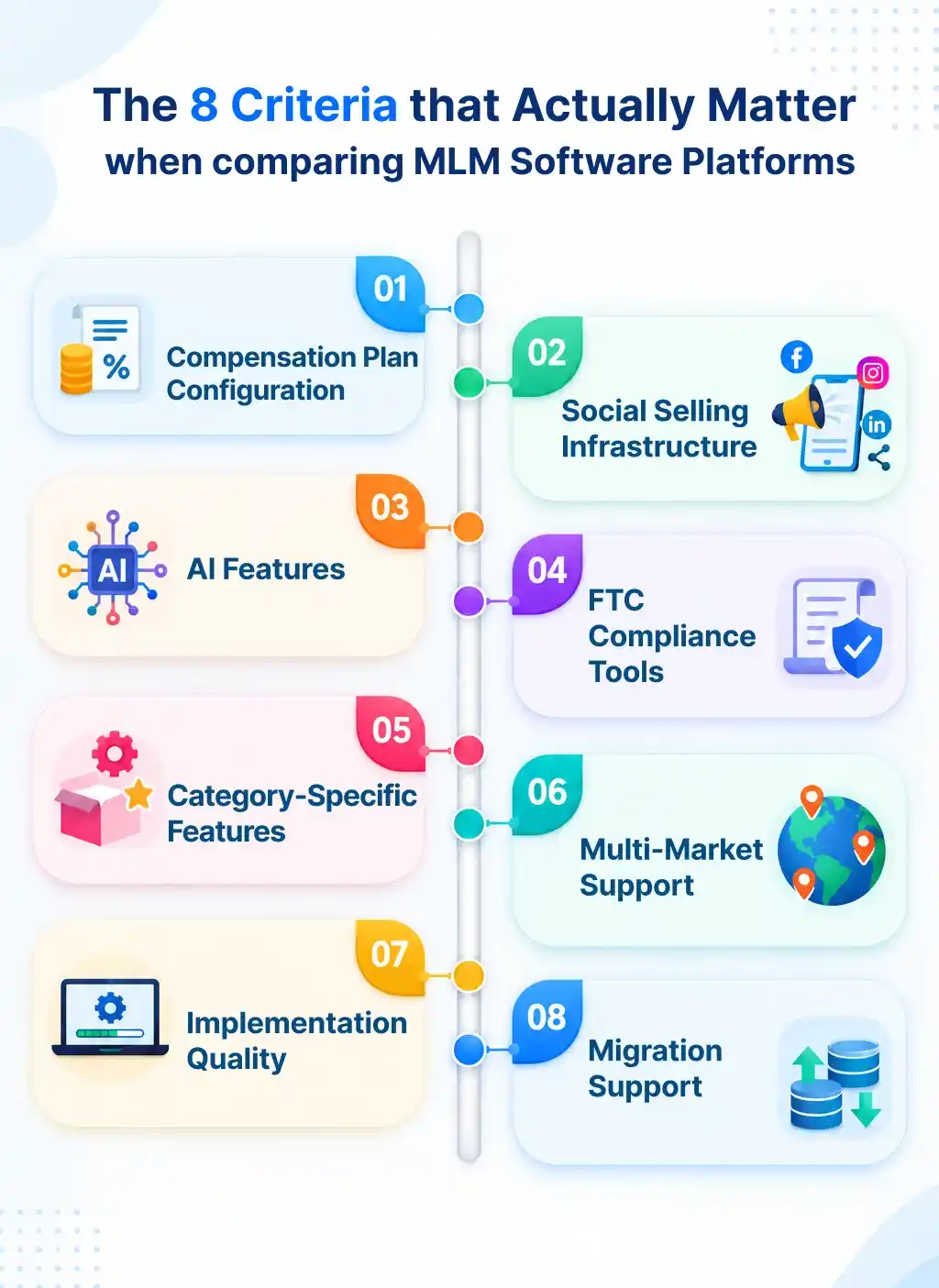
| Criterion | Why It Matters | Demo Verification Question | Red Flag |
|---|---|---|---|
| 1. Compensation Plan Configuration→ Comp Plan Deep Dive | A platform that cannot configure your specific plan is not a platform for your company. Binary, unilevel, matrix, hybrid, affiliate — each has edge cases that must be handled correctly at scale. Edge cases discovered after launch produce commission errors that damage distributor trust permanently. | Configure my specific compensation plan right now — I will describe my ranks, commission rates, and override structure. Process a test transaction and show me the calculation. | Vendor needs a "follow-up call" to configure your plan. Or confirms configuration is correct without processing a test transaction. |
| 2. Social Selling Infrastructure | Distributors recruit and sell through Instagram, TikTok, and YouTube. The platform must support this model natively — personal storefronts active from day one, in-app content sharing without downloading, cross-platform referral tracking, and enrollment links that work in social media bio tools. | Show a distributor sharing content to Instagram from within the app without downloading the file first. Show me the referral attribution dashboard. | Content must be downloaded before sharing. No cross-platform attribution. Storefronts only activate after rank qualification. |
| 3. AI Features→ AI MLM Software Guide | Genuine AI means churn prediction from behavioural patterns, commission anomaly detection before payout runs, and adaptive onboarding. Most vendors claiming AI deliver rule-based automation. The difference determines whether your platform can identify at-risk distributors 30–90 days before they go inactive. | Show me your current at-risk distributor list with the data signals behind each risk score. What is the training dataset for your churn prediction model? | No live at-risk distributor list. AI description is vague — "our AI learns from your data" — with no mention of model architecture or training data volume. |
| 4. FTC Compliance Tools→ FTC Compliance Guide | USA direct selling companies must demonstrate retail sales primacy, maintain accurate income disclosures, and monitor distributor claim compliance. These tools must be included as standard — not priced as premium add-ons. DSA Capitol Hill Day on September 23 will address FTC enforcement priorities heading into 2027. | Generate a live IDS report from the platform's earnings data. Show me the retail-to-recruit ratio dashboard updating in real time. | FTC compliance tools are a premium tier or separate module. IDS is manually generated by admin team. No retail-to-recruit monitoring. |
| 5. Category-Specific Features→ Beauty DS Guide | Beauty brands need visual-first storefronts, tutorial video libraries, multi-SKU daily auto-ship, and cosmetic claim compliance. Wellness brands need supplement claim monitoring and monthly auto-ship. Personal care, fitness, and nutrition have their own specific requirements. Confirm your category is live and operational for existing clients. | Show me a live account in my category — beauty, wellness, personal care — configured for a company at my scale. Can I speak to that reference client? | No live reference clients in your specific category. Category support is described as "we can configure it" rather than "we have it live." |
| 6. Multi-Market Support→ USA Launch Guide | If your expansion roadmap includes markets beyond your launch market, the platform must support them natively — not through custom development. Native support means live client accounts in that market, correct currency and tax handling, and support hours that overlap with that market's business hours. | Show me a live client account in South Africa or Australia. How does the platform handle VAT in South Africa and GST in Australia? | International market support means "we can build custom modules for your market." No live reference clients outside the primary market. |
| 7. Implementation Quality | Implementation quality predicts go-live success more accurately than any product feature. A well-featured platform with poor implementation support will go live late, with errors, and with a frustrated founding distributor cohort. Implementation quality has three markers: a written project plan provided before signing, a named implementation contact, and a timeline guarantee. | Can you provide a written project plan with specific milestones and the name of my implementation contact before I sign — not after? | Implementation plan provided after contract signing. No named implementation contact. Timeline is "typically 8–12 weeks" without specific milestones for your configuration. |
| 8. Migration Support→ Migration Guide | If you are switching from another platform, migration quality determines whether your distributor network arrives intact. The highest risk is genealogy accuracy — any error in upline/downline relationships produces incorrect commission calculations from day one. Require a documented migration process and a reference client at similar distributor counts who completed a migration. | Show me your documented migration process for transferring distributor genealogy. Provide a reference client who completed a migration with a distributor network similar to mine. | Migration described as "we help you move your data" without a documented genealogy verification process. No migration reference clients. |
What To Verify In An MLM Software Demo — The Questions That Reveal The Most
The questions are designed to produce a yes/no result — a vendor either demonstrates the capability live, or they don't. There's no partial credit. "We can show you that in a follow-up call" is itself an answer: the feature isn't operational yet.
The demo questions in the table above are structured to produce binary results: the vendor can demonstrate the capability live, or they cannot. There is no partial credit in a live demonstration. A vendor who says "we can show you that in a follow-up session" has answered the question. The feature is not operational in the current platform.
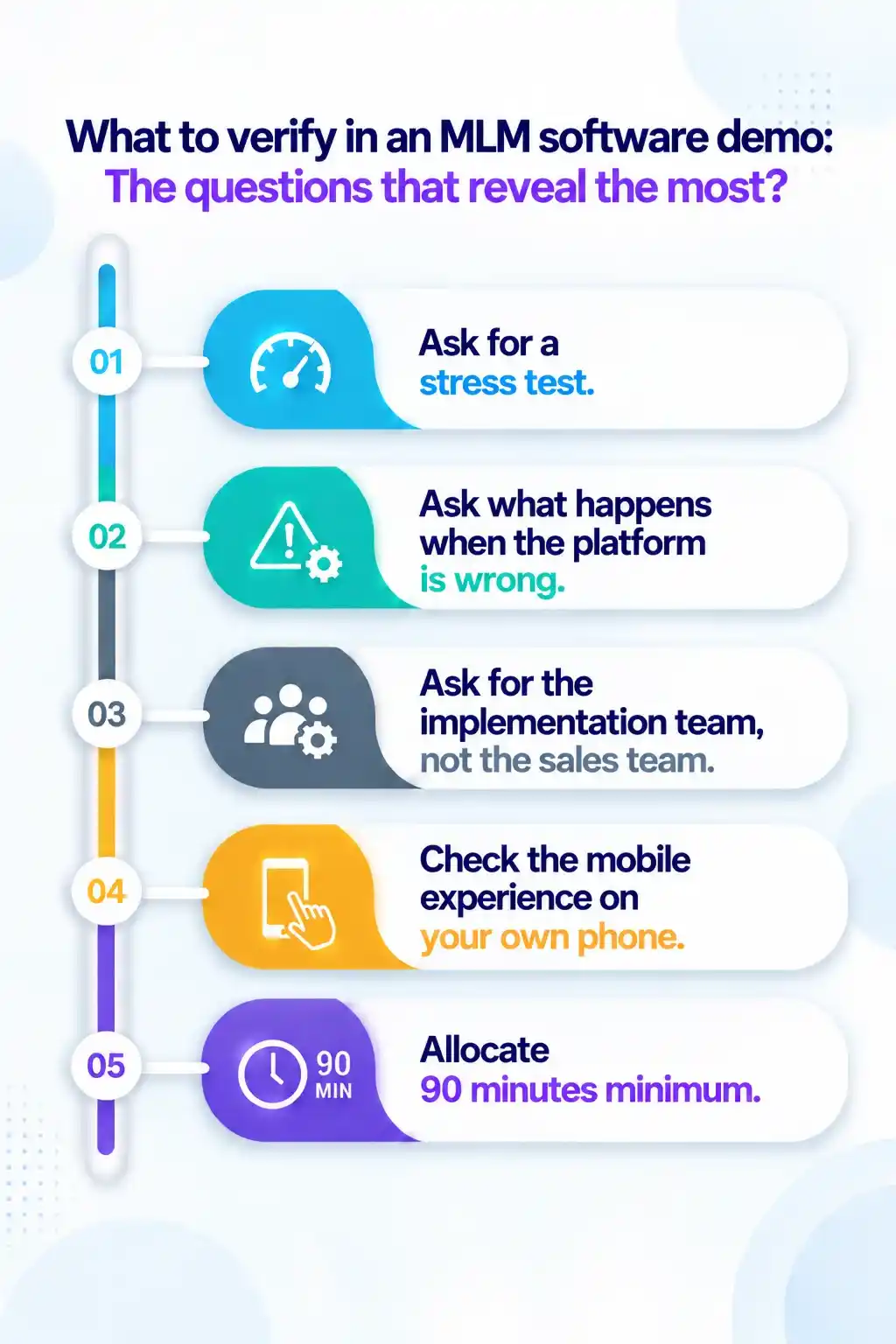
Five additional demo practices that reveal platform quality beyond the 8-criterion checklist:
Ask for a stress test- Process 50 test transactions with your specific compensation plan and ask for the commission calculation report. Edge cases in complex compensation plans produce calculation errors at volume. If the platform has never run your plan at scale, you want to discover the errors in a demo, not after your first payout run.
Ask what happens when the platform is wrong- Every platform has errors. The differentiator is how the vendor handles them. Ask directly: "What happens if a commission calculation error affects a distributor's payout — what is your process and who bears the cost of correction?" A vendor who deflects this question is a vendor who has not thought about it.
Ask for the implementation team, not the sales team- Approximately 30 minutes into the demo, ask to speak with the implementation manager or a technical configurator — the person who will actually build your platform. The quality of that conversation tells you more about post-sale execution than the quality of the sales presentation.
Check the mobile experience on your own phone- Open the distributor-facing app on your personal phone during the demo. Navigate to the storefront, share a piece of content, and attempt to complete a test enrollment. The mobile experience a founder sees in a demo on the vendor's laptop is different from what a distributor experiences on a phone with a variable connection.
Allocate 90 minutes minimum- A 30-minute demo is a product introduction. A 90-minute demo is an evaluation. If a vendor cannot spend 90 minutes demonstrating all 8 criteria — that is itself a data point about implementation depth.
The Red Flags That Reveal a Platform Is Wrong For Your Company
One red flag warrants a follow-up question. Three or more red flags in a single demo is a reasonable point to end the evaluation for that vendor.
Every vendor demo presents the platform at its best. The following seven red flags appear across all vendor demos when you know what to look for — and each one is a signal that the platform's capability does not match its marketing.
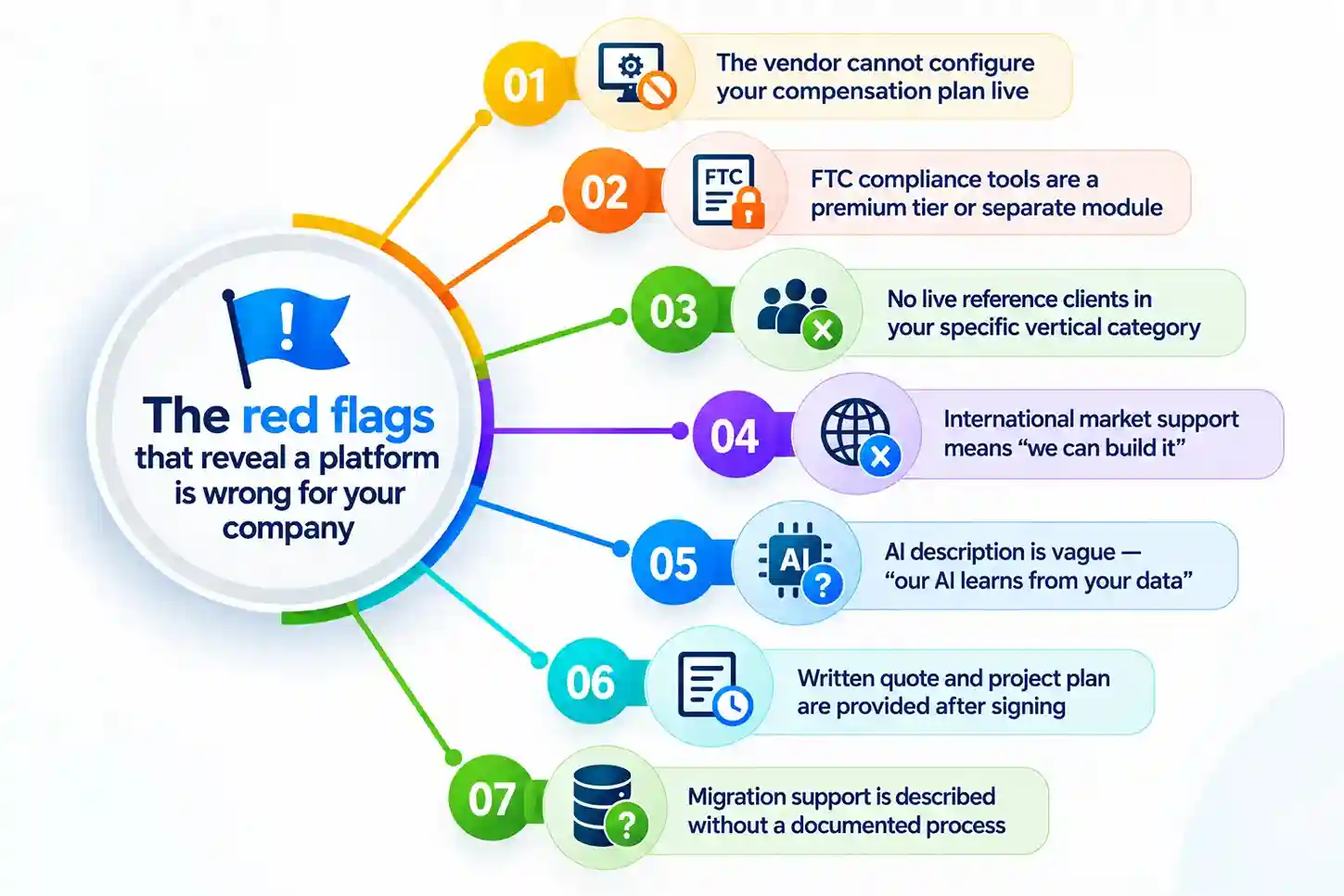
They need a follow-up call, a technical team member, or additional information. Your compensation plan is the core product. A platform that cannot demonstrate it live in a 30-minute demo will not configure it correctly after you sign.
For USA-launched direct selling companies, retail-to-recruit monitoring, IDS generation, and a complete transaction audit trail are table stakes — not premium features. A platform that prices these as add-ons is telling you that their core licence is not built for the USA regulatory environment.
A wellness platform marketed to a beauty brand is a wellness platform. A vendor who cannot provide three live reference clients in your specific category — beauty, personal care, fitness, nutrition — is a vendor who has not successfully deployed in your category yet.
Every vendor can "build custom modules" for additional markets. Native support means live client accounts in that market, correct currency and tax handling already in production, and reference clients you can call. If a vendor cannot name a live client in your target international market, that market is not supported — it is on their roadmap.
Genuine AI means a prediction model trained on historical distributor behaviour data. If a vendor cannot name their training data volume, their model architecture, and their retraining cadence — they have automation with an AI label. Ask: "What is the training dataset for your churn prediction model and when was it last retrained?" A vague answer is the answer.
A vendor who will not provide a written, scoped quote and a milestone project plan before you sign a contract has not committed to what they are selling you. Everything they described in the demo is marketing until it is in writing. Written confirmation before signing is non-negotiable.
"We help you transition" is not a migration process. A documented migration process names the steps, the verification checkpoints, the genealogy accuracy confirmation procedure, and the rollback plan if errors are discovered post-migration. A vendor who cannot show you a documented process has not done enough migrations to have developed one.
How To Complete Your MLM Software Evaluation Before DSU Fall 2026 — October 6
DSU Fall 2026 is October 6–8 at The Westin Galleria in Dallas, Texas. Founders who arrive at DSU with a signed platform agreement are in a fundamentally different position than those who arrive with open platform questions. The 4-week evaluation timeline below maps the next 26 days into specific milestones.
Define your evaluation criteria using the 8-criterion framework. Identify 2–3 platforms to demo. Book 90-minute demo sessions for Week 2. Download the Platform Evaluation Checklist and prepare your specific compensation plan description for the live configuration test.
Complete all vendor demos using the 8-criterion framework and your specific demo questions. Score each vendor using the Platform Evaluation Checklist (0–3 per criterion). Request reference client lists from vendors who pass the initial framework.
📅 DSN Social Commerce Deep Dive — Sep 15, Lehi UTContact 3 reference clients per vendor who passed your framework evaluation. Ask the five reference questions above. Request written quotes scoped to your specific model, market, and distributor volume. Confirm FTC compliance tools are included as standard in every written quote — not as line-item add-ons.
📅 DSA Capitol Hill Day — Sep 23, Washington DCReview written quotes and reference feedback. Select your platform and begin contract negotiation. Confirm all demonstrated features are listed individually in the contract scope — not described as "standard features." Target: signed agreement by October 5.
🏁 DSU Fall 2026 — Oct 6–8, Dallas TX — arrive as a decision-makerDSU Fall 2026 Is October 6 — 26 Days to Complete Your Evaluation
26 days. 4 weeks. Enough time to demo 3 platforms, check references, and sign a contract before you walk into Dallas. Founders who arrive at DSU with a signed platform agreement arrive as decision-makers. Those who arrive with open platform questions arrive as prospects.
Book a Demo Before October 6How Choosing MLM Software Differs For a USA Company vs. An International Launch
USA companies must prioritize FTC compliance tooling (retail-to-recruit monitoring, IDS generation, claim monitoring) as a non-negotiable baseline. International launches should prioritize native, already-live market support — not a vendor's promise to build it.
USA-based direct selling companies face two regulatory layers that international launches may not encounter immediately: FTC compliance requirements and state-specific business opportunity registration. These requirements shape the platform evaluation in specific ways.
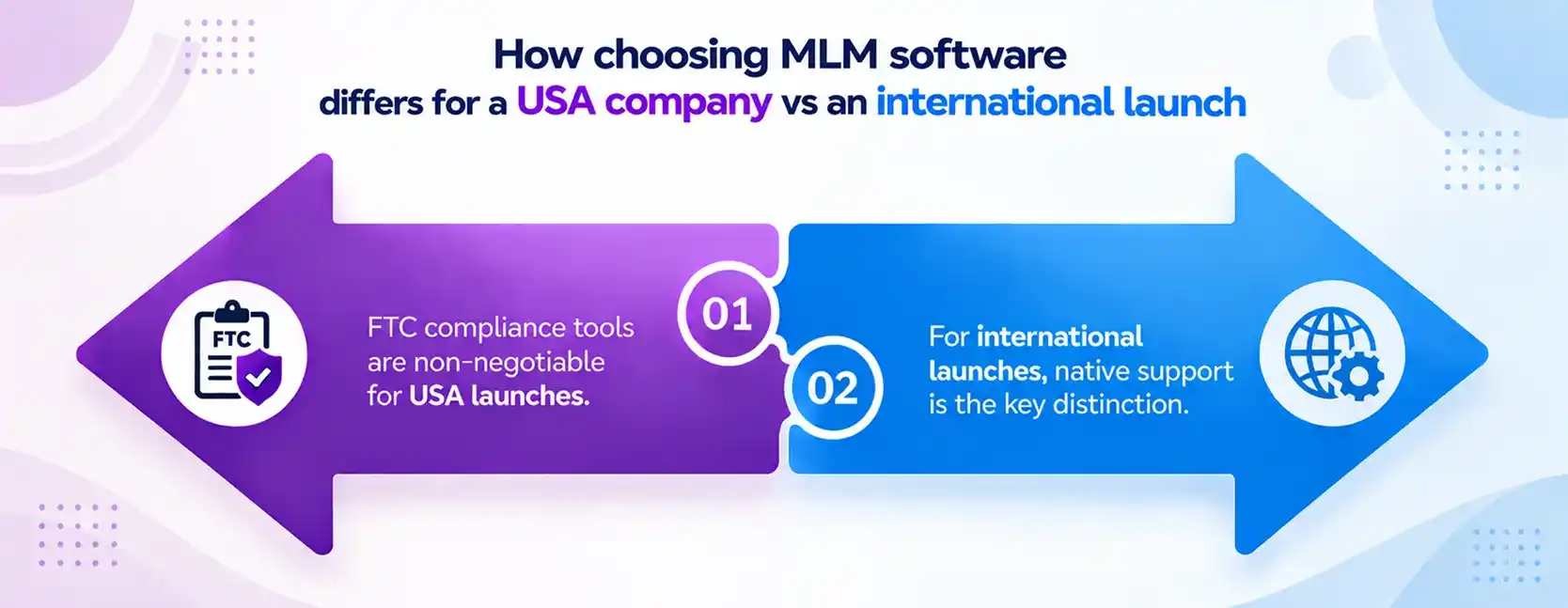
FTC compliance tools are non-negotiable for USA launches- The FTC's primary test for a legitimate direct selling company — retail sales must exceed recruitment-driven purchases — requires real-time retail-to-recruit ratio monitoring. Income Disclosure Statements must accurately represent actual distributor earnings. Distributor social content must be monitored for unapproved income and product claims. These tools must be included in the base platform licence. The DSA's Direct Selling Day on the Hill on September 23 will address FTC enforcement priorities heading into 2027 — the regulatory posture is intensifying, not softening. A platform that prices compliance tools as premium add-ons is not built for the USA market in 2026. See our FTC-Compliant MLM Software guide for the complete compliance framework.
For international launches, native support is the key distinction- Every vendor claims to support international markets. The question is whether that support is live and operational — with existing client accounts in the market, correct currency and tax handling already in production, and support hours that overlap with the target market's business day. A platform that requires custom development modules for a South Africa or Australia launch is not a multi-market platform — it is a USA platform with a roadmap. Verify market support with a reference client call in each target market, not with a vendor's marketing claim.
Global MLM Software Supports- USA, South Africa, Australia, UAE, Malaysia, Philippines, Canada, and UK — all with live client accounts, native currency and tax handling, and support hours that overlap with each market's business day. If your expansion roadmap includes any of these markets, we can show you a live configuration in your target market during the demo.
Upcoming Industry Events Referenced in This Guide
| Event | Date | Location |
|---|---|---|
| DSN Social Commerce Deep Dive | September 15, 2026 | Young Living HQ, Lehi, UT |
| DSA Capitol Hill Day | September 23, 2026 | Washington, DC |
| DSU Fall 2026 | October 6–8, 2026 | The Westin Galleria, Dallas, TX |

Shabana is a dynamic writer and strategist with profound expertise in network marketing. Her sharp analysis of industry trends and exceptional ability to distill complex concepts into clear, actionable insights make her content invaluable for professionals at every level. Through her writing, she empowers readers to navigate the evolving landscape of relationship-driven sales with confidence and integrity. Blending data-driven strategies with human-centric principles, Shabana provides a unique perspective that helps businesses thrive while maintaining authentic connections.
Free: MLM Platform Evaluation Checklist 2026
8 criteria. 32 verification items. Score each vendor 0–3. Pass mark: 80/96. Global MLM Software scores 96/96. Take this into every vendor demo and complete your evaluation before DSU Fall 2026 on October 6.
FAQ: MLM Software Comparison Guide
1. Why do most MLM software comparisons lead founders to the wrong decision?
Most comparisons focus on price, feature count, and review ratings. None of these predict whether a platform will configure your specific compensation plan correctly, run your market's compliance requirements natively, or handle your distributor profile's social selling mechanics. The right primary criterion is whether the vendor can configure your specific plan live in a 30-minute demo. If they cannot, no other feature matters.
2. What are the 8 criteria that actually matter when comparing MLM software?
The 8 criteria that predict platform fit:
(1) Compensation plan configuration — live demo of your specific plan;
(2) Social selling infrastructure — storefronts, content library, referral tracking;
(3) AI features — genuine churn prediction vs rule-based alerts;
(4) FTC compliance tools — included as standard;
(5) Category-specific features — beauty, wellness, personal care requirements;
(6) Multi-market support — live clients in your target markets;
(7) Implementation quality — written plan before signing;
(8) Migration support — documented process with reference clients.
3. What should I verify in an MLM software demo?
For compensation plans — configure my specific plan live in this demo. For social selling — share content to Instagram from within the app without downloading. For AI — show the at-risk distributor list with data signals behind each score. For FTC compliance — generate a live IDS from earnings data. For migration — show the documented process and provide a reference migration client. Allocate 90 minutes minimum. A vendor who cannot demonstrate any criterion live has answered the question.
4. What are the red flags that reveal a platform is wrong for my company?
Seven red flags: cannot configure your plan live; FTC tools are premium add-ons; no live references in your category; international support means "we can build it"; AI description is vague with no training data specifics; written quote is provided after signing; migration support has no documented process. Any single red flag warrants a follow-up question. Three or more red flags in one demo ends the evaluation for that vendor.
5. How do I complete my MLM software evaluation before DSU Fall 2026 on October 6?
4-week timeline:
Week 1 (Sep 7–14) — define criteria, identify platforms, book demos.
Week 2 (Sep 15–21) — complete all demos using the 8-criterion framework. Score each vendor. DSN Social Commerce Deep Dive is September 15.
Week 3 (Sep 22–28) — contact references, request written quotes. DSA Capitol Hill Day is September 23.
Week 4 (Sep 29–Oct 5) — select platform, begin contract, sign before October 6. Founders who arrive at DSU with a signed agreement arrive as decision-makers.
6. How is choosing MLM software different for a USA company vs an international launch?
USA launches need FTC compliance tools (retail-to-recruit monitoring, IDS generation, claim monitoring) built in as standard. International launches need native currency/tax handling and support hours in the target market, verified with live reference clients rather than a roadmap promise.Confirm specific regulatory requirements with a qualified professional, since rules vary by jurisdiction and change over time.
7. Should I choose MLM software based on price or features?
Neither, as a primary factor. A cheaper platform that requires developer time to configure your compensation plan can end up costing more than a pricier platform that configures it live in front of you. Similarly, a long feature list where most features don't apply to your model isn't a real advantage. Use live configurability as your primary filter, and treat price and feature count as secondary factors once a platform has passed that test.
8. How many MLM software platforms should I demo before deciding?
Minimum two, maximum four. One demo gives you no comparison baseline. More than four creates evaluation fatigue where the differences between vendors become unmemorable. Allocate 90 minutes per demo — 30 minutes cannot cover all 8 evaluation criteria. Arrive at every demo with the Platform Evaluation Checklist and your specific compensation plan description ready for the live configuration test.
9. What does MLM software migration actually involve?
Migration transfers four categories: distributor records, commission history, customer and order data, and genealogy structure. Genealogy accuracy is the highest risk — any error in upline/downline relationships produces incorrect commission calculations from day one on the new platform. Require a documented migration process with a genealogy verification step and a rollback plan. Require a reference migration client at similar distributor counts to yours.
10. Is it better to build MLM software or buy an existing platform?
For most direct selling companies, buying an established platform is the more practical option. Custom development is commonly estimated in the range of $200,000–$800,000 and 12–24 months, though actual costs vary significantly by scope and vendor — treat any specific figure, including this one, as a rough planning estimate rather than a quote. During a long build, distributor recruitment can't begin and market conditions can shift. Purpose-built platforms typically bring years of tested compensation-plan logic, compliance tooling, and genealogy management. Custom development tends to make sense only for compensation plan structures that no existing platform can reasonably support.
11. What questions should I ask MLM software reference clients?
Five revealing questions:
(1) What did not work as advertised in the first 90 days?
(2) How accurate was the implementation timeline the vendor committed to?
(3) How does the vendor handle a commission error that affects a distributor's payout?
(4) What feature do you wish the platform had that it does not?
(5) Would you select the same vendor again if starting today? Contact minimum 3 references per vendor. Ask for references at a similar company stage to yours.
12. What does Global MLM Software include that other platforms charge extra for?
Standard inclusions: FTC compliance tools (retail-to-recruit monitoring, IDS generation, audit trail), AI-powered distributor analytics (churn prediction, performance dashboard), social selling infrastructure (personal storefronts, content library, referral tracking), multi-market support (USA, South Africa, Australia, UAE, Malaysia, Philippines, Canada, UK), and dedicated implementation support with a written project plan. Book a free 30-minute demo — all 8 evaluation criteria verified live, written quote within 24 hours.
General disclaimer: This guide is for general informational purposes only and does not constitute legal, financial, or regulatory advice. Direct selling compliance requirements (FDA cosmetic claim rules, FTC income claim rules, and state-level regulations) can vary and change over time. Consult qualified legal and compliance counsel before launching or modifying a distributor programme.