While running a multi-level marketing business, you consistently deal with sensitive data, such as distributors’ personally identifiable information, KYC details, genealogy tree structures, banking details, and payout histories. Therefore, data security threats, such as phishing, API fraud, and ransomware, loom over your operations at every touchpoint.
When data security in MLM gets compromised, it translates into churn, reputation harm, and regulatory scrutiny. There are several such instances when data leakage, ID theft, or ransomware attacks occurred. In 2020, Avon, a global cosmetic brand, discovered a leak of 19 million records due to one misconfigured cloud server.
Such instances are lessons for every MLM business to prioritise data security.
This Article Contains:
What is Data Security in MLM?
Data security in MLM is the set of policies, processes, and technical controls implemented in order to protect distributor and customer data from unauthorized access from any of the touchpoints, alteration of logs or data, loss of information, or misuse of any details. It also safeguards systems like the distributor genealogy tree, payouts, and the e-commerce front.
Exactly, what data does an MLM need to protect generally?
Distributor personally identifiable information: Name, contact information, government IDs, tax IDs, photograph, and signature.
KYC documents: ID scans, biometrics, sanction checks, and regulatory reports.
Payments, payouts, and commission details: Ranks, commission details, bonuses, bank details, and payouts.
MLM-specific information: Genealogy-sponsor relationship, PV/BV volumes, and compliance notes.
Customer data: Complete customer lifecycle details, including order history, returns, and support interactions, and personally identifiable information.
Operational assets: Audit logs, device identifiers, IPs, admin actions, and API traffic.
Why Data Security Matters in MLM?
It may begin as a routine leadership meeting focused on refining compensation structures, tracking downline performance, and discussing scalability. In the middle of those strategic discussions, a system engineer reports that distributor data has been exfiltrated through an unpatched API endpoint. The leaked information includes personal identifiers, KYC records, and payout histories, all of which are now circulating on dark-web forums.
At that moment, growth strategies give way to crisis management, highlighting the importance of implementing secure MLM software platform. Closing the vulnerable endpoint cannot undo the exposure, and under direct selling data-protection frameworks such as GDPR, CPRA, DPDP, GLBA, and PCI DSS, organizations are obligated to notify regulators and affected individuals. Failure to do so risks heavier penalties once the breach is uncovered through forensic review.
As news of the incident spreads, the trust that fuels MLM operations begins to erode. Distributors doubt the company’s ability to safeguard their data, attrition rates rise, and recruitment slows dramatically. Customers, worried about the safety of their payment details and personal information, reduce purchases or disengage entirely. The ripple effect quickly undermines both field confidence and customer loyalty.
The consequences extend well beyond the loss of sales. Financially, the organization faces investigation costs, legal fees, compensation claims, higher insurance premiums, and potentially significant fines. Legally, regulators and courts scrutinize compliance practices and impose obligations for remediation. Operationally, teams are pulled away from growth initiatives to focus on containment, reporting, and rebuilding infrastructure.
The breach becomes not just a technical failure but an existential crisis. Had the organization invested in regular security audits, penetration testing, and robust authentication methods using an integrated MLM security management platform, it could have significantly reduced the risk of data breaches and financial losses. Instead, the business is forced to rebuild its roadmap around regaining trust and demonstrating a security-first infrastructure, proving that direct-selling data protection is not optional but fundamental to the survival of MLM enterprises.
1) Trust, retention, and brand reputation
Field confidence: Distributors are the acquisition engine, whether it comes to customers or potential recruits. Data leakage about genealogy, payout, etc., can degrade morale and make it tougher to convince people to join the business.
Customer Loyalty: If the data security in MLM is not up to the mark, customers will be reluctant to store card details and addresses. The existing ones will remove the details added and stop recording if they don’t trust your portal.
Spreading of Negative Narrative: News, screenshots, negative feedback videos, everything starts spreading rapidly, where the doubt doesn't stay limited to data security, but expands to products, services, and everything associated with the business.
Proof Beats Promise: When you keep your portal encrypted, access controlled, and only use secure storage spaces,
2) Financial, legal, and operational risk
Direct Costs: Legal counselling and incident response costs.
Revenue Impact: Cart abandonment, decrease in purchases, subscription cancellations, payout freezes, and chargebacks.
Regulatory Exposure: When you implement weak data security in MLM, it breaches customer and distributor data privacy laws, attracting hefty penalties even after providing rapid breach notices.
Contractual Penalties: When you have third-party contracts with processors, e-wallet providers, etc., they also impose security clauses for keeping the shared data secure. They can also impose penalties if data breaches violate the security clauses.
Operational Downtime Costs: When data breaches, ransomware attacks, or account hacking occur, it becomes necessary to shut down activities to avoid more damage and identify the source. This halts the operations, causing losses every minute.
3) Unique MLM data ecosystems
Decentralized Access at Scale: Data security in MLM becomes crucial as incoming traffic to the website, apps, and portal is from a variety of audiences, such as customers, distributors, their downlines, and vendors. It makes the network more vulnerable than the ordinary, requiring you to prioritize data security.
Replicated Sites and Mobile-Heavy Workflows: Distributors are provided with replicated websites, social media posts, and referral links, flooding the web. It makes it challenging for customers to identify phishing links and fraudulent websites.
Compensation complexity: Information such as genealogy trees, PV/BV, commissions, bonus data, etc., makes the MLM business a high-value target for attackers.
High Vendor Velocity: Data security in MLM is also necessary as its open-ended nature requires dealing with multiple third parties, such as KYC/AML services, tax applications, learning management systems, payment gateways, etc.
Global Hurdles: When an MLM business functions in multiple countries, whether it’s about serving only the customers or both customers and distributors, cross-border data transfers occur, which are guided by different consent laws. It complicates compliance and requires stronger data security efforts.
Key Risks and Threats in MLM Data Security
Because MLM businesses have multiple touchpoints, such as an e-commerce platform, payout system, and genealogy, they provide a broad surface for MLM security threats.
Data security attacks can occur at replicated storefronts, distributor mobile apps, public APIs, third-party payment systems, KYC providers, and distributors' personal devices, located worldwide.
The primary differentiator is the decentralized structure, where the company has limited control. Team leaders and their downline engage with customers by themselves, making independent decisions, which can give rise to security issues. Let’s go into each MLM data security threat in detail.
1. Identity Compromise and Large-Scale Account Takeover
Attackers make attempts to break into distributors, customers, or admin accounts by credential stuffing, i.e., by reusing the passwords stolen from other sites. Multi-level authentication (MFA) phishing is also a proven tactic where the attacker sends a phishing link disguised as a legitimate MFA prompt. Once they get the access, they can view details, such as the genealogy tree, payouts, bank details, and expose MLM businesses and their distributors to financial fraud.
To avoid such issues, use secure MLM software that keeps your data safe with highly secure servers, controlled access, and encrypted payouts.
2. Social Engineering and Brand Impersonation
Network marketing businesses need to be extra careful here. It’s easy for attackers to blend their fake, replicated website amongst the ones your distributors own. When they conduct social recruiting and impersonate your brand, they build trust amongst customers and potential recruits.
Customers and potential recruits perform sign-ups on look-alike domains, believing that it's your MLM brand. From there, it becomes a one-step process for attackers to install malware or conduct QR-phishing.
3. API and Webhook Abuse
MLM stacks depend heavily on APIs and webhooks for orders, payout systems, e-commerce activities, data synchronization, etc. Therefore, these doors must be strongly locked and verified. If not, then attackers can bug integrations to inject fake orders, redirect payouts to different accounts, or alter genealogy data.
Such instances occur when there’s weak or missing authentication, unsigned or poorly signed webhooks, idempotency gaps, over-permission tokens and scope, and infra pitfalls such as no rate limit and no mTLS/allow-listing for partner IPs.
4. Cloud Misconfiguration and Exposed Data Stores
It’s possible that your cloud storage, databases, backups, etc., accidentally end up in public and are reachable from the internet, leaking sensitive customer and distributor data.
It usually happens when static-website hosting is turned on, or a file’s access control list overrides the file’s private setting. Therefore, even if the bucket, usually where the files are kept, is locked down, it can still be accessed publicly.
When a database or search server is left open for anyone to access through the internet, or backups are shared without the login requirements, or an admin dashboard is left accessible, outsiders can browse and copy data.
Similarly, loose firewall rules can cause a major data leakage. When it is configured to permit incoming networking connections to a resource on certain ports and from certain sources, managed databases become reachable over the public internet. However, these databases should only be accessible through private network endpoints.
In addition to these, Temporary admin roles that never get deleted will eventually be found by someone.
5. Mobile App Weaknesses
When your distributors use the app on their personal mobile phones, a few gaps can be exposed and exploited by hijackers. For instance, if the app stores its session keys in an easy-to-read place, another app can use them to log in as a user.
Though it still causes issues on an individual level, it can turn into a severe problem when multiple distributors face the same issue.
When your app doesn't have public key pinning, it can trust any server that pretends to be your server. An attack usually takes place when devices are connected to public Wi-Fi networks. Attackers pretend to be the real server, eavesdrop, and access the app data.
Regulatory & Compliance Frameworks
It is essential to map your business footprint before implementing the controls. It is to ensure that you cover and secure all the endpoints without putting in extra effort. You must comply with security standards based on where your users live, what data you collect, the vendors involved, and where the processing takes place.
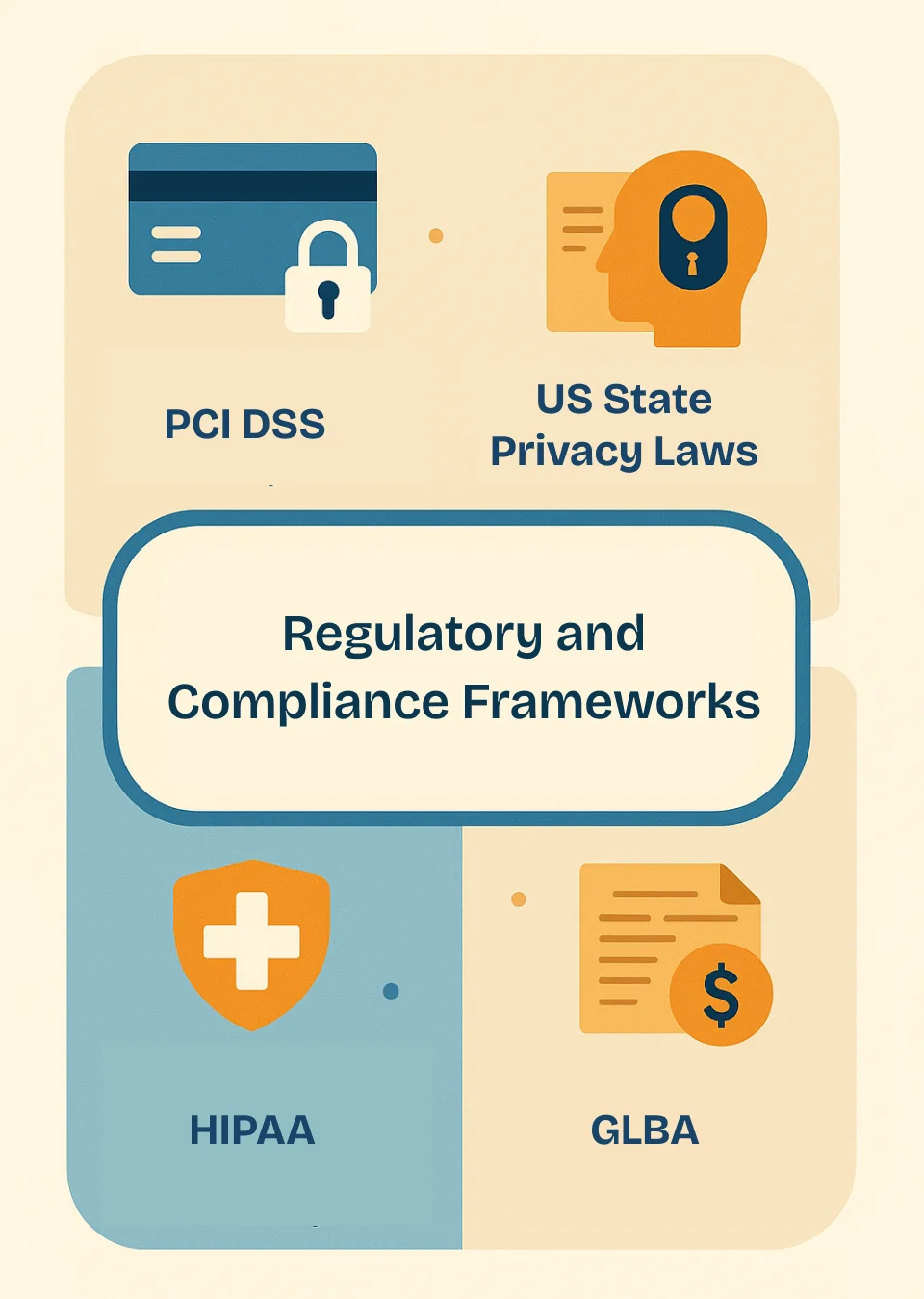
Here, we’ll go through all the laws, regulations, and standards applicable to a global company.
PCI DSS (Payment Card Industry Data Security Standard)
When it applies
PCI DSS is one of the necessary standards that every business, whether it’s MLM or not, needs to comply with if it stores, processes, or transmits cardholder data. Even if your MLM business impacts the cardholder data environment or uses a payment gateway, PCI DSS needs to be followed.
What to Implement
Keep card data in hosted payment fields, i.e., use your PCI-compliant payment provider’s embedded, hosted inputs for card details instead of your own form fields.
Keep the card details under strong access control with multi-factor authentication for admins with short session lifetimes.
Always keep the card details protected by encryption when in transit ( between browser, server, and partner) and where it is stored.
Implement tokenization that replaces the real card number with a unique token number. The payment provider uses the token to charge/refund instead of a real card. So, even if the data leak occurs, it doesn’t expose the real card details.
To be PCI-compliant, you must run quarterly AVS (approved scanning vendors) scans, which are external vulnerability scans run by a PCI-approved company against your internet-facing systems, to identify security vulnerabilities.
Keep your web application firewall active, which is a security filter that sits in front of your public websites and APIs that monitors every incoming request, blocking the bad ones, such as hacking attempts, before they reach your app.
MLM-specific pitfalls
MLM businesses must not treat distributor data as purely B2B. The privacy laws still apply to them as they are considered independent contractors and not businesses, which must not be ignored. Besides that, MLM businesses must not share genealogy tree details, PV/BV information, and contact details with third parties without DPA and “service-provider” restrictions. If any breach occurs at the vendor’s end, it will be considered yours, and thus, an elaborated DPA can be a complete savior here. Also, do not forget to take prior consent for non-essential cookies. Firing tags early violates privacy rules, inflates profile risks, and creates an inconsistent user experience across multiple replicas.
US State Privacy Laws
When it applies
When your MLM business handles personal data of US residents and meets the state threshold by achieving a minimum revenue or number of customers, under most of the US state laws, distributors are usually considered customers too.
What to Implement
Notify and clearly request consent before collecting sensitive customer data.
Your MLM customers have the legal right to access, correct, delete, or opt out of the sale/sharing of their data.
Your MLM business must follow purpose-bound use of data and delete the unnecessary data from the system through defined deletion pipelines.
It is necessary for data security in MLM that you sign a data processing addendum with your vendors that handle your users’ personal data. Under the DSA (Direct Selling Association), the purpose of data sharing, the vendors’ role, what data is shared, security controls, etc., are shared.
Conduct a risk assessment of your MLM business activities that use distributors/customers' data in a risky way. For instance, if you use email addresses to run retargeting campaigns, evaluate the privacy and security risks to individuals, and document the evaluation process. The MLM business also needs to conduct profiling by scoring prospects.
MLM-specific pitfalls
MLM business must not treat distributor data as purely B2B. The privacy laws still apply to them as they are considered independent contractors and not businesses, which must not be ignored. Besides that, MLM businesses must not share genealogy tree details, PV/BV information, and contact details with third parties without DPA and “service-provider” restrictions. If any breach occurs at the vendor’s end, it will be considered yours, and thus, an elaborated DPA can be a complete savior here. Also, do not forget to take prior consent for non-essential cookies. Firing tags early violates privacy rules, inflates profile risks, and creates an inconsistent user experience across multiple replicas.
HIPAA (if selling health/wellness MLM products)
When it applies
The Health Insurance Portability and Accountability Act is not applicable to all MLM businesses. When your MLM business is related to healthcare and creates/handles/maintains/transmits protected health information, then only HIPAA is applicable.
What to implement
Sign a Business Associate Agreement with any vendor that will create, receive, store, or transmit protected health information for you, as it legally binds the vendor to protect PHI and to follow HIPAA rules.
Create HIPAA-compliant policies, provide training to employees and distributors, define access controls, and implement transmission security.
Promote the minimum necessary use only, conduct risk analysis based on usage, and implement breach notification procedures.
When choosing your technology stack, ensure your health and wellness MLM software is built with HIPAA compliance in mind. It should cover data encryption, access controls, and secure transmission of any health-related distributor or customer information.
MLM-specific pitfalls
MLM businesses should not store medical testimonials or images in general MLM CRMs/LMS, as these systems often lack essential PHI controls. Similarly, PHI controls must exist while sending information to support emails or chat. An MLM business must also keep PHI details separate from non-PHI data.
GLBA (Gramm-Leach-Bliley Act – if MLM offers financial services like e-wallets)
When it applies
The Gramm-Leach-Bliley Act (GLBA) applies to MLM businesses when the MLM business is itself a financial institution or acts as a service provider to a financial institution; it needs to comply with its standards. For instance, an MLM company that deals with providing insurance to customers directly and through its distributors needs to follow GLBA data security requirements.
What to implement
The companies need to maintain the same level of security as expected under MLM businesses by conducting risk assessment, implementing access controls, and ensuring multi-factor authentication.
Along with that, in-depth vendor due diligence must be conducted to check whether it’s secure or if there are any data security vulnerabilities.
Incident response & notifications aligned to regulatory expectations.
MLM-specific pitfalls
Many of the pitfalls will be covered when MLM businesses follow US state privacy laws. However, under GLBA, missing out on the broad data scopes of vendors can lead to infecting your system as well.
Best Practices for MLM Data Security
In network marketing, tiny security gaps at each endpoint combine to cause serious security vulnerabilities. For instance, if there’s an issue with a replicated website’s JavaScript, it will appear on all replicated websites, the jackpot that attackers want.
Each best practice for data security in MLM works as a part of the MLM-specific security checklist. Treat this as your Minimum Viable Security (MVS). After implementing the essentials, conduct in-depth vulnerability scans, test the existing ones, and keep improving the security. Now, let’s check the best practices in detail.
Highly Secure Access Ensuring Only True Identity Logs In: Implement single sign-on, multi-factor authentication, and role-based or attribute-based access controls. Keep the session time limited and create immutable log entries to track accountability when required.
Tame Your APIs and Keep the Integrations Secure: Place your API behind the gateway, enforcing rate limits, IP rules, and logging before traffic reaches your site. API calls pass the gateway when it is authentic and follows IP rules. Every call gets logged.
Ship Clean Code Only and Fulfill Secure Delivery: Ensure that code and cloud changes are safe before you make the release of your MLM application. Conduct static application security testing, dynamic application security testing, and software composition analysis, and if you find any vulnerabilities, block the deployment. To avoid tampering during deployment, cryptographically sign images/bundles.
Keep Your Data Organized and Protected: Your sensitive data, such as PII, KYC docs, and payout details, is scattered across different databases. You must use discovery tools to auto-find them, tag them as sensitive for internal use, and encrypt them using AES-grade encryption. Keep the access strict and show the token instead of real values, helping you avoid data leakage.
Maintain Top-Notch Cloud Security: Watch your cloud configuration for errors, such as public buckets or open ports, and can block them at build time. Access managed databases and storage via private network endpoints (e.g., AWS PrivateLink or Azure Private Link) within your Virtual Private Cloud (VPC) or Virtual Network (VNet), rather than over the public internet, to minimize your attack surface.
Keep your Storefronts Secure: Implement a response header that tells the browser which sources to allow for running codes. Also, use HTTP Strict Transport Security (HSTS), forcing browsers to use HTTPS only, even when someone tries to downgrade to HTTP.
Introduce Sharing Controls for Data Loss Prevention: Each export request must be linked to the requester’s name, it should be timestamped, and have a short expiry link. Only share details on a “need to know” basis in the CSV document by limiting columns. When there are mass exports, the system must trigger an alert and require a manager-level approval before proceeding.
Security from Payout Fraud: Take anti-money laundering measures to secure data by aligning payouts with KYC information, flagging suspicious patterns, and keeping auditable records. Besides that, any change to payout details must be authenticated through multi-factor systems and approved by a higher role.
Quick Detection and Right Response: Have a functioning security information and event management system in place that collects and correlates logs from everywhere, enabling speedy pattern detection. When a particular device catches malware or shows suspicious behavior, your MLM business should be able to isolate it from the complete network with one click. To improve the detection accuracy, implement user and entity behavior analytics that learn “normal” behavior for users and services, and flag anomalies and update them as the user behavior changes.
Disaster Recovery Plan: In case the data security in MLM gets compromised, you must implement a business continuity or disaster recovery plan. Keep the notice templates for regulators and customers/distributors ready, keep the roles and tasks defined under the recovery stage, and run restore drills to ensure it hits the recovery target. Try the same with different scenarios, turning practice sessions into muscle memory.
Written Information Security Program: Create a master guide that explains what to protect, how to protect, who’s accountable, and how you prove it. It defines the scope, roles, and RACI, policies, standards to follow, and procedures.
Based on all the best practices, we have created a comprehensive Checklist for Data Security in MLM.
Future Trends in MLM Data Security
The multi-level marketing industry is growing both digitally and globally. Therefore, the MLM data security landscape is also evolving. Traditional controls like encryption, multi-factor authentication, and firewalls remain essential, but they can’t be considered sufficient.
Emerging hacking techniques, new compliance requirements, and growing endpoints are reshaping security requirements and how companies need to protect sensitive data.
Below are some of the most important emerging trends that will rewrite the future of MLM data security.
Use of artificial intelligence and machine learning for detecting abnormal patterns, predictive threat modeling, and automating security tasks such as KYC checks and log analysis.
Stronger adoption of post-quantum cryptography and quantum-ready architectures, to prepare for when quantum computers can break current encryption algorithms.
Data sharing regulations and privacy laws are becoming stringent, promoting better infrastructure for cross-border data sharing, product security, and vendor accountability.
Ethical data practices, such as a better consent management system, blocking third-party cookies, and a strict “need to know basis” data sharing internally and with partners.
Enhanced security automation with more mature control over cloud posture and data posture continuously, not limited to static audits.
Improved transparency and auditability, where you not only commit controls but prove them to distributors and customers.
Enhanced integration security by conducting vendor audits to ensure the complete ecosystem, wherever your data reaches, is safe from attackers.
Technology trends such as edge computing and field agent devices will create new endpoints to protect, requiring better encryption, more attestation, and stricter zero-trust policy
Common Myths about Data Security in MLM
Before falling victim to hackers, MLM companies become prey to data security misconceptions. Businesses and distributors often assume that compliance checklists are enough, but that’s not true. Some MLM businesses even carry the myth that attackers won’t bother targeting a direct-selling business, but that’s far from reality. We have compiled such common myths and listed them below:
We are Too Small to be Targeted
Attackers don’t care about the company size, if there’s data, security threats will be there too. MLM businesses are, in fact, more vulnerable targets due to their nature of working with distributors. Attackers don’t need to breach into organizations’ systems. They can target distributors through replicated websites, personal mobile phones, and other endpoints, and find their way to the core.
Our Cloud Vendor Handles The Security
It’s true that cloud vendors such as AWS, Azure, or GCP protect the infrastructure, but MLM businesses must play their part in data security as well. You must configure access, encrypt data, restrict buckets, secure APIs, and monitor accounts.
PCI Compliance Means We’re Secure
Complying with PCI DSS standards is the primary task, but not the only task. You must also take data security measures, such as continuously monitoring payouts, tracking genealogy data, and implementing KYC requirements. Also, take care of non-card personally identifiable information that’s outside of PCI scope but equally risky.
Distributors are Safe From MLM Data Security Threats
Distributors are often the first target. Hackers conduct phishing attacks, create fake replicated sites, and present malware-laced tools as authentic ones. One compromised distributor account can lead to mass payout diversions and data theft.
MLM Data Security Can Slow Down Business
Secure-by-default automation actually reduces friction between the processes. Security debt and disaster recovery not only slow down but also halt launches. Getting back on track requires more time than implementing baseline controls from the start.
Breaches Are Not Expensive
MLM businesses live on trust and reputation. A successful MLM business must earn the trust of not only its customers and distributors but also the governing authorities. One breach is not only about paying fines and penalties. You lose trust and reputation, which will affect sales and recruitment and attract compliance scrutiny.
Once the Data is stored, We Can Keep it Forever
Retaining unnecessary data, such as KYC documents of inactive distributors, years-old payout data, etc., creates massive liability as you need to keep all of these protected. You should follow data minimization and deletion policies.
Conclusion
We discussed several aspects related to data security in MLM, whether it’s using trustworthy applications or implementing monitoring controls. Now, if you want to make your MLM business data more secure than ever, start by understanding the existing endpoints and auditing the existing system.
You must also consider migrating from vulnerable applications to trustworthy MLM solutions such as Global MLM Software that keeps your data secure, whether it’s payout info, genealogy data, or KYC files.
About Global MLM Solution
Global MLM Solution is built with data security at its core. Every platform we deploy comes with robust encryption, role-based access controls, and secure data transmission — so your business and your distributors are always protected. We have done this for businesses across industries and at every scale.
Take a look at our customer success stories to see how. When you are ready to build something secure and scalable, our MLM software pricing options are a good place to start.
FAQs
1. How does data security impact the success of an MLM business?
When you keep the data secure, your MLM business stays free from breaches, ransomware, and data theft. Loss or leakage of data attracts hefty penalties. On the other hand, proof of controls keeps customers and distributors confident while doing business with you.
2. How can encryption improve MLM data protection?
Encryption improves distributor and customer data protection in MLM by ensuring sensitive distributor, customer, and payout information is unreadable to unauthorized users. It safeguards data in transit and at rest, reducing breach risks and strengthening compliance.
3. What role do regular data backups play in MLM data security?
Regular data backups safeguard MLM businesses by enabling quick recovery after breaches, ransomware, or failures. Encrypted, immutable, and tested backups preserve distributor trust, ensure compliance, and maintain continuity during unexpected disruptions.